

Key Takeaways
Start here
Why Body Style Matters Before You Shop
Core knowledge
The Core Body Styles Explained
Expand your vocabulary
Specialty and Less Common Styles
Apply it
Matching a Body Style to Your Life
Why Body Style Matters Before You Shop
When you start researching your first vehicle, you'll encounter a wall of terminology almost immediately - sedan, crossover, hatchback, coupe, wagon, ute. These aren't just marketing labels. Each term describes a distinct physical configuration that directly affects how a vehicle feels to drive, how many people it can carry comfortably, and how much gear it can haul.
Understanding body styles before you set foot in a dealership or start filtering search results gives you a genuine advantage. It lets you rule out entire categories that don't fit your life, ask informed questions, and avoid the all-too-common mistake of choosing a vehicle that looks right in photos but doesn't work in daily reality.
Body style is also one of the few vehicle characteristics that doesn't change with a trim level or an options package - the shape is the shape. So getting clear on this foundation pays dividends throughout the entire shopping process. When you're ready to go further, the full vehicle buying journey walks you through every stage from budget to signature.
Body style
The overall shape and structural design of a vehicle, including its roofline, door count, and how passenger and cargo space are laid out.
Body-on-frame
A construction method where the vehicle's body is built separately and bolted onto a rigid frame - common in trucks and traditional SUVs; generally more durable for heavy-duty use.
Unibody
A construction method where the body and frame are integrated into a single structure - used in most cars and crossovers; lighter and more fuel-efficient than body-on-frame.
Roofline
The shape and height of a vehicle's roof, which determines headroom, aerodynamics, and the overall visual character of the body style.
Liftgate
A hinged rear door that swings upward, commonly found on hatchbacks, wagons, SUVs, and crossovers to provide access to the cargo area.
Cab configuration
On pickup trucks, the size and layout of the passenger cabin - regular (two doors, minimal rear seat), extended (small rear seat), or crew (full-size rear doors and rear seat).
The Core Body Styles Explained
These are the body styles you'll encounter most often on American roads and in dealership inventories:
Sedan
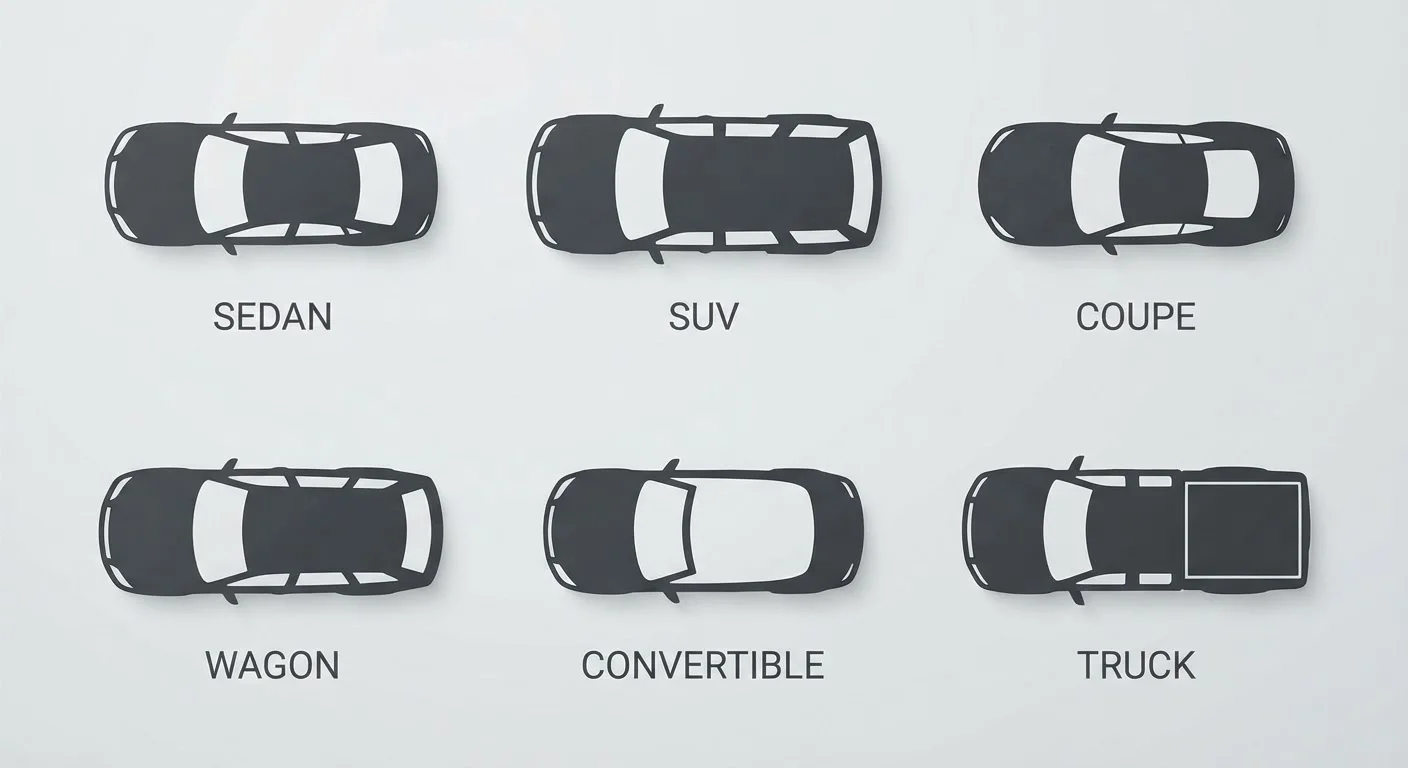
A sedan has a separate trunk compartment, four doors, and a three-box profile (engine, passenger cabin, trunk). It's the baseline for most people's mental image of a car. Sedans generally offer a smooth, car-like ride and good fuel efficiency, but cargo space is limited by the closed trunk.
SUV and Crossover
The terms are often used interchangeably, but there's a meaningful distinction. A traditional SUV uses a truck-based, body-on-frame construction - making it more capable for towing and off-road driving. A crossover uses a car-based unibody platform, which delivers a smoother ride and better fuel economy. Most family-oriented vehicles in this category sold today are crossovers. For a deeper breakdown of how these compare to other major types, see Sedan, SUV, Truck, or Van.
Hatchback
A hatchback is essentially a sedan with the trunk wall removed - the cargo area flows directly into the cabin and is accessed through an upward-swinging rear gate. This design makes the most of a compact footprint, offering more practical cargo flexibility than a traditional sedan.
Pickup Truck
A pickup has an open cargo bed separated from the passenger cab. Trucks are built for hauling and towing and ride on rugged body-on-frame platforms. They come in different cab sizes (regular, extended, crew) and bed lengths, all of which affect both capability and day-to-day drivability.
Minivan
Minivans prioritize passenger and cargo capacity above all else. Sliding rear doors, configurable seating for up to eight, and large interior volume make them the practical choice for families - even if the styling rarely generates excitement.
Test the cargo area before you commit
Photos and spec sheets rarely convey how usable a cargo area actually is. Before finalizing a body style choice, physically load it with the items you carry most - strollers, golf bags, toolboxes - during a test drive. A few minutes of real-world loading will tell you more than any trunk-volume figure.
Specialty and Less Common Styles
Beyond the core categories, a few body styles are worth knowing - especially if you're drawn to driving experience or a specific lifestyle:
Coupe
A coupe traditionally has two doors and a lower, sportier roofline. The reduced door count and tighter rear seat make coupes better suited to drivers who prioritize style and performance over passenger practicality. Note that some automakers have applied the coupe label to four-door vehicles with a sloping roof - always verify the door count.
Convertible
A convertible (also called a cabriolet) has a retractable roof - either a soft fabric top or a hard folding panel. The open-air driving experience comes with real trade-offs: less structural rigidity, reduced trunk space, and higher noise levels. Convertibles are most practical in mild climates.
Station Wagon
A wagon extends the roofline of a sedan all the way to the rear, creating a long cargo area accessed through a liftgate. Wagons fell out of mainstream popularity in the U.S. with the rise of the SUV, but they remain a practical, lower-profile alternative with car-like handling. Classic wagon enthusiasts will recognize their enduring appeal - an interest well explored in the classic car hobby guide.
Body style terminology isn't always consistent
Automakers sometimes use body style terms loosely for marketing purposes - calling a four-door vehicle a 'coupe' or labeling a car-based crossover an 'SUV.' When in doubt, check the door count, platform type, and cargo configuration directly in the vehicle's specifications rather than relying solely on the model name.
Matching a Body Style to Your Life
The right body style isn't the most impressive or the most popular - it's the one that fits how you actually use a vehicle. A few practical questions help clarify the decision:
- How many people ride with you regularly? If you frequently carry five or more passengers, a minivan, three-row SUV, or full-size sedan will serve you better than a coupe or compact hatchback.
- What do you haul? Bikes, lumber, large appliances, and landscaping materials all suggest a pickup truck or at minimum a hatchback or wagon. A sedan trunk handles luggage and groceries but little else.
- Where do you drive? Rural roads, unpaved surfaces, or snowy terrain may justify a higher-riding crossover or SUV. Urban commuters often benefit more from a compact, fuel-efficient sedan or hatchback.
- How important is fuel economy? Crossovers and sedans generally outperform trucks and traditional SUVs in this area, all else being equal.
Once you have a body style direction, the next logical step is thinking about specific use cases in greater depth. Vehicle types by use case gives you a structured framework for matching vehicle categories to real driving scenarios. And when you're ready to move from research to purchase, vehicle shopping guidance covers everything you need to navigate that process confidently.
Don't let styling override practicality
Coupes and sporty crossovers with sloping rooflines can look attractive but deliver meaningfully less rear headroom and cargo space than their dimensions suggest on paper. If you regularly carry rear passengers or need reliable cargo access, prioritize a test sit in the back seat and a hands-on look at the cargo area before deciding.