

Key Takeaways
Motorcycle vs. Scooter vs. Moped
Motorcycles, scooters, and mopeds are all two-wheeled motor vehicles, but they differ in engine size, top speed, frame design, and - critically - how they are classified under state traffic law. These differences determine what license you need, whether registration and insurance are required, and where you can legally ride.
Classifications vary by state. Most states define mopeds by engine displacement (typically under 50cc) and maximum speed (usually 30 mph or less), while motorcycle definitions often begin at 150cc or above. Scooters occupy a gray zone that may fall under either category depending on jurisdiction.
How the Three Vehicles Are Actually Defined
The confusion between motorcycles, scooters, and mopeds is understandable - all three are two-wheeled, motorized, and ridden rather than driven. But their differences go well beyond styling.
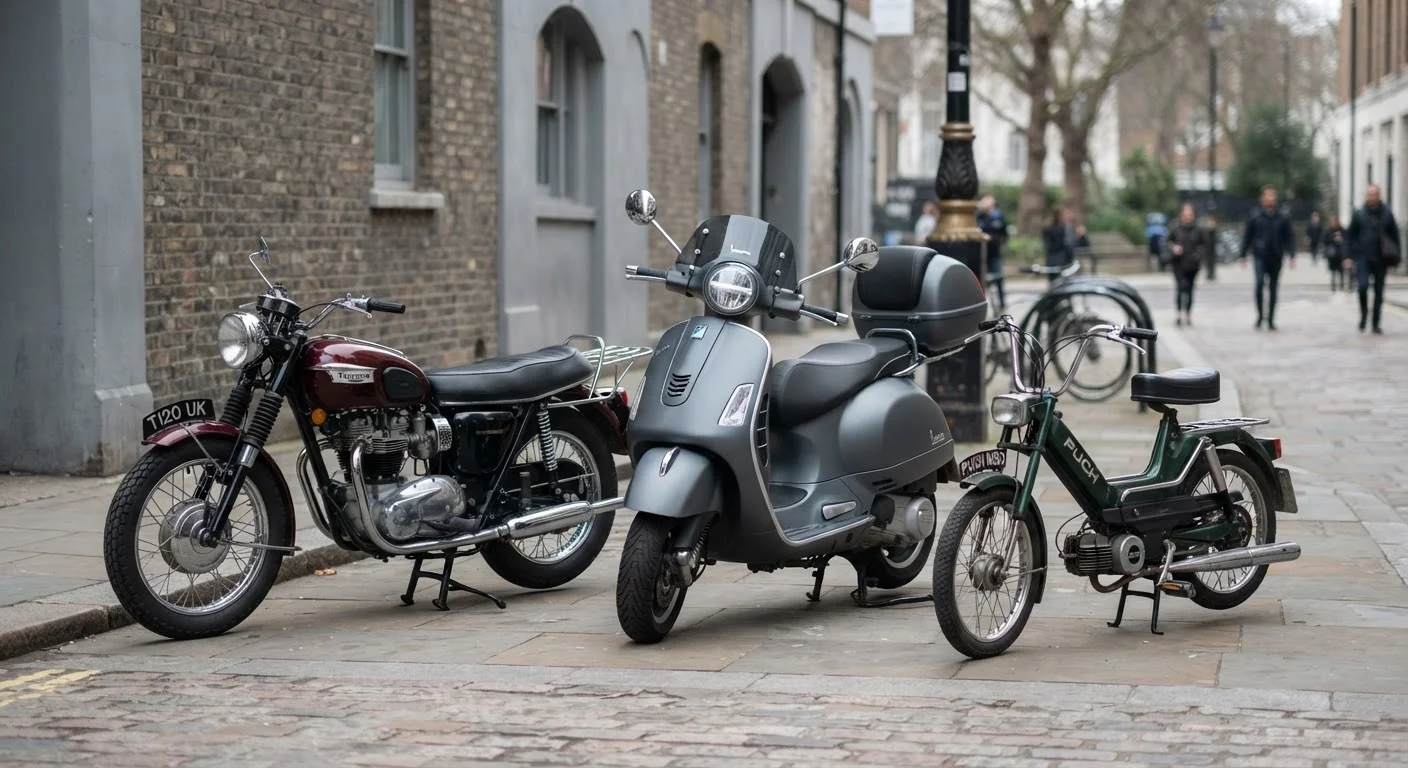
Motorcycles are defined by larger engines (commonly 150cc and up), a frame where the engine serves as a structural element, and a rider seating position that straddles the vehicle. They are designed for higher speeds and can legally operate on any road open to standard motor vehicles, including highways.
Scooters use a step-through frame - the flat floorboard between the seat and handlebars is the defining visual cue - and almost universally use an automatic transmission. Engine sizes range widely, from 50cc neighborhood models to 650cc highway-capable machines. This range is exactly why scooters don't occupy a single legal category.
Mopeds (a portmanteau of "motor" and "pedal," reflecting their early designs with functional bicycle pedals) are defined primarily by their small engines - generally under 50cc - and their capped top speed, typically 30 mph or less under state law. Modern mopeds rarely include actual pedals, but the legal definition has largely carried forward based on those performance parameters.
For a broader look at how two-wheelers fit into the full landscape of American motor vehicles, see the full spectrum of motor vehicle types recognized on U.S. roads.
50cc
Common moped engine displacement threshold
Most U.S. states define mopeds as having engines at or below 50cc, though exact thresholds vary by jurisdiction.
30 mph
Typical moped maximum speed under state law
Many states cap moped classification at 30 mph top speed; vehicles exceeding this are often reclassified as motorcycles or scooters.
50 states
States requiring motorcycle endorsement for motorcycle operation
Every U.S. state requires a motorcycle endorsement or separate motorcycle license to legally operate a motorcycle on public roads.
The Legal Divide: Licensing, Registration, and Where You Can Ride
The practical stakes of these classifications become clear when you factor in licensing and registration requirements.
Motorcycles require a motorcycle endorsement (an "M" designation) or a separate motorcycle license in every U.S. state. Earning this typically involves a written knowledge test, a skills test or approved safety course, and in many states, a minimum age requirement. Full registration and insurance - at least liability coverage - are universally required.
Scooters fall into whichever category their engine size triggers under state law. A 49cc scooter in most states is legally a moped. A 150cc scooter is typically a motorcycle. Some states have a distinct "motor scooter" classification. The implication: two visually similar scooters can have completely different legal requirements depending solely on engine displacement.
Mopeds occupy the lightest regulatory burden in most states. A standard driver's license - sometimes no license at all, for riders above a minimum age - is often sufficient. Many states require basic registration but not full motorcycle insurance. However, mopeds are generally restricted to roads with posted speeds of 35-45 mph or lower, and are prohibited from highways.
Check Your State DMV Before You Ride
Classification rules differ meaningfully from state to state. Before operating any two-wheeled vehicle, look up your state DMV's specific definitions for motorcycles, mopeds, and motor scooters - and confirm the license class your vehicle's engine size requires. Many state DMV websites list these thresholds explicitly in their motorcycle or moped sections.
Helmet laws also vary: motorcycle riders face mandatory helmet requirements in most states, while moped helmet rules differ by jurisdiction and sometimes by rider age.
Mechanical Considerations That Affect Ownership
Beyond legal classification, the mechanical differences between these vehicles affect maintenance, performance, and long-term ownership costs.
Motorcycles offer the widest mechanical range - from air-cooled single-cylinder engines to liquid-cooled inline-four configurations used in sportbikes. Manual transmissions are common, which contributes to the distinct skill curve for new riders. Parts availability and mechanic familiarity tend to be strong for major motorcycle platforms.
Scooters are mechanically simpler for daily use. The CVT (continuously variable transmission) eliminates manual shifting, making them accessible to new riders. Engines are typically mounted under the seat platform and are relatively compact. Maintenance intervals for smaller scooters are generally less intensive than for full-sized motorcycles, though repair expertise varies more widely by region.
Mopeds are the most mechanically straightforward of the three. Small-displacement engines require minimal maintenance, and parts are widely available and inexpensive. Trade-offs include limited performance headroom - mopeds are purpose-built for short, low-speed urban trips, not sustained road riding.
If you're weighing two-wheelers as part of a broader transportation decision, matching vehicle type to your actual use case is a useful framework to apply before committing.
Why Getting the Classification Right Matters
Misidentifying your vehicle type carries real consequences. Riding a 150cc scooter on a standard driver's license - believing it qualifies as a moped - can result in fines, license suspension, or complications with insurance claims after an incident. Conversely, new riders sometimes avoid scooters unnecessarily, assuming a motorcycle license is always required when their vehicle may legally qualify as a moped in their state.
Insurance implications are equally significant. A vehicle misclassified at registration may not be covered as expected under a standard policy, and claims can be denied if the vehicle was operated without the appropriate license class. This is a practical financial risk, not just a paperwork technicality.
The clearest path is to identify your vehicle's engine displacement in cubic centimeters, look up your state's DMV definitions for motorcycles, mopeds, and motor scooters, and confirm what license class and registration that specific displacement triggers. States publish these definitions publicly, and many DMV websites include vehicle classification tools.
For broader context on how vehicle categories are structured - including four-wheeled alternatives for urban commuting - see the core vehicle categories guide.
Classifications Can Change When You Cross State Lines
A vehicle legally classified as a moped in your home state may be treated as a motorcycle in a neighboring state due to different engine displacement thresholds. If you plan to ride across state lines, verify the classification rules in each state you'll travel through. Operating without the appropriate license in another state carries the same legal risk as doing so at home.