

Key Takeaways
Best-in-class passenger and cargo volume
Minivans routinely offer more total interior cubic footage than three-row SUVs at comparable price points, with flatter floors that make the space more usable rather than just larger on paper.
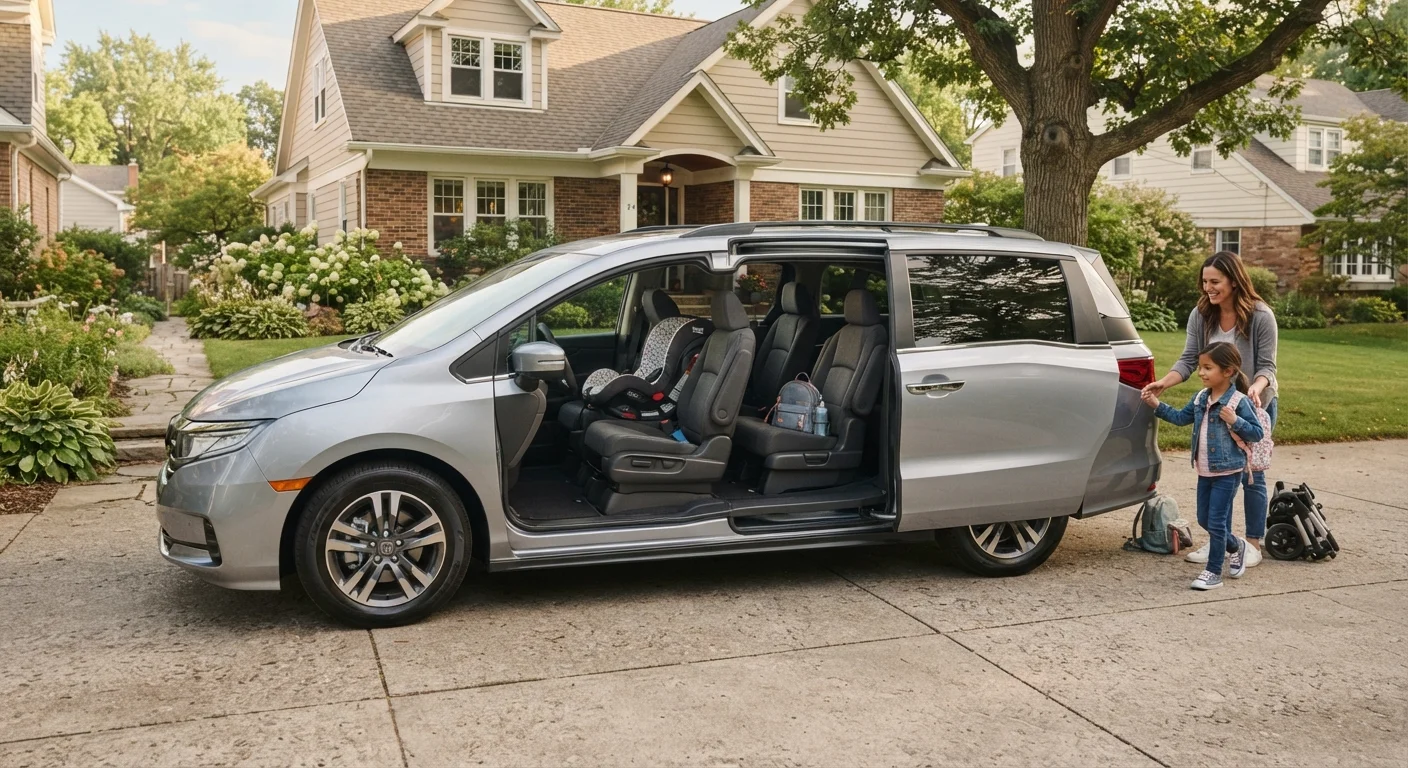
Sliding doors improve safety in tight spaces
Sliding rear doors can't swing open into adjacent vehicles or passing cyclists, a genuine safety and damage-avoidance advantage in crowded parking lots and garages.
Lower fuel consumption than comparably sized SUVs
The combination of lower curb weight and aerodynamically tuned design typically yields better highway and city fuel economy than three-row truck-based SUVs, reducing operating costs over time.
Easier passenger boarding for all ages
The low step-in height and wide sliding-door opening makes entry and exit far simpler for young children, older passengers, and anyone carrying gear - an ergonomic advantage that compounds over years of daily use.
Generally lower purchase price than three-row SUVs
Minivans often deliver more interior space and utility at a lower sticker price than equivalent three-row crossovers or SUVs, making them a stronger value proposition for budget-conscious buyers.
Purpose-built for passenger comfort on long trips
Features like in-cabin entertainment systems, fold-flat third rows, and multiple climate zones are standard or widely available in minivans because the segment was designed around family travel from the ground up.
Limited towing capacity compared to SUVs and trucks
Most minivans are rated for approximately 3,500 pounds, adequate for light-duty towing but insufficient for larger boats, horse trailers, or full-size campers that some SUVs and trucks handle routinely.
No meaningful off-road capability
Low ground clearance and front-wheel-drive architecture on most models make minivans poorly suited for unpaved roads, deep snow, or any terrain requiring real clearance or traction management.
Carries persistent cultural stigma
Despite strong utility credentials, the minivan continues to carry an image association with a particular life stage that discourages some buyers - a perception issue that can affect resale dynamics in some markets.
Reduced segment competition limits choice
The shrinking number of manufacturers still producing minivans means buyers have fewer models to compare, less competitive pricing pressure, and fewer trim variants than in peak years.
Large footprint complicates urban parking
Despite being easier to park than a full-size van, minivans are longer and taller than sedans or crossovers, which can create real challenges in dense urban environments with tight garage clearances.
Our Verdict
Minivans are an engineering-first solution to the challenge of moving people and gear efficiently. They consistently outperform three-row SUVs on interior volume, fuel efficiency, and ease of entry - at a lower price point. The tradeoffs are real but narrow: limited towing, no off-road capability, and a cultural stigma that has more to do with perception than performance.
Families hauling five or more passengers regularly, high-mileage road trippers, and buyers who prioritize cargo flexibility and fuel costs over vehicle image.
Why Minivans Got a Bad Reputation - And Whether It's Deserved
The minivan peaked culturally in the 1990s and has spent much of the time since being treated as the vehicle you drive when you've given up on something - though nobody agrees on exactly what. That reputation is almost entirely image-driven. The minivan wasn't retired because it stopped working; it was displaced by the SUV as a lifestyle statement.
What actually changed was consumer preference for a vehicle that looked more capable, even when the underlying task - hauling a family and their gear - hadn't changed. If you're evaluating a vehicle based on how it performs the job rather than what it communicates about you, the minivan's case becomes considerably stronger. See our guide to core vehicle categories for a straightforward look at how these body styles actually differ.
Best-in-class passenger and cargo volume
Minivans routinely offer more total interior cubic footage than three-row SUVs at comparable price points, with flatter floors that make the space more usable rather than just larger on paper.
Sliding doors improve safety in tight spaces
Sliding rear doors can't swing open into adjacent vehicles or passing cyclists, a genuine safety and damage-avoidance advantage in crowded parking lots and garages.
Lower fuel consumption than comparably sized SUVs
The combination of lower curb weight and aerodynamically tuned design typically yields better highway and city fuel economy than three-row truck-based SUVs, reducing operating costs over time.
Easier passenger boarding for all ages
The low step-in height and wide sliding-door opening makes entry and exit far simpler for young children, older passengers, and anyone carrying gear - an ergonomic advantage that compounds over years of daily use.
Generally lower purchase price than three-row SUVs
Minivans often deliver more interior space and utility at a lower sticker price than equivalent three-row crossovers or SUVs, making them a stronger value proposition for budget-conscious buyers.
Purpose-built for passenger comfort on long trips
Features like in-cabin entertainment systems, fold-flat third rows, and multiple climate zones are standard or widely available in minivans because the segment was designed around family travel from the ground up.
The Real Limitations You Should Factor In
A balanced assessment requires honest accounting of where minivans genuinely fall short. Towing capacity is one area where most minivans trail body-on-frame SUVs and trucks - typical ratings fall in the 3,500-pound range, sufficient for a small trailer or boat but not for serious hauling. If towing is a regular requirement, that ceiling matters.
Ground clearance is another tangible limitation. Minivans sit low, which contributes to their efficiency and ease of entry but means rough terrain, deep snow, or unpaved roads are genuinely problematic - not just uncomfortable. For buyers who routinely drive unpaved roads or navigate significant winter conditions, that's a practical constraint rather than a cosmetic one.
Finally, the segment is smaller than it once was. Fewer manufacturers offer minivans today compared to their 1990s peak, which means less competition and fewer choices. That's worth acknowledging when researching vehicles.
Limited towing capacity compared to SUVs and trucks
Most minivans are rated for approximately 3,500 pounds, adequate for light-duty towing but insufficient for larger boats, horse trailers, or full-size campers that some SUVs and trucks handle routinely.
No meaningful off-road capability
Low ground clearance and front-wheel-drive architecture on most models make minivans poorly suited for unpaved roads, deep snow, or any terrain requiring real clearance or traction management.
Carries persistent cultural stigma
Despite strong utility credentials, the minivan continues to carry an image association with a particular life stage that discourages some buyers - a perception issue that can affect resale dynamics in some markets.
Reduced segment competition limits choice
The shrinking number of manufacturers still producing minivans means buyers have fewer models to compare, less competitive pricing pressure, and fewer trim variants than in peak years.
Large footprint complicates urban parking
Despite being easier to park than a full-size van, minivans are longer and taller than sedans or crossovers, which can create real challenges in dense urban environments with tight garage clearances.
How Minivans Compare on the Metrics That Matter Most
When the comparison moves from image to data, minivans consistently perform well. Interior volume is the most obvious advantage - sliding doors allow access to second and third rows without the gymnastics required by many three-row crossovers. The flat floor between rows, absent in most SUVs with all-wheel drive hardware, dramatically improves livability on longer trips.
~165 cu ft
Typical minivan maximum cargo volume
Many current minivans offer maximum cargo volumes around 140-165 cubic feet with all rear seats folded, often exceeding three-row SUVs in the same price range.
~28 mpg
Typical minivan highway fuel economy
Current front-wheel-drive minivans commonly achieve highway estimates in the high 20s, generally outpacing comparably sized three-row SUVs by several miles per gallon.
3,500 lbs
Typical minivan towing capacity
Most current minivans are rated to tow around 3,500 pounds, which covers small trailers and lightweight boats but falls short of many body-on-frame SUVs and trucks.
Fuel economy is another area where minivans hold a structural advantage. Their boxy shape is efficient to engineer around a powertrain, and their lower weight compared to truck-based SUVs contributes to real-world efficiency gains. This has meaningful long-term cost implications for high-mileage families - a point worth working through in detail when sizing a vehicle to your actual life.
It's also worth noting what minivans share with full-size passenger vans in terms of sliding-door functionality, while remaining far easier to drive and park daily. The distinction between cargo and passenger vans illustrates how platform decisions shape real-world utility.
All-Wheel Drive Is Available - With Tradeoffs
Some minivan models have offered all-wheel drive as an option, which addresses winter traction concerns without requiring a step up to an SUV. However, AWD variants typically show a fuel economy penalty and are offered on a limited range of trims. Buyers in high-snowfall regions should confirm current availability and weigh the efficiency impact before assuming AWD resolves all weather limitations.