

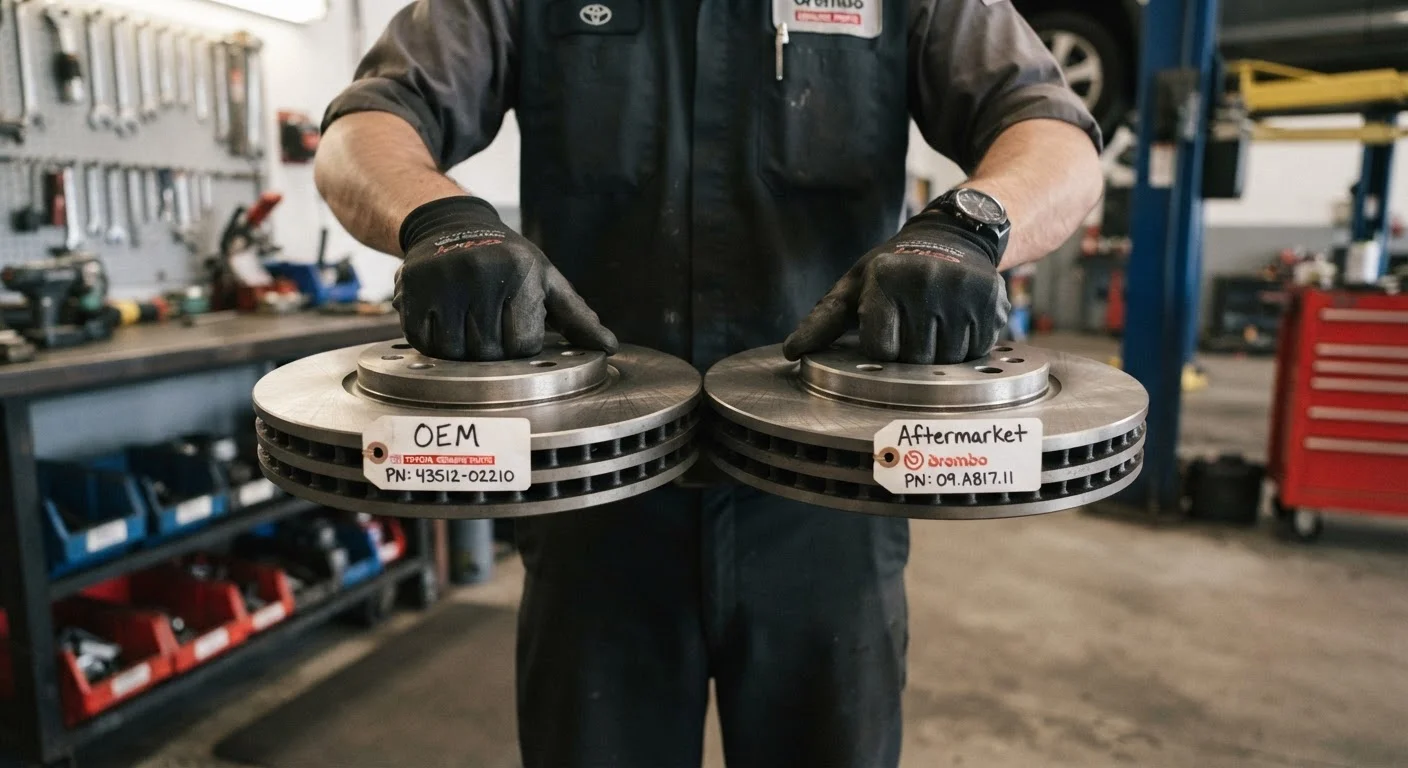
Key Takeaways
Option A
OEM Parts
The manufacturer-specified, factory-matched standard.
Best for: Drivers who prioritize guaranteed fit, preserved warranties, and exact original-equipment specifications.
Option B
Aftermarket Parts
The flexible, often lower-cost alternative.
Best for: Owners seeking broader availability, potential cost savings, or performance upgrades beyond factory spec.
If your vehicle is still under a manufacturer or powertrain warranty
OEM Parts
Using non-OEM parts for covered repairs can jeopardize your warranty. Stick to OEM to avoid complications with claims.
If you own a high-mileage or older vehicle outside of warranty
Aftermarket Parts
The cost savings on routine wear items are hard to ignore, and quality-tier aftermarket parts from established suppliers can perform comparably.
If you need a safety-critical component replaced
OEM Parts
For brakes, steering, and airbag-related components, OEM ensures validated performance to exact design tolerances - a meaningful consideration for safety systems.
If you're making a performance or customization upgrade
Aftermarket Parts
The aftermarket excels here - purpose-built suspension, exhaust, and intake components can exceed factory specs in specific performance applications.
If your vehicle's parts are difficult to source or discontinued
Aftermarket Parts
For older or discontinued models, aftermarket suppliers may be the only practical option to keep the vehicle roadworthy.
What OEM and Aftermarket Actually Mean
OEM stands for Original Equipment Manufacturer. An OEM part is either made by or manufactured to the exact specifications of the company that built your vehicle. In some cases, OEM parts come from the same supplier that built the component installed at the factory - just sold through the dealership rather than a parts distributor.
Aftermarket parts are produced by third-party manufacturers independently of the vehicle's automaker. This category is enormous and diverse - it spans everything from budget-tier components to high-performance upgrades engineered to exceed factory standards. Quality within the aftermarket is not uniform, which is one of the most important things consumers need to understand.
The distinction matters for practical reasons: fit precision, warranty implications, parts availability, and long-term reliability can all differ depending on which path you choose. Understanding what each category actually represents helps you make a better-informed decision when you're facing a repair estimate - or checking parts pricing yourself.
| Criterion | OEM Parts | Aftermarket Parts |
|---|---|---|
| Fitment precision | Exact factory specification | Varies; can be equivalent or off |
| Price | Typically higher | Often lower; wide range |
| Quality consistency | Uniform, automaker-controlled | Varies by manufacturer and tier |
| Warranty compatibility | Fully compatible | May affect related warranty claims |
| Parts availability | Limited to dealers and authorized suppliers | Widely available across many suppliers |
| Performance upgrades | Not applicable - factory spec only | Yes, purpose-built options available |
| Best use case | New/warranty vehicles, safety systems | Older vehicles, routine wear, modifications |
Quality, Fit, and Performance: Where the Differences Show Up
OEM parts are held to the automaker's tolerances by definition. When a brake caliper or water pump is produced to OEM spec, it's engineered specifically for that vehicle's make, model, and model year. That tight specification reduces the chance of fitment issues or calibration mismatches during installation.
Aftermarket parts range from essentially equivalent to noticeably inferior - and in some performance categories, superior. Reputable aftermarket manufacturers invest in engineering and quality control, and many parts they produce meet or exceed OEM standards. Industry certification programs from organizations like CAPA exist specifically to help consumers identify aftermarket collision parts that meet independent quality benchmarks.
Where aftermarket quality tends to be least reliable is in unbranded, ultra-low-cost components - particularly those sourced without clear certification. Sensors, emissions components, and safety-adjacent parts are areas where cutting costs can carry real consequences. For these categories, verification matters more than price savings.
$49B+
U.S. aftermarket parts industry annual revenue
The Automotive Aftermarket Suppliers Association estimates the U.S. light-vehicle aftermarket represents tens of billions in annual parts sales, reflecting the scale and diversity of the sector.
~40%
Typical OEM price premium over aftermarket
Industry repair cost analyses commonly find OEM parts priced 20-60% higher than comparable aftermarket alternatives, depending on the component and vehicle segment.
3,000+
CAPA-certified aftermarket part categories
The Certified Automotive Parts Association maintains certification standards across thousands of collision repair part categories to help verify aftermarket quality.
Warranty Coverage and What's at Stake
One of the most misunderstood aspects of this decision involves warranty protection. Under the Magnuson-Moss Warranty Act, a vehicle manufacturer generally cannot void your entire warranty simply because you used an aftermarket part. However, if an aftermarket part is found to have caused a specific failure, the manufacturer can deny warranty coverage for that particular repair.
This is a meaningful distinction. If you install an aftermarket oil filter and later experience an engine failure traced to that filter, the powertrain warranty claim could be denied. The warranty on other unrelated systems typically remains intact.
For vehicles still under a new-car or certified pre-owned warranty - which is particularly relevant if you're weighing your options as part of broader ownership decisions like those outlined in our CPO vs. new vs. used vehicle comparison - OEM parts are generally the safest choice for any covered repair category.
The Magnuson-Moss Warranty Act Explained
Enacted in 1975, the Magnuson-Moss Warranty Act governs written warranties on consumer products sold in the U.S. It generally prevents manufacturers from voiding a full warranty solely because an aftermarket part was used. However, the manufacturer may deny a specific claim if they can demonstrate that the aftermarket part caused the failure in question. If you're uncertain how this applies to your situation, consult your vehicle's warranty documentation or a qualified mechanic before proceeding with non-OEM repairs on a covered vehicle.
Making the Decision: A Practical Framework
The right choice between OEM and aftermarket isn't universal - it depends on your vehicle's age, the component involved, your budget, and the repair context. Here's a framework that applies to most situations:
- Safety-critical systems (brakes, steering, airbag components): Lean OEM unless the aftermarket supplier has strong independent certification for that category.
- Routine wear items (filters, belts, wiper blades, brake pads on an older vehicle): Quality-tier aftermarket is often appropriate and cost-effective.
- Warranty-covered vehicles: Use OEM to avoid complicating claims.
- Performance modifications: The aftermarket is the natural choice - purpose-built parts exist specifically for this application.
- Older or high-mileage vehicles: Aftermarket makes increasing practical sense, particularly when OEM availability is limited or the cost of OEM parts approaches the vehicle's value.
When evaluating aftermarket suppliers, look for parts that carry CAPA certification (for collision components), meet OES equivalent standards, or come with manufacturer warranties. Your mechanic's recommendation on a specific brand or grade is worth factoring in - experienced technicians see how parts perform over time.
For more context on how vehicle ownership decisions interconnect, see our overview on vehicle shopping considerations.