

Key Takeaways
Option A
Timing Belt
The scheduled-replacement rubber component requiring proactive maintenance.
Best for: Owners of vehicles with known belt-equipped engines who want to follow a strict, manufacturer-defined replacement schedule.
Option B
Timing Chain
The metal, longer-lived alternative designed to last the engine's lifetime.
Best for: Drivers seeking reduced scheduled maintenance overhead, provided engine oil is changed regularly to protect chain lubrication.
If you drive a high-mileage vehicle and haven't confirmed replacement history
Timing Belt (inspect immediately)
An overdue belt replacement is a ticking clock. If records are unavailable, have a mechanic confirm status before the interval is exceeded.
If you prioritize lower long-term scheduled maintenance
Timing Chain
Chain-equipped engines rarely need timing system service under normal conditions, making them lower-effort for owners who maintain oil changes diligently.
If you're buying a used vehicle and evaluating reliability risk
Timing Chain
Without full service records, a chain system carries less immediate catastrophic risk than an unknown-interval timing belt on an interference engine.
What Each Component Actually Does
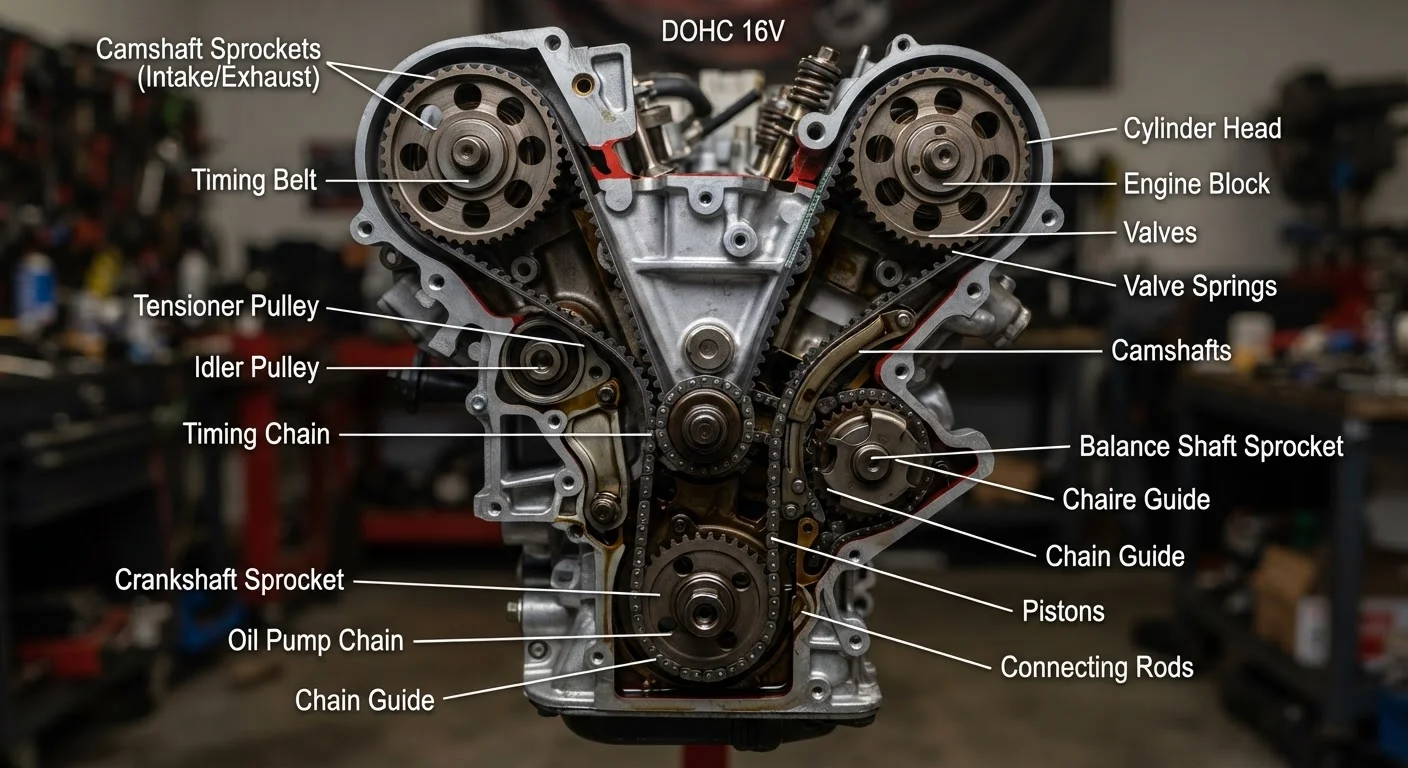
Both the timing belt and timing chain serve the same critical function: synchronizing the rotation of the crankshaft and camshaft so that engine valves open and close at precisely the right moment during each combustion cycle. Without accurate timing, an engine cannot run efficiently - and in many designs, it cannot run at all without causing serious internal damage.
A timing belt is made from reinforced rubber with internal cords - typically fiberglass or Kevlar - and rides on a series of pulleys and tensioners. It operates quietly and requires no lubrication, running dry outside the engine's oiling system. A timing chain resembles a bicycle chain, made entirely of metal links, and runs inside the engine where it is continuously bathed in motor oil. Chains are heavier and can produce slightly more noise, but their metal construction makes them inherently more durable under normal operating conditions.
See our vehicle maintenance intervals guide for a broader overview of scheduled service items your engine depends on.
How Each System Ages - and Why It Matters at High Mileage
The critical distinction between these two systems is how they degrade over time and distance.
Timing belts deteriorate from both age and mileage regardless of use. Rubber hardens, cracks, and loses tensile strength over time - which is why most manufacturers specify replacement by both mileage and elapsed years (commonly every 60,000-100,000 miles, or every 7-10 years, whichever comes first). Crucially, a belt approaching or past its interval may show no obvious symptoms before it fails. When it does fail, failure is sudden and complete.
Timing chains stretch gradually rather than snap outright. Early warning signs - rattling on cold starts, rough idle, illuminated check-engine lights related to camshaft timing - typically appear before catastrophic failure. However, chains in engines with chronic low oil levels or infrequent oil changes can stretch prematurely, and tensioner or guide failure can occur well before the engine reaches otherwise end-of-life mileage.
| Criterion | Timing Belt | Timing Chain |
|---|---|---|
| Material | Reinforced rubber | Metal links |
| Lubrication | None (runs dry) | Engine oil (internal) |
| Typical lifespan | 60,000-100,000 miles or 7-10 years | Engine lifetime with proper oil maintenance |
| Failure mode | Sudden snap with no warning | Gradual stretch with audible warning signs |
| Scheduled replacement | Yes - manufacturer-defined interval | Generally no, unless symptoms develop |
| Noise level | Very quiet | Slightly louder; rattles signal wear |
| Interference engine risk | High if belt fails without warning | Lower - typically shows warning before failure |
Understanding your engine oil's role in chain longevity is closely related to which motor oil your engine actually needs.
Interference vs. Non-Interference: The Stakes of Belt Failure
Not every engine faces the same consequences when timing fails. Engines fall into two broad categories:
- Interference engines are designed so that the piston's travel path overlaps with the valve's open position. If timing is lost - for example, when a belt snaps - pistons collide with open valves, bending them and potentially destroying the engine. The majority of modern fuel-efficient engines are interference designs.
- Non-interference engines have enough clearance that pistons and valves never occupy the same space simultaneously. A broken belt here stops the engine but typically does not cause internal destruction - an expensive repair becomes a manageable one.
Knowing whether your engine is an interference design is not optional information for timing belt owners. Your owner's manual or a qualified mechanic can confirm this. If you own a high-mileage interference-engine vehicle with a belt system and no documented replacement history, treating it as overdue is the only prudent approach.
~60%
Modern engines using timing chains
Industry estimates suggest the majority of contemporary engine designs have shifted toward timing chains over belts in recent decades, driven by reduced maintenance requirements.
60K-100K
Typical belt replacement interval (miles)
Manufacturer-specified intervals vary significantly by engine design; always consult your vehicle's owner's manual for the exact figure applicable to your engine.
What Replacement Actually Involves
For timing belt replacement, labor is the dominant cost. Accessing the belt requires removing accessory components - often including the water pump, which most mechanics recommend replacing simultaneously since it shares the same labor access window. The job is typically several hours of skilled shop time. Parts themselves are relatively inexpensive compared to the labor investment.
For timing chain service, the procedure is more involved mechanically - chains, tensioners, and guides all live deeper inside the engine - and is generally reserved for engines showing symptoms of wear rather than performed on a scheduled basis. The total job can be more expensive when it does become necessary, but it is far less frequently needed.
In both cases, this is not a DIY task for most owners. Incorrect timing - even by a single tooth - can cause misfires, reduced power, or engine damage. A qualified mechanic with access to the appropriate service specifications should perform this work.
How to Confirm Which System Your Vehicle Has
The owner's manual is the first place to check - it will reference belt or chain replacement in the maintenance schedule section. If no timing belt replacement interval appears, your engine likely uses a chain. A mechanic can also confirm this quickly. Do not rely solely on the vehicle's model name, as the same nameplate is sometimes sold with different engine options that use different timing systems.