

Key Takeaways
Start here
What the Suspension System Actually Does
Next
Springs: The Load Bearers
Then
Shock Absorbers: Controlling the Bounce
Going deeper
Struts: One Part, Two Jobs
Apply it
How to Know When Something's Wrong
What the Suspension System Actually Does
Your car's suspension has two fundamental jobs: keep the tires in firm contact with the road, and isolate the cabin from road impacts. Those two goals are in constant tension - a system tuned only for grip would feel punishing to passengers, while one tuned purely for comfort would wander unpredictably through corners.
The suspension sits between the chassis (the car's rigid frame) and the wheels. Every pothole, expansion joint, and crowned road sends energy upward through the wheels. The suspension absorbs, controls, and dissipates that energy before it reaches you. It also maintains the geometry - meaning the angle and position - of each wheel relative to the road surface, which directly affects steering response and braking.
Understanding how each component contributes helps you make sense of service recommendations and recognize warning signs before a minor issue becomes a safety concern. See also our guide to tire rotation, balancing, and alignment - those services are closely connected to suspension health.
Spring rate
A measure of a spring's stiffness - specifically, how many pounds of force are needed to compress it by one inch. Higher rates mean stiffer, more responsive handling; lower rates mean a softer ride.
Damper
The technical name for a shock absorber. It slows down and controls the movement of the suspension, preventing the spring from bouncing repeatedly after a road impact.
Strut
A suspension component that combines a shock absorber with a structural mounting assembly. Unlike a standalone shock, a strut physically supports the vehicle's weight and is part of the wheel's positioning geometry.
Suspension geometry
The precise angles and positions at which a wheel is held relative to the road and the vehicle body. Correct geometry ensures even tire wear, predictable steering, and stable braking.
Rebound
The upward return motion of a suspension component after it has been compressed by a bump or load. Controlling rebound speed is one of the primary functions of a shock absorber.
Bushing
A small cushioning sleeve - typically rubber or polyurethane - installed at suspension pivot points to reduce metal-to-metal contact, absorb vibration, and allow controlled movement.
Springs: The Load Bearers
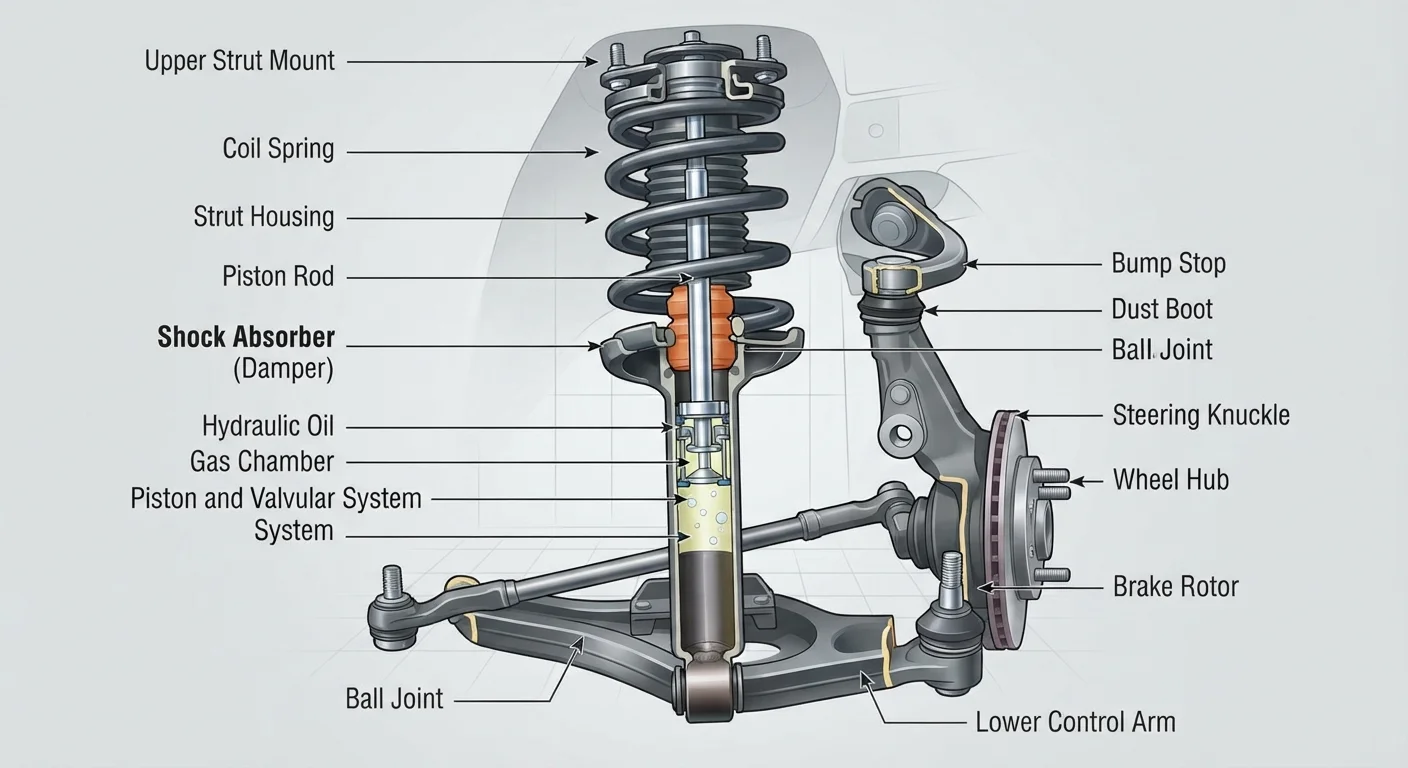
Springs are the suspension's first line of response. They support the weight of the vehicle and compress when a wheel encounters an obstacle, absorbing the initial impact energy. Most passenger vehicles use coil springs - tightly wound steel helices that compress and rebound with wheel movement. Trucks and older body-on-frame vehicles often use leaf springs, which are stacked steel strips arced horizontally along the axle.
Springs are rated by their spring rate - the amount of force required to compress them by one inch. A stiffer spring rate provides more precise handling but transmits more road feel to the cabin. A softer rate improves comfort but allows more body roll in corners. Factory spring rates are an engineering compromise tuned to the vehicle's intended use. Aftermarket springs that change this rate should be selected carefully, ideally with guidance from a qualified shop.
Springs alone, however, have a significant limitation: once compressed, they rebound. Without something to control that rebound, the car would continue oscillating - bouncing rhythmically - long after each bump. That's where dampers come in.
Shock Absorbers: Controlling the Bounce
Shock absorbers - commonly called shocks - are hydraulic devices that dampen spring oscillation. They don't support vehicle weight; that's the spring's role. Instead, a shock converts kinetic energy (motion) into heat energy by forcing hydraulic fluid through small internal valves as the suspension moves. The resistance this creates slows both compression and rebound, preventing the spring from bouncing repeatedly.
A simple test mechanics use: push down firmly on a corner of the car and release. A healthy shock should allow one rebound and settle. If the car continues bouncing two or more times, the shocks are likely worn.
The Bounce Test Is a Starting Point
The push-and-release bounce test gives a rough indication of shock absorber condition, but it's not a definitive diagnosis. Internal wear, leaking seals, and failing mounts won't always show up in this test. If you have any concerns about ride quality or handling, have a mechanic inspect the suspension on a lift, where components can be checked for play, leaks, and wear more accurately.
On vehicles where shocks are separate from the spring-mount assembly, they're typically cylindrical units mounted alongside the spring. Many rear suspension setups use this configuration even on vehicles with front struts.
Struts: One Part, Two Jobs
A strut is a structural suspension component that combines a shock absorber with a mounting assembly - typically including a coil spring perch and a bearing plate at the top. Unlike a standalone shock, a strut is a load-bearing member of the suspension. Removing it would leave the wheel without structural support.
Struts are common on the front axle of front-wheel-drive and all-wheel-drive passenger vehicles. They simplify the suspension geometry, reduce the number of separate parts, and allow for a more compact wheel well. The tradeoff is that replacement is more involved than swapping a shock absorber - the coil spring must often be compressed and removed using specialized tools, which is why strut replacement is generally a task for a qualified mechanic.
It's worth noting that shocks and struts are not interchangeable. A vehicle designed with front struts cannot simply be converted to a shock-and-separate-spring setup without significant engineering changes. If a service advisor or parts counterperson ever implies otherwise, that's a red flag worth questioning. The type of vehicle you drive often determines which configuration you'll find at each axle.
Strut Replacement Requires Specialized Tools
Replacing a strut involves compressing a coil spring under significant tension - a task that requires a proper spring compressor tool. Attempting this without the correct equipment is genuinely dangerous and can result in serious injury. Unless you have professional-level experience and the right tools, strut replacement should be performed by a qualified mechanic.
How to Know When Something's Wrong
Suspension wear is gradual, which makes it easy to miss until the problem is significant. Common symptoms worth paying attention to include:
- Excessive bouncing or swaying after bumps or during lane changes - often a sign of worn shocks or struts
- Nose-diving under braking - the front end dips sharply when you apply the brakes
- Uneven tire wear, particularly cupping or scalloping patterns around the tread
- Knocking or clunking sounds from the wheel area over rough surfaces, which may indicate worn mounts or bushings
- Steering that feels vague or pulls to one side, especially after hitting a pothole
If you notice any of these signs, a professional inspection is the appropriate next step. Suspension components interact with steering, braking, and tire wear - a problem in one area can accelerate wear in others. Addressing issues promptly is both a safety and cost consideration.
This article is for general informational purposes only. Always consult a qualified mechanic for inspection, diagnosis, and repair of vehicle suspension components.