

Key Takeaways
Savings Psychology
Savings psychology refers to the mental and emotional forces that shape how people approach - or avoid - setting money aside for the future. It draws on behavioral science to explain why, even with good intentions and adequate income, many people consistently struggle to save. Understanding these forces is a first step toward working with them rather than against them.
Key mechanisms include present bias (overweighting immediate rewards), hyperbolic discounting (the steep drop in how we value future rewards as they grow more distant), and loss aversion - concepts developed by behavioral economists including Daniel Kahneman and Amos Tversky.
Your Brain Wasn't Built for Saving
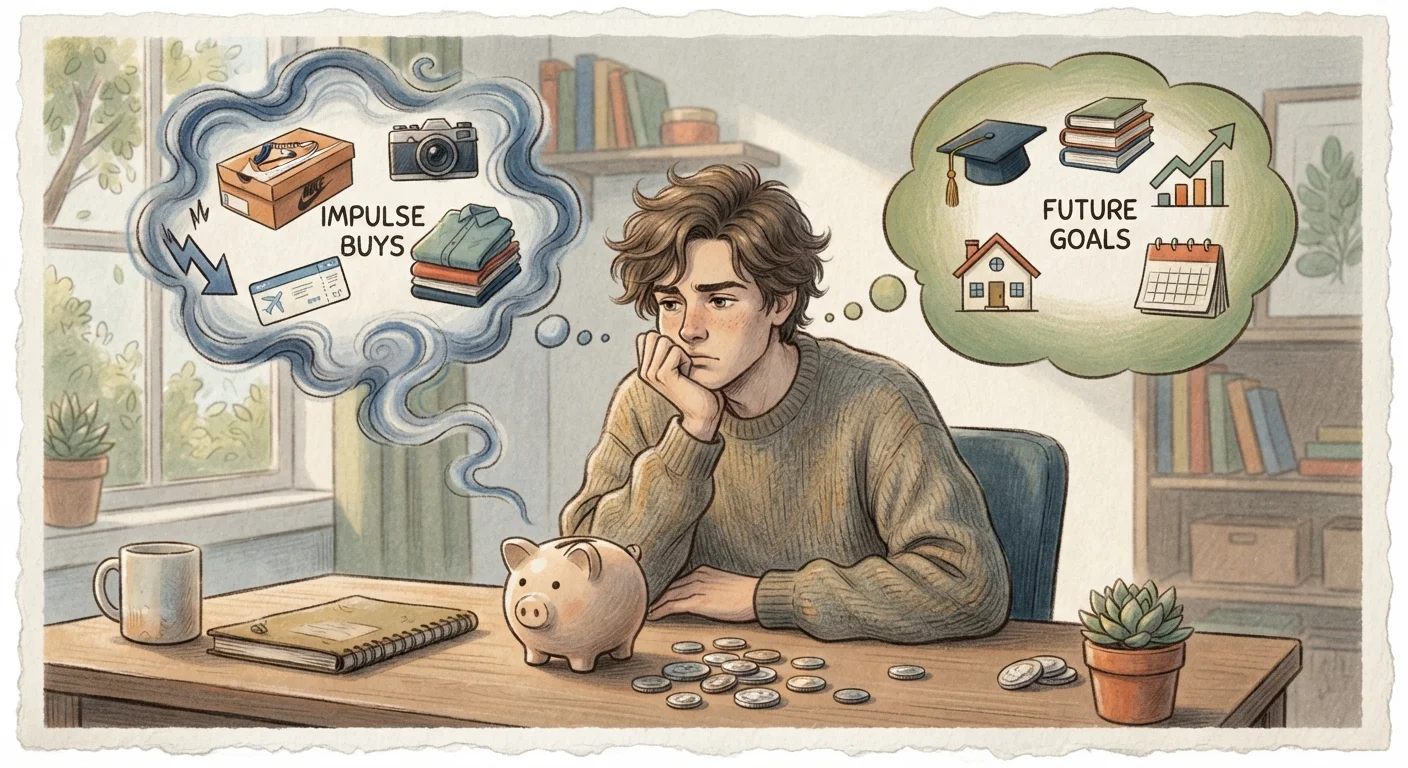
Saving money requires doing something the human brain finds genuinely uncomfortable: accepting a cost right now for a benefit that won't arrive for months or years. Behavioral scientists call this the problem of intertemporal choice - decisions where costs and rewards are separated in time. And the evidence is clear: our brains handle these decisions poorly.
The core issue is present bias - a well-documented tendency to place disproportionate value on immediate rewards over future ones. It's not simply impatience. Brain imaging research suggests that thinking about future rewards engages different neural pathways than thinking about immediate ones, making the future feel less real and less motivating.
This connects to a related concept called hyperbolic discounting: the value we assign to a future reward drops steeply as that reward becomes more distant. A retirement account growing over thirty years is genuinely hard for the brain to make emotionally vivid - which is why many people know they should save more but still don't. For a broader look at how these biases shape everyday decisions, see how behavioral economics explains daily money choices.
“The combination of cognitive limitations and the peculiarities of human motivation make saving genuinely difficult - not because people lack discipline, but because the task runs counter to some deeply ingrained mental tendencies.”
— Richard Thaler, Nobel laureate in Economics, behavioral economist
Loss Aversion and the Pain of Moving Money
Even when people intend to save, the act itself can trigger resistance. Research by Daniel Kahneman and Amos Tversky demonstrated that people feel the pain of losses roughly twice as intensely as the pleasure of equivalent gains - a principle known as loss aversion.
In practical terms, transferring $200 from a checking account into savings can feel psychologically like losing $200, even though the money remains yours. That emotional discomfort is enough to stall action, rationalize delays, or quietly abandon saving goals. It's the same mechanism that makes people hold onto losing investments longer than they should, and it operates just as powerfully in everyday saving behavior.
57%
Americans unable to cover a $1,000 emergency
According to Bankrate's annual emergency savings survey, a majority of U.S. adults lack sufficient liquid savings to handle a common unexpected expense.
2x
How much more painful losses feel than gains
Kahneman and Tversky's foundational research estimated that losses are felt approximately twice as intensely as equivalent gains, underpinning loss aversion theory.
~40%
Daily behaviors that are habitual
Research published in the American Journal of Psychology estimated that roughly 40% of daily actions are habits rather than deliberate decisions, highlighting the limits of willpower-based approaches.
Understanding loss aversion doesn't eliminate it, but it does reframe the problem. If moving money to savings feels like a loss, then structuring that transfer so it happens automatically - before you ever see the funds - removes the emotional trigger. See what automation gains and costs you for a balanced look at this approach.
Emotional Spending and the Role of Stress
Cognitive biases aren't the only forces at work. Emotional states - particularly stress, anxiety, and low mood - reliably shift people toward short-term gratification. Behavioral researchers describe this as ego depletion or cognitive load: when mental resources are stretched, self-regulation suffers, and impulsive spending fills the gap.
Social comparison adds another layer. Observing others' apparent spending - amplified by social media - can trigger spending to maintain perceived status, a dynamic that quietly erodes saving capacity. The research on this is consistent: peer norms influence financial behavior more than most people acknowledge. For more on this mechanism, see how social comparison shapes spending.
Reduce Decision Points, Not Just Spending
Rather than relying on willpower at each spending decision, consider reducing the number of decisions you face. Automating transfers, unsubscribing from promotional emails, and removing saved payment information from retail sites are structural changes that lower the cognitive load - and research consistently shows they outperform good intentions alone.
These emotional patterns often show up as what researchers call financial self-sabotage - recurring behaviors that undermine money goals even when the person consciously wants to do better.
What Behavioral Science Suggests About Changing Course
The most consistent finding from behavioral research is that willpower alone is a fragile solution. Because these psychological patterns are predictable and largely automatic, the most effective interventions tend to change the environment, not just the intention.
Automating savings transfers - so money moves before it reaches the spending account - removes the moment when present bias can intervene. Framing saving as protecting future-you from loss (rather than as giving something up now) can also reduce the emotional resistance driven by loss aversion. Identity-based approaches, where saving becomes part of how a person sees themselves rather than a chore to complete, show consistent promise in the research. For a deeper look at these principles, see evidence-backed principles for financial behavior change.
Even tight budgets can accommodate saving when the structural approach is right. Practical strategies for saving on a constrained income show that small, consistent transfers often outperform larger but irregular ones - partly because they lower the psychological stakes of each individual decision.
This article is for general informational and educational purposes only and does not constitute personalized financial advice. Consult a qualified financial professional for guidance specific to your circumstances.