

Key Takeaways
Mental Health Professionals
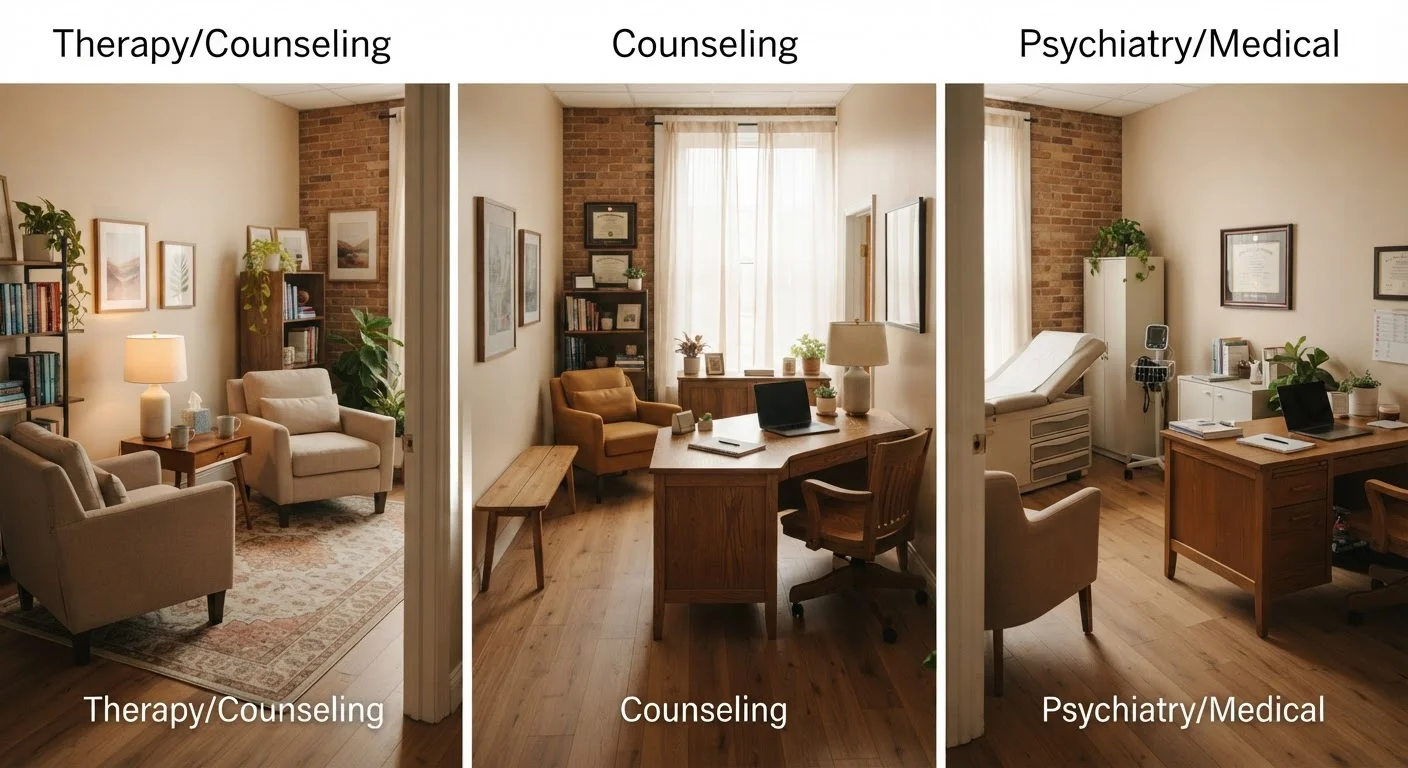
Mental health professionals are trained specialists who support psychological and emotional well-being through different methods. Therapists and counselors primarily use talk-based approaches to help people understand and manage their thoughts, feelings, and behaviors. Psychiatrists are medical doctors who can diagnose mental health conditions and prescribe medication when appropriate.
Licensing requirements vary by state; credentials such as LCSW, LPC, LMFT (therapists/counselors) and MD or DO (psychiatrists) reflect distinct training pathways and regulated scopes of practice.
Three Roles, One Goal: Supporting Mental Health
The terms therapist, counselor, and psychiatrist are often used interchangeably in everyday conversation - but they describe meaningfully different professionals with distinct training, credentials, and roles. Understanding those differences helps you make more informed decisions about your own mental health care or that of someone you support.
All three share a common purpose: helping people navigate psychological and emotional challenges. The differences lie in how they do that, and what they are qualified to provide. As mental health support looks different for everyone, knowing the landscape of available professionals is a meaningful first step.
1 in 5
U.S. adults with a mental illness annually
According to the National Institute of Mental Health, approximately 1 in 5 American adults experiences a mental illness in a given year, underscoring the broad relevance of mental health care.
~16%
Adults who received mental health treatment in the past year
The Substance Abuse and Mental Health Services Administration (SAMHSA) estimates that roughly 1 in 6 U.S. adults received mental health treatment in a recent 12-month period, including therapy, counseling, or medication.
45%
Of those with mental illness who receive treatment
SAMHSA data consistently shows that fewer than half of adults with a mental illness receive treatment in a given year, highlighting the importance of understanding available options and reducing barriers.
Therapists: Talk-Based, Relationship-Centered Care
A therapist is a broad term for a licensed mental health professional who provides psychotherapy - structured, evidence-based talk therapy aimed at helping individuals understand and change thought patterns, process emotions, and develop coping strategies. Common therapy approaches include CBT, dialectical behavior therapy (DBT), and psychodynamic therapy.
Therapists hold master's or doctoral-level degrees and work under state licensure. Depending on their specific credential, they may be called a Licensed Clinical Social Worker (LCSW), Licensed Professional Counselor (LPC), Licensed Marriage and Family Therapist (LMFT), or Psychologist (PhD or PsyD). Psychologists with doctoral degrees may also conduct psychological testing and assessment, in addition to providing therapy.
Therapists work with a wide range of concerns - anxiety, depression, trauma, grief, relationship difficulties, and everyday life stress. They do not prescribe medication in most U.S. states.
Ask About a Provider's Approach
Before your first appointment, it's reasonable to ask a therapist or counselor what modalities they use and what a typical session looks like. Different therapeutic approaches suit different people and concerns. Finding someone whose style feels like a good fit matters as much as their credential type.
Counselors: Focused Support for Specific Challenges
Counselors often work within specific contexts or populations - school counselors, substance use counselors, career counselors, and mental health counselors are all distinct roles. In the mental health context, a licensed counselor (such as an LPC or Licensed Mental Health Counselor, or LMHC) provides talk-based support that overlaps significantly with therapy.
The distinction between "therapist" and "counselor" is more a matter of setting, specialty, and credential than a clear hierarchy of depth or quality. Both can offer meaningful support for a broad range of emotional and psychological concerns.
Counselors typically emphasize practical strategies, problem-solving, and building skills to manage specific life challenges. They may focus on shorter-term work, though many provide ongoing care as well. Like therapists, they do not prescribe medication.
Psychiatrists: Medical Expertise and Medication Management
A psychiatrist is a medical doctor (MD or DO) who has completed specialized training in psychiatry after medical school. This medical background gives psychiatrists the authority to prescribe and manage psychiatric medications - a key distinction from therapists and counselors.
Psychiatrists conduct diagnostic evaluations to assess whether a condition such as major depressive disorder, bipolar disorder, schizophrenia, or ADHD may be present. They use this assessment to guide treatment, which may include medication, psychotherapy (some psychiatrists provide both), or referrals to other providers.
“Psychiatry is fundamentally about understanding the relationship between the brain, behavior, and lived experience - and using that understanding to relieve suffering through the most appropriate means available, including but not limited to medication.”
— National Institute of Mental Health, U.S. federal agency for mental health research and public education
In practice, many psychiatrists today focus primarily on medication management rather than ongoing talk therapy, often working in coordination with a separate therapist. This is not a limitation - it reflects a team-based model of care that can be highly effective. The difference between primary care and specialist visits applies here too: psychiatrists function as specialists within a broader care network.
How to Think About Choosing the Right Support
The right professional depends on what you're experiencing - not on how "serious" your situation is. Therapy is not reserved for crises, and seeing a psychiatrist does not mean medication is inevitable. Many people work with more than one type of provider at the same time.
Some practical considerations:
- If you want to talk through emotions, stress, or relationships: A therapist or counselor is typically a strong starting point.
- If you're concerned about symptoms that may have a biological component - persistent low mood, significant sleep disruption, or experiences that feel difficult to explain - a psychiatrist evaluation may be helpful.
- If you're unsure: Your primary care provider can conduct an initial assessment and help navigate referrals.
It's also worth noting that social connection plays a meaningful role in mental well-being alongside formal professional support. Professional care and strong relationships are not in competition - they often reinforce each other.
This article is for general informational purposes only and is not a substitute for professional medical or mental health advice. If you have concerns about your mental health or someone else's, please consult a qualified healthcare provider.