

Key Takeaways
Leash Pulling
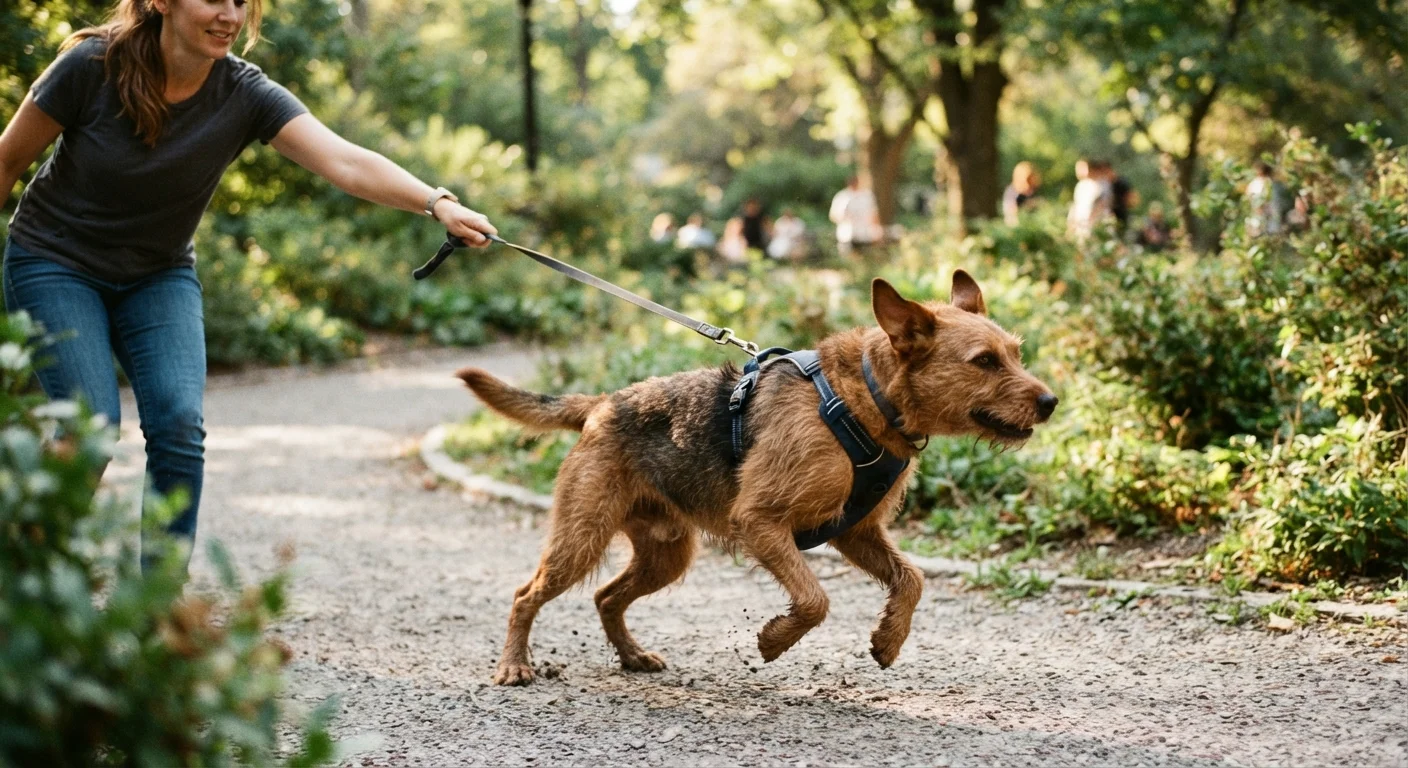
Leash pulling is when a dog moves forward faster than the person holding the leash, creating constant tension on the line. It's not defiance or a personality flaw — it's a natural result of how dogs move through the world and what their brains are wired to do. The behavior is almost always reinforced unintentionally: when a dog pulls and still gets to move forward, the pulling works.
From a behavioral science perspective, leash pulling is typically maintained by negative reinforcement — the dog learns that pulling removes the 'obstacle' (the stationary owner) and produces forward movement toward a desired stimulus.
The Real Reason Your Dog Pulls — It's Not What You Think
Ask most dog owners why their dog pulls on the leash and you'll hear the same answers: "She's stubborn," "He wants to be in charge," or "She just doesn't listen." None of these explanations are accurate — and believing them leads owners toward the wrong solutions.
Dogs pull because pulling works. Every time a dog surges forward and the walk continues, the brain logs a simple lesson: tension on the leash equals forward progress. It's operant conditioning happening in real time, on every block, every day. The leash doesn't communicate anything by itself. What teaches the dog is what happens next.
At the neurological level, dogs experience a significant arousal spike the moment a walk begins. The combination of smells, sounds, visual movement, and the anticipation of exploration floods the brain with dopamine. A dog in that state has genuinely reduced impulse control — not because they're being defiant, but because their brain is running a very different program than yours is.
“Dogs do what works. If pulling on the leash gets them closer to what they want, they'll pull harder and harder. The leash doesn't tell the dog anything — what the owner does next is the actual message.”
— Dr. Ian Dunbar, Veterinarian and animal behaviorist, founder of the Association of Professional Dog Trainers
How Instinct and Reinforcement Combine to Create the Habit
Dogs are exploratory animals. Their primary sense — smell — is oriented outward and forward. When something interesting registers, the instinct is to move toward it immediately. This is the same drive that makes dogs effective trackers, hunters, and scavengers. It is not a training failure; it is biology.
The problem is that this instinct intersects with inadvertent human reinforcement. Most owners continue walking when the dog pulls, stop and wait briefly, then walk again — which the dog experiences as a short delay before getting what it wanted. That's not a deterrent. That's a mild intermittent delay, which actually strengthens the behavior over time rather than weakening it.
~78M
Pet dogs currently owned in the U.S.
According to the American Pet Products Association, the U.S. has one of the largest pet dog populations in the world — making leash manners a near-universal concern for owners.
#1
Most reported dog behavior complaint
Leash pulling consistently ranks as the top behavior problem reported by dog owners seeking professional training help, according to surveys of certified dog trainers.
If you've ever wondered why your dog pulls more on the way to the park than on the way home, this explains it. Anticipation of a high-value reward amplifies arousal, which amplifies pulling. The walk itself is a training session — the question is only what lesson it's teaching.
New owners are especially vulnerable to building this habit early without realizing it. The most common early mistakes new dog owners make often include assuming that puppies will "grow out" of pulling — when in fact those early walks are actively cementing the pattern.
What Loose-Leash Walking Actually Requires
Loose-leash walking isn't a piece of equipment — it's a trained skill that requires the dog to understand what behavior earns continued forward movement. That means the owner must become a consistent, readable source of information.
The core principle is simple: a tight leash means the walk pauses; a loose leash means the walk continues. When applied consistently, dogs learn the rule quickly in low-distraction environments. The challenge is generalizing that rule to busier, more arousing situations — and that takes deliberate practice over time.
Start Training in Low-Distraction Environments
Before expecting loose-leash walking on a busy sidewalk, practice the behavior in your backyard or a quiet hallway. Dogs generalize skills gradually — mastering the rule in a calm setting first gives them a real foundation to build on when distractions increase.
Structured daily routines dramatically accelerate this process. A dog that walks at predictable times, on predictable routes, with a consistent handler develops calmer baseline arousal and learns the rules of engagement faster. Building a reliable daily schedule isn't just about feeding times — it directly supports leash training progress.
It's also worth noting that leash pulling is a discrete learned behavior, distinct from anxiety-based issues. Dogs who pull are not necessarily stressed — they're motivated. This is an important distinction, because the same outward urgency that characterizes pulling can sometimes be confused with reactivity or fear. Understanding what separation anxiety actually looks like is a useful reference point for owners trying to distinguish drive-based behaviors from distress-based ones.
This article is for general informational and educational purposes only. For personalized guidance on your dog's behavior, consult a certified professional dog trainer or veterinary behaviorist.