

| IDA Certification Body | International Dark-Sky Association (IDA) (darksky.org) |
| Number of IDA-Designated Places Worldwide | Over 200 (parks, reserves, sanctuaries, communities) (IDA, as of 2024) |
| Optimal Viewing Condition | New moon phase, low humidity, high elevation |
| States with IDA Parks Covered Here | Utah, Arizona, New Mexico, Nevada, Colorado |
| Best Seasons in the Southwest | Spring and fall (mild temps, stable skies) |
| Elevation Advantage | Higher altitude = thinner atmosphere = less atmospheric distortion |
Why the Southwest Leads the Country in Dark Skies
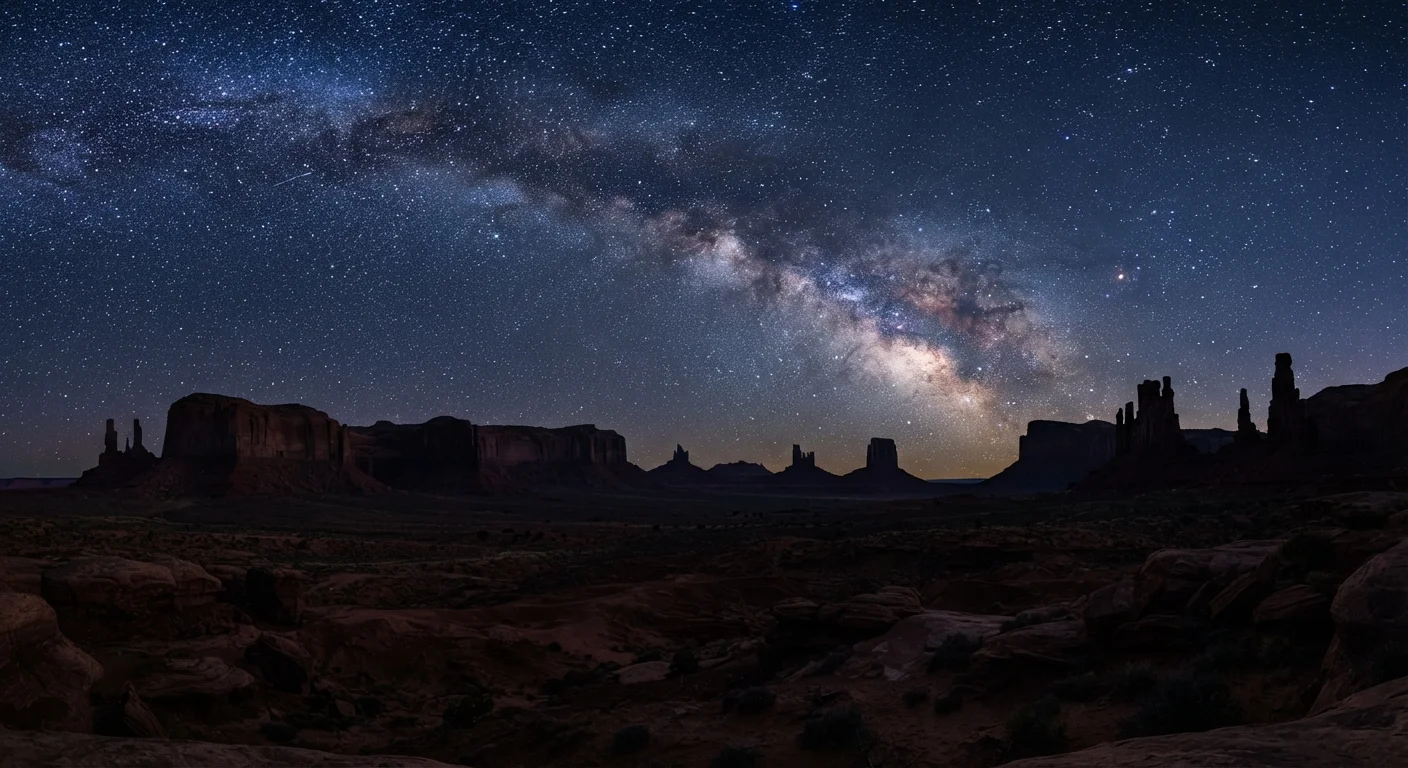
Thin air, low humidity, sparse population, and wide-open terrain make the American Southwest a natural observatory. Light pollution — the glow cast by cities, highways, and commercial areas — hasn't reached many corners of this region, leaving swaths of sky that look much the same as they did centuries ago.
The International Dark-Sky Association (IDA) certifies places that actively protect their night environments. The Southwest holds a remarkable concentration of these designations, spanning national parks, monuments, and state reserves across Utah, Arizona, New Mexico, Nevada, and Colorado. Each certified site has agreed to limit artificial light, educate visitors, and preserve the dark sky as a resource.
| IDA Certification Body | International Dark-Sky Association (IDA) (darksky.org) |
| Number of IDA-Designated Places Worldwide | Over 200 (parks, reserves, sanctuaries, communities) (IDA, as of 2024) |
| Optimal Viewing Condition | New moon phase, low humidity, high elevation |
| States with IDA Parks Covered Here | Utah, Arizona, New Mexico, Nevada, Colorado |
| Best Seasons in the Southwest | Spring and fall (mild temps, stable skies) |
| Elevation Advantage | Higher altitude = thinner atmosphere = less atmospheric distortion |
Whether you're a serious amateur astronomer or just someone who wants to stand beneath the Milky Way for the first time, this regional reference lays out what each major destination offers — and what to plan for before you go.
Certified Dark Sky Parks by State
Utah
Bryce Canyon National Park holds an IDA International Dark Sky Park designation and hosts ranger-led astronomy programs, including seasonal Star Party events. At roughly 8,000 feet in elevation, the thin atmosphere reduces atmospheric interference. The park's signature hoodoo formations glow eerily under starlight.
Canyonlands National Park and neighboring Arches National Park share the broader Bears Ears and Canyon Country dark sky landscape, which the IDA recognizes as one of the largest dark sky reserves in the world. Visitors can self-guide from established pullouts or join scheduled programs at the park visitor centers.
Arizona
Grand Canyon National Park earned IDA designation in 2019. The South Rim's high elevation and remoteness from Phoenix's glow make it a legitimate dark sky site, though its western reaches near Toroweap Overlook are even more isolated. The park hosts an annual Star Party each spring in collaboration with the Tucson Amateur Astronomy Association.
Petrified Forest National Park is often overlooked for stargazing but carries a full IDA Dark Sky Park designation. Its high desert plateau produces clear, still nights, and the fossilized logs scattered across the badlands provide a uniquely prehistoric foreground for astrophotography.
New Mexico
Chaco Culture National Historical Park is a UNESCO World Heritage Site and IDA Dark Sky Park. The Ancestral Puebloans who built Chaco were skilled astronomers; interpretive programs explain how the architecture aligns with celestial events. The road in is unpaved, so verify conditions before traveling.
Valles Caldera National Preserve, a vast volcanic caldera northwest of Santa Fe, holds a quieter dark sky designation and draws far smaller crowds than the canyon parks.
Nevada & Colorado
Great Basin National Park in Nevada is one of the least-visited national parks in the contiguous U.S. and among its darkest. The park hosts astronomy programs at the Lehman Caves Visitor Center. In Colorado, Black Canyon of the Gunnison National Park received IDA designation and offers dramatic vertical relief that frames the night sky like a natural amphitheater.
For other undervisited gems in the region, see America's lesser-known national parks worth the drive.
Light Pollution
Artificial brightening of the night sky caused by streetlights, signage, and urban glow. It reduces the number of stars visible to the naked eye and interferes with astronomical observation.
Bortle Scale
A nine-level numeric scale measuring the darkness of the night sky at a given location. A Bortle 1 sky is the darkest possible; most US suburban areas fall between 7 and 9.
Dark Adaptation
The process by which the human eye adjusts to low-light conditions, typically taking 20–30 minutes. Exposure to white light resets this process.
IDA Dark Sky Park
A land area designated by the International Dark-Sky Association for its exceptional night sky quality and the active measures taken to protect it from light pollution.
Milky Way Core
The brightest, most visually dense portion of the Milky Way galaxy as seen from Earth. It is best visible from the Northern Hemisphere between April and October, particularly in summer months.
Planning Your Dark Sky Visit
Timing matters more than location. A full moon washes out faint stars as effectively as suburban light pollution. Plan visits around the new moon phase, when lunar light is absent from the sky. Most IDA-certified parks publish moon calendars or link to public lunar phase tools on their websites.
99%
Of Americans who can't see the Milky Way from home
According to a peer-reviewed study published in Science Advances (Falchi et al., 2016), roughly 99% of the US and European populations live under light-polluted skies.
200+
IDA-designated dark sky places worldwide
The International Dark-Sky Association maintains a growing registry of certified parks, reserves, sanctuaries, and communities globally.
8,000 ft
Approximate elevation of Bryce Canyon's viewing areas
Higher elevation reduces atmospheric interference, improving the clarity and brightness of stars visible to the naked eye.
Arrive early enough to let your eyes dark-adapt — typically 20 to 30 minutes away from any artificial light source. Red-light flashlights preserve night vision; standard white flashlights reset the adaptation process. Pack layers even in summer: desert temperatures drop sharply after sunset, and high-elevation sites can dip into the 40s Fahrenheit on warm-season nights.
Accessibility varies significantly between parks. Bryce Canyon and the Grand Canyon South Rim have paved pullouts and accessible viewing areas. Chaco and Great Basin require longer drives on rough roads. Always check current road and weather conditions with the individual park's official site before departure, and verify any required entry fees or timed-entry reservations, which many Southwest parks have adopted.
Entry fees, reservation requirements, ranger program schedules, and road conditions change regularly. Verify all details directly with the relevant national park or preserve before your visit.