

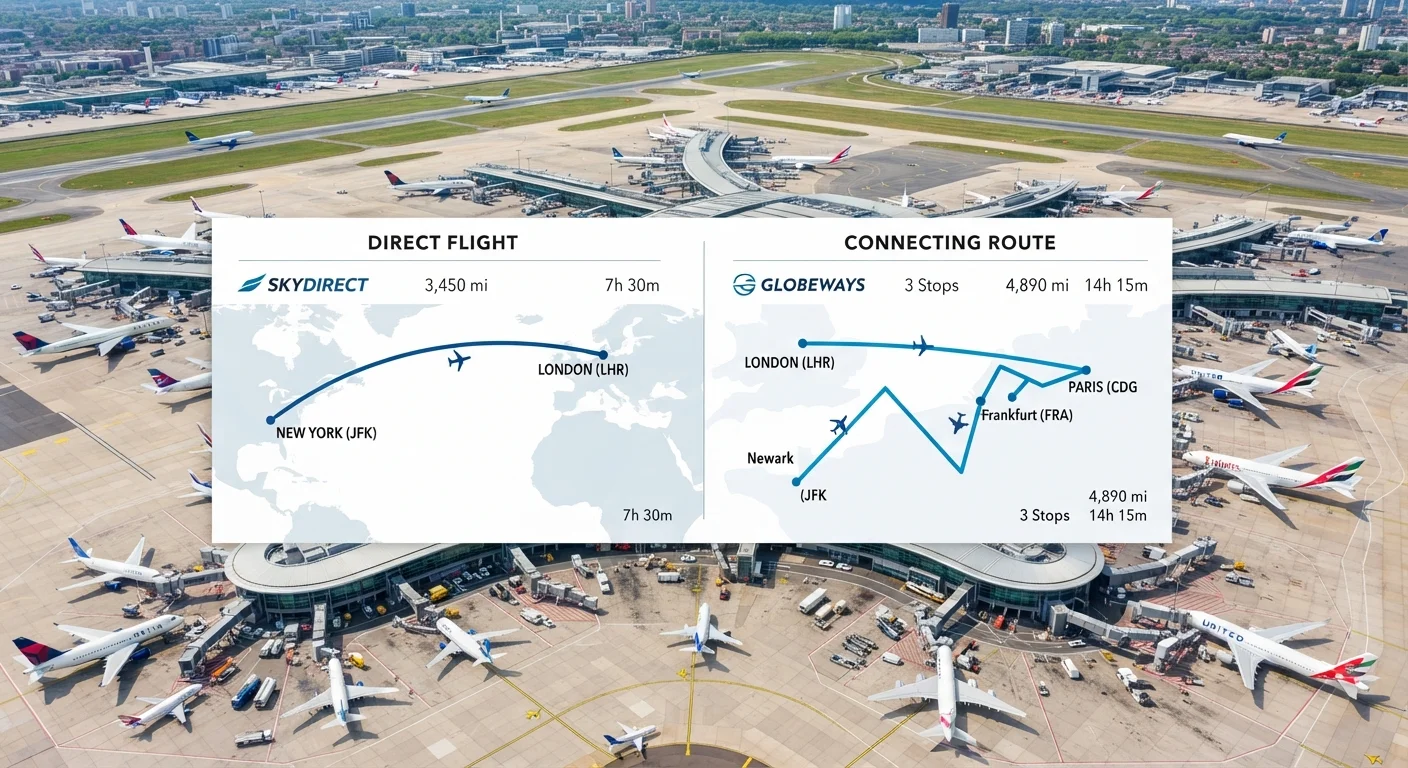
Key Takeaways
Option A
Nonstop Flights
The direct, premium-priced peace of mind.
Best for: Travelers who value reliability, comfort, and protecting tight schedules or special occasions.
Option B
Connecting Flights
The budget-friendly route with hidden strings attached.
Best for: Flexible travelers with extra time who can manage layover risk to save significantly on fare.
If you're traveling for a wedding, job interview, or cruise departure
Nonstop Flights
Missing a time-sensitive event because of a delayed connection is a risk not worth taking. Pay the premium and arrive with certainty.
If you're a flexible leisure traveler with a generous schedule
Connecting Flights
When you have buffer days and no hard deadlines, a connection can genuinely save hundreds of dollars with manageable downside risk.
If you're traveling with young children or elderly family members
Nonstop Flights
Multiple boarding processes, gate changes, and potential delays compound quickly with less mobile or easily fatigued travelers in tow.
If you're a solo traveler curious about a layover city
Connecting Flights
A long layover in the right city can become a mini-destination in itself — turning a travel inconvenience into a travel bonus.
If your route has no reliable nonstop option
Connecting Flights
For many smaller markets, a connection isn't a choice — it's simply the only way to get there. Booking on the same airline reduces rebooking friction if things go wrong.
Why the Price Difference Exists
The fare gap between nonstop and connecting flights is real — and often significant. Airlines price nonstop routes at a premium because demand for them is high: most travelers prefer them when they can afford them. Connecting itineraries, by contrast, fill seats on less-trafficked legs and help airlines optimize hub-and-spoke networks, so carriers use lower prices as an incentive.
That said, the advertised price difference rarely tells the full story. The true cost of a connecting flight includes factors that don't show up at checkout: the risk of a missed connection and its rebooking fee, a potential overnight hotel stay, lost work hours, a checked bag that arrives a day late, or simply arriving exhausted instead of ready. As we explore in Myths About Cheap Travel That Can Actually Cost You More, the cheapest-looking option often isn't the cheapest in practice.
| Criterion | Nonstop Flights | Connecting Flights |
|---|---|---|
| Typical upfront cost | Higher fare | Lower fare |
| Travel time | Shortest possible | Adds 2–6+ hours |
| Missed connection risk | None | Moderate to high |
| Baggage misrouting risk | Low | Higher |
| Physical fatigue | Minimal | Notably higher |
| Route availability | Limited to major markets | Reaches nearly everywhere |
| Best for tight schedules | Yes | Risky |
| Layover opportunity | Not applicable | Possible with long layover |
The Hidden Costs of a Connection
Missed connections are the single biggest financial risk of choosing a connecting itinerary. When your inbound flight is delayed and you miss your next leg, what happens next depends entirely on how you booked. If both flights are on the same airline and the same ticket, the carrier is obligated to rebook you at no extra charge. If you booked two separate tickets to save money — a common workaround — you're on your own, and a new one-way fare purchased last-minute can cost several times what you originally saved.
Short minimum connection times amplify this risk. Major US hubs like Chicago O'Hare, Dallas/Fort Worth, and Atlanta can require a terminal change that realistically takes 30 minutes on a smooth day. A 50-minute layover leaves almost no margin. Airlines do publish minimum connection times, but these are operational minimums, not comfortable ones.
~20%
US flights delayed or cancelled annually
The US Department of Transportation consistently reports roughly 1 in 5 domestic flights experiences a delay or cancellation in a given year.
2x
Disruption exposure on a connecting itinerary
With two flight legs, travelers face two separate opportunities for delays to compound — doubling the statistical exposure compared to a single nonstop.
$200+
Average last-minute domestic one-way rebooking cost
Industry fare data suggests last-minute one-way domestic fares routinely exceed $200, quickly erasing savings from an original connecting ticket purchase.
Beyond missed connections, there's the fatigue math. Two takeoffs, two landings, two security queues if you clear customs at an international connection, and the cumulative stress of navigating an unfamiliar terminal while watching a departure board — all of this has a real cost in energy that doesn't appear in your fare comparison. See How to Read a Flight Itinerary Without Missing the Fine Print for help decoding what your ticket's fine print actually commits you to.
When a Connection Actually Makes Sense
Connecting flights aren't always the worse choice — sometimes they're genuinely smart. If the fare difference is $200 or more and your schedule has genuine flexibility (a trip with no fixed-time commitments on arrival day), the savings can be well worth a few extra hours in transit. This is especially true on international routes, where connecting through a hub can slash costs dramatically compared to a rare or premium-priced nonstop.
Layover length matters enormously here. A connection of 2.5 to 4 hours at a manageable hub gives you breathing room to handle delays, grab a meal, and board the next flight without stress. Some travelers even turn long layovers into mini-adventures — Getting More from a City Layover Than You Think Is Possible explores exactly how to do that. For more on turning layovers into something worthwhile, also check out Airport Layovers: Wasted Time or Hidden Opportunity?.
The smartest connecting-flight strategy: book both legs on a single ticket with one airline or an alliance partner, choose a layover of at least 90 minutes at an uncongested airport, and avoid tight connections during historically delay-prone seasons like winter holidays or summer storm months.
Same Ticket vs. Two Separate Tickets
Booking both legs under a single itinerary — even across partner airlines — gives you legal protection if a delay causes you to miss the connection. The operating carrier must rebook you at no charge. By contrast, two separately purchased tickets are treated as independent reservations: if your first flight is late, no airline is obligated to cover your missed second ticket. Always confirm whether your itinerary is issued as one ticket before finalizing.
Making the Call: A Practical Framework
Before clicking purchase on either option, run through a quick mental checklist. First, ask what the trip is for. A connecting flight to a beach vacation with three flexible days? Fine. A connection to a conference where you're presenting the morning you land? That's a gamble. Second, calculate the real savings after accounting for your time's value. If you earn $40 an hour and a connection costs you four extra hours plus a $15 airport meal, you've already spent $175 in value — before anything goes wrong.
Third, check the route's on-time performance history. The US Department of Transportation publishes airline on-time data by route, and some consumer aviation sites aggregate this in readable form. A hub with a 70% on-time departure rate in January is a much riskier connection point than one with a 90% rate in May.
Finally, consider the Flexible Booking vs. Locking in Rates Early dimension: if you're booking a connecting itinerary, a refundable or changeable fare buys meaningful insurance. The extra cost of flexibility may be worth more on a connection than on a nonstop, simply because your exposure to disruption is higher. For all the big-picture trip planning decisions that surround this choice, Trip Planning is your go-to resource.