

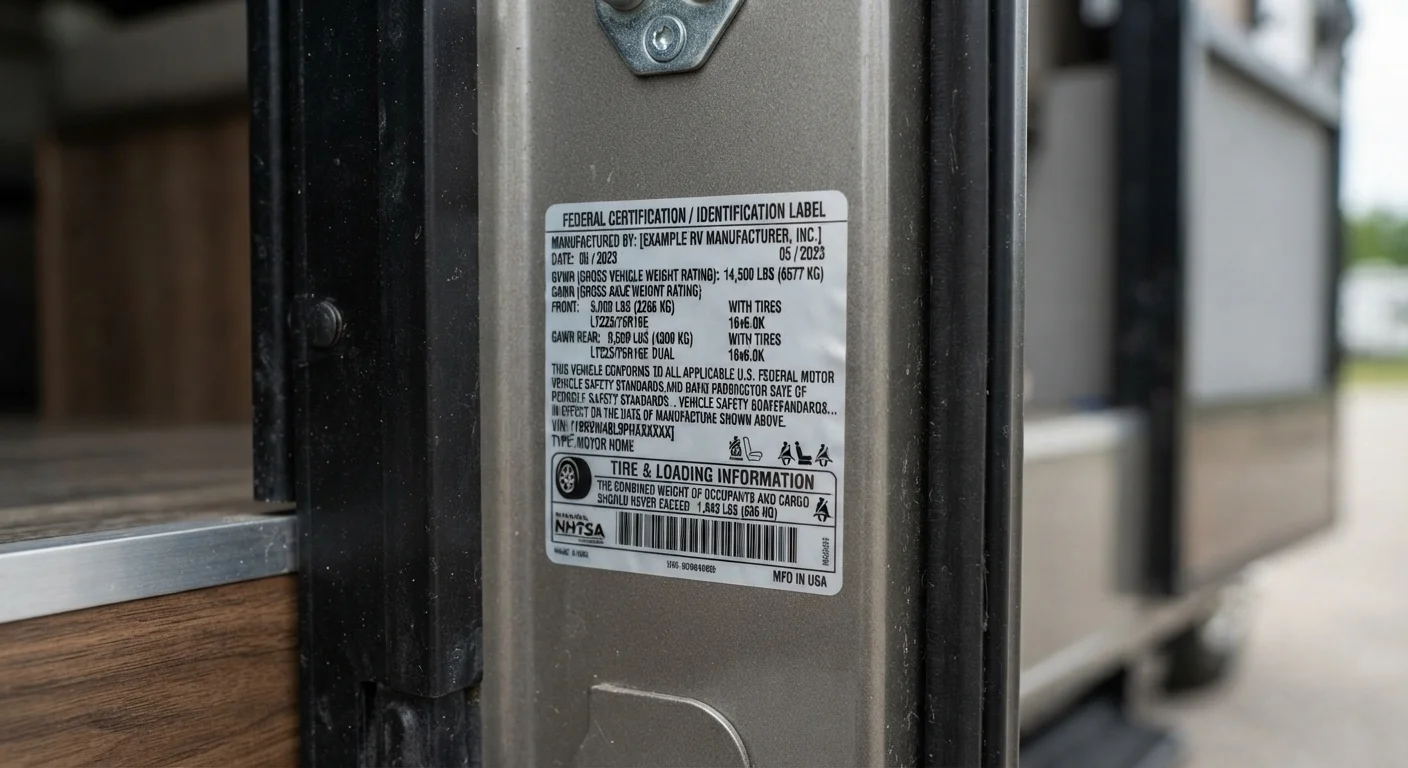
| Where GVWR is listed | Federal certification label on the driver's side door jamb or door frame |
| Who sets weight standards | NHTSA (National Highway Traffic Safety Administration) mandates label requirements |
| Typical Class A motorhome GVWR range | Approximately 26,000 - 33,000 lbs (General industry figures; verify for specific models) |
| Typical travel trailer GVWR range | 1,500 - 20,000+ lbs depending on size and class (General industry figures) |
| CCC formula | GVWR − UVW − factory options weight |
| Overweight risk | Tire blowouts, brake failure, frame stress, and handling loss |
The Weight Ratings on Your RV's Label - and What Each One Controls
Every RV sold in the United States must carry a federal certification label, typically mounted on the driver's side door jamb. That label lists the weight ratings the manufacturer has determined are safe limits for that specific vehicle. Ignoring those numbers isn't just inadvisable - it can mean compromised brakes, tire blowouts, and handling characteristics that no driver can fully compensate for.
| Where GVWR is listed | Federal certification label on the driver's side door jamb or door frame |
| Who sets weight standards | NHTSA (National Highway Traffic Safety Administration) mandates label requirements |
| Typical Class A motorhome GVWR range | Approximately 26,000 - 33,000 lbs (General industry figures; verify for specific models) |
| Typical travel trailer GVWR range | 1,500 - 20,000+ lbs depending on size and class (General industry figures) |
| CCC formula | GVWR − UVW − factory options weight |
| Overweight risk | Tire blowouts, brake failure, frame stress, and handling loss |
The two most fundamental ratings are GVWR and GAWR. The GVWR sets the ceiling for total loaded weight: the RV itself plus every gallon of fuel, every gallon of water, every passenger, and every piece of gear you bring. The GAWR - listed separately for front and rear axles - sets the limit for each axle independently. You can be within GVWR and still overload a single axle by storing heavy items over one end of the vehicle, which is why both ratings matter.
For motorhomes towing a dinghy car or small trailer, a third rating applies: the GCWR. This caps the combined weight of the motorhome and whatever it's pulling. See our guide to towing capacity for a deeper look at how these combined limits interact with your tow vehicle's capabilities.
Understanding Cargo Carrying Capacity - Your Real Working Budget
Knowing GVWR matters, but the number that directly controls your packing is Cargo Carrying Capacity (CCC). CCC is calculated by subtracting the Unloaded Vehicle Weight (UVW) and any factory-installed options from the GVWR. It represents the actual pounds available for people, food, water, clothing, tools, and recreational equipment.
Water Weight Adds Up Fast
Fresh water weighs approximately 8.3 pounds per gallon. A 40-gallon fresh water tank at full capacity adds roughly 332 pounds to your RV's loaded weight - enough to noticeably reduce your remaining Cargo Carrying Capacity. Factor in gray and black tank contents as well when estimating total loaded weight before a trip.
CCC figures on manufacturer brochures can be optimistic. They're based on a base-model UVW without optional equipment. Every accessory added at the factory - a washer/dryer, upgraded entertainment system, or second air conditioner - eats into that number before you even pack a bag. Always verify CCC using the actual certification label on your specific unit, not the spec sheet for the model line.
The practical takeaway: weigh your RV loaded and ready to travel before your first trip. Many RV owners discover they've exceeded CCC the first time they step on a certified truck scale. For a broader look at vehicle weight classifications, our field guide to commercial vehicle classes explains how GVWR also determines which licensing and inspection requirements may apply to your motorhome.
10-15%
Recommended tongue weight as share of loaded trailer weight
Industry-standard guideline cited by RV safety educators and trailer brake manufacturers.
~30%
Of RVs found overweight in roadside studies
Periodic weigh-station checks by state enforcement agencies have found a significant share of RVs operating above their GVWR.
Proper cargo distribution matters as much as total weight. Aim to load heavier items low and centered over the axles rather than at the rear or in overhead storage. Uneven loading can push a single GAWR over its limit even when total GVWR is within range.
GVWR
Gross Vehicle Weight Rating - the maximum allowable total weight of the RV, including the vehicle itself, all fluids, cargo, passengers, and gear. Exceeding this rating compromises brakes, tires, and structural integrity.
GAWR
Gross Axle Weight Rating - the maximum load each individual axle is designed to carry. An RV typically has both a front GAWR and a rear GAWR listed separately on the certification label.
UVW
Unloaded Vehicle Weight - the manufacturer's stated weight of the RV with standard equipment, full fuel, and engine fluids, but no cargo, water, or passengers. Also called dry weight.
CCC
Cargo Carrying Capacity - the weight available for passengers, food, water, gear, and personal belongings. Calculated as GVWR minus UVW minus any factory-installed options weight.
GCWR
Gross Combined Weight Rating - applies to motorhomes towing a dinghy vehicle. It is the maximum allowable combined weight of the motorhome and the vehicle being towed.
Tongue Weight
The downward force a trailer's coupler exerts on a tow vehicle's hitch ball. Proper tongue weight is typically 10-15% of the trailer's loaded weight and must stay within the tow vehicle's tongue weight rating.
For new owners still learning the language of RV ownership, the RV and camping glossary covers these terms alongside dozens of others you'll encounter at the dealer lot and on the road. And once you have your weight management sorted, safe RV driving habits from experienced travelers can help you translate that preparation into confident, controlled road performance.