

Key Takeaways
How Two Different Vehicles Got the Same Label
Walk into any dealership and you'll see rows of tall, wagon-like vehicles marketed as SUVs. But a significant portion of them are, by engineering definition, crossovers - a distinct vehicle category that emerged in the 1990s and has since come to dominate the market. The blurring of these terms isn't accidental; automakers and media outlets have used them interchangeably for decades. For consumers trying to make informed decisions, that's a problem.
The distinction isn't just semantic. How a vehicle is built determines how it rides, how it handles, what it can tow, and how it performs when the pavement ends. Understanding the difference puts you in a better position to match a vehicle to your actual needs - whether that's daily city driving, weekend family hauling, or genuine trail work. See our guide to matching vehicle types to use cases for a broader framework.
The Core Myths, Corrected
These are the misconceptions that trip up the most shoppers - and the accurate information that replaces them.
Myth
SUV and crossover are just two words for the same type of vehicle.
Fact
They refer to fundamentally different construction methods - a body-on-frame platform for traditional SUVs versus a unibody platform for crossovers.
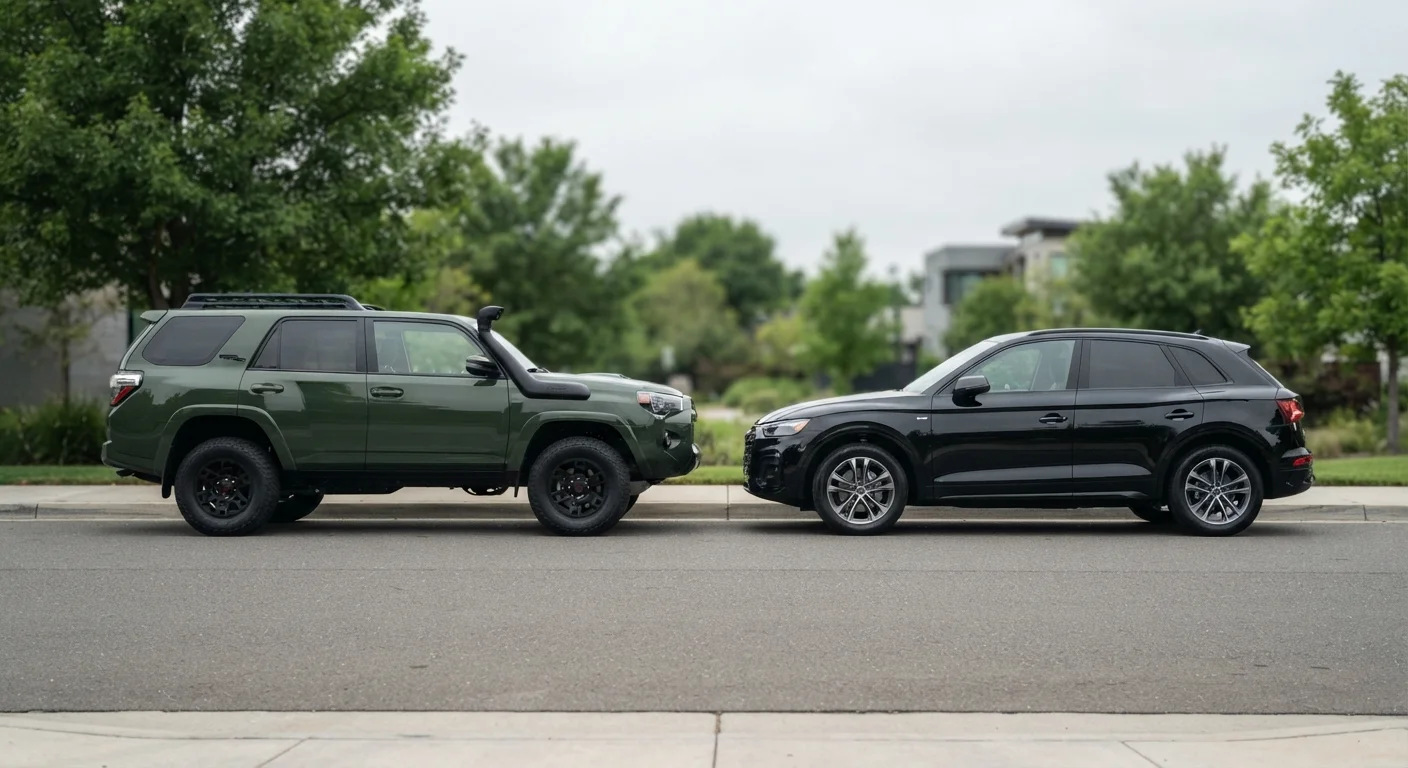
The term SUV (Sport Utility Vehicle) originally described body-on-frame vehicles - trucks, essentially, with enclosed passenger compartments. A crossover (sometimes called a CUV, or Crossover Utility Vehicle) uses a unibody platform derived from passenger cars. The two architectures produce very different driving dynamics, weight profiles, and capability ceilings. Automakers market both under the SUV label because consumers respond to it, but the engineering underneath is not the same.
Myth
All AWD vehicles marketed as SUVs are built for serious off-road use.
Fact
AWD improves on-road traction in rain and snow but does not alone make a vehicle capable of technical off-road terrain.
All-wheel drive (AWD) distributes power to all four wheels automatically and is particularly useful in slippery conditions. However, off-road capability also depends on ground clearance, approach and departure angles, suspension articulation, and whether the vehicle has a low-range transfer case. Most crossovers with AWD are optimized for wet pavement and light gravel, not rock ledges or deep ruts. True off-road performance requires a combination of hardware that most crossovers simply aren't equipped with.
Myth
Crossovers are just smaller, weaker versions of real SUVs.
Fact
Crossovers are purpose-built for a different set of priorities - not a downsized compromise - and often outperform traditional SUVs in their intended use cases.
A crossover isn't a shrunken SUV; it's a distinct vehicle type engineered for everyday utility with car-derived efficiency and handling. Many three-row crossovers seat seven or eight passengers, offer substantial cargo space, and tow between 3,500 and 5,000 pounds - sufficient for a small boat or trailer. They're not designed to compete with a body-on-frame SUV on a boulder field, but for the vast majority of drivers, their real-world performance is entirely adequate and often preferable.
Myth
If it looks tall and boxy, it must be a real SUV.
Fact
Exterior styling gives no reliable indication of the underlying platform; many tall, angular vehicles are unibody crossovers.
Automakers style crossovers to project ruggedness - squared-off rooflines, pronounced wheel arches, roof rails, and faux skid plates are common design elements. These are styling choices, not structural ones. A vehicle can look every bit the part of a traditional SUV while riding on a car platform with a fully independent suspension. The only reliable way to identify the construction type is to check the manufacturer's specification sheet, which will indicate whether the vehicle uses a body-on-frame or unibody architecture.
Myth
Crossovers can't tow anything meaningful.
Fact
Many mid-size and full-size crossovers carry factory tow ratings between 3,500 and 6,000 pounds - enough for a wide range of trailers and light recreational loads.
Towing capacity on crossovers varies considerably by model, engine choice, and tow package configuration. While they generally don't match the 8,000-14,000+ lb ratings of body-on-frame SUVs or full-size trucks, a well-equipped crossover can handle a small camper, a ski boat, or a utility trailer without issue. Always verify the specific tow rating for the configuration you're considering, and remember that ratings assume a properly loaded vehicle and correct hitch equipment.
What the Difference Means in Practice
The unibody construction of a crossover integrates the body and frame into a single welded structure - the same approach used in sedans and hatchbacks. This reduces weight, lowers the center of gravity, and allows for car-like suspension tuning. The result is a vehicle that feels composed on highway on-ramps, returns competitive fuel economy figures, and fits comfortably in standard parking structures.
A body-on-frame SUV, by contrast, mounts a separate body onto a rigid ladder frame - the same fundamental architecture used in full-size pickup trucks. That frame is what enables serious towing ratings and the structural rigidity needed for technical off-road terrain. It also means more weight, a higher ride height, and a driving character that feels noticeably different from a passenger car.
~80%
U.S. new vehicle sales that are crossovers or SUVs
Industry sales data has consistently shown that crossovers and SUVs together account for roughly four out of every five new vehicles sold in the United States in recent model years.
3,500-6,000 lbs
Typical crossover tow rating range
Many mid-size unibody crossovers with available tow packages are rated to pull between 3,500 and 6,000 pounds, according to manufacturer specification sheets.
If your needs fall closer to light trails or occasional gravel roads rather than rock crawling or towing a fifth-wheel trailer, a crossover may be entirely sufficient. For a deeper look at how automakers describe off-road capability - and what those claims actually mean - see what off-road marketing language really means.
Choosing Based on What You Actually Need
Neither category is universally superior. A crossover's strengths - ride quality, efficiency, maneuverability - make it the practical choice for the majority of American drivers whose days involve highways, school runs, and the occasional unpaved parking lot. A traditional SUV's strengths - towing muscle, frame durability, and genuine off-road geometry - matter most to buyers who use those capabilities regularly.
Be clear-eyed about your real usage patterns before letting marketing language steer the decision. Most buyers never approach the towing limits or off-road capability of the vehicle they purchase. If you're also evaluating other vehicle formats, articles like how hatchbacks differ from sedans and the difference between cargo and passenger vans can help round out your understanding of the full vehicle landscape.
Don't Rely on the Trim Name Alone
Terms like 'Sport,' 'Trail,' 'Adventure,' and 'Terrain' in a vehicle's trim name are marketing designations, not engineering certifications. A trim named for off-road exploration may sit on a standard unibody crossover platform with no additional hardware to support that use. Always review the actual specifications - ground clearance, towing capacity, drivetrain type, and suspension design - before assuming a vehicle matches the imagery in its advertising.