

Key Takeaways
Why the Window Sticker Falls Short
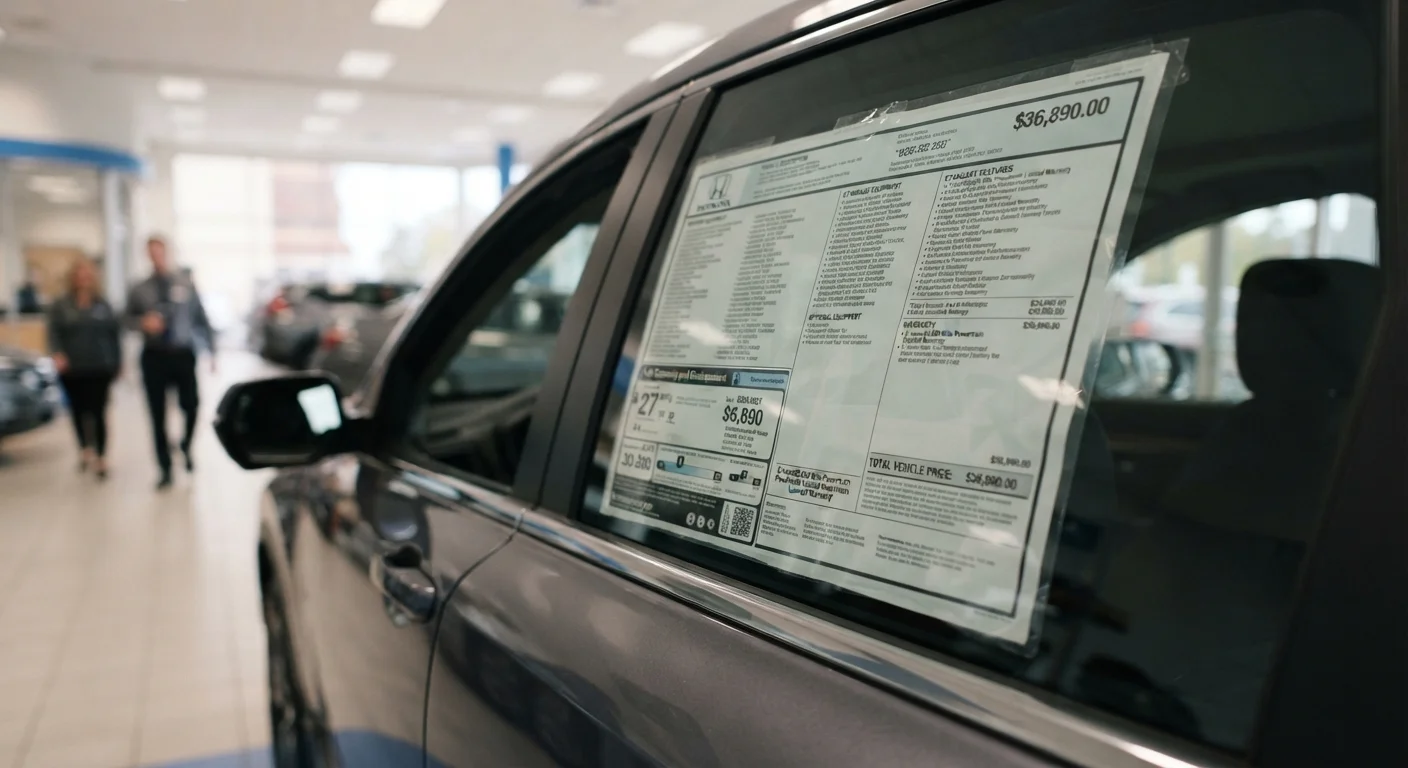
The Monroney label - the federally required window sticker on every new vehicle - was designed primarily to disclose pricing, fuel economy, and standard equipment. It does that job well. What it was never required to do is give you a complete mechanical portrait of the vehicle you're about to buy.
For everyday commuter cars, the gap between what the sticker shows and what you need to know is narrow. But for trucks, SUVs, vans, and vehicles intended for towing, hauling, or off-road use, that gap can be significant. Shoppers who rely solely on the sticker - and the persuasive trim names printed on it - sometimes end up with a vehicle that doesn't match their actual needs. See our guide to reading every section of the Monroney label for a closer look at what the sticker does cover.
Assuming the trim name reflects the vehicle's drivetrain or off-road capability.
Why it happens: Names like "Trail Edition," "Adventure," or "Sport" are primarily marketing designations. Shoppers reasonably assume they describe hardware, but they often describe appearance packages or minor equipment upgrades.
Confusing the model-line tow rating with the actual rating for the configured vehicle.
Why it happens: Manufacturers advertise the maximum tow rating achievable within a model line, which often requires a specific engine, axle ratio, and tow package. Shoppers assume that number applies to any version of that truck or SUV.
Treating 'SUV' and 'crossover' as interchangeable categories with equivalent capability.
Why it happens: The automotive industry uses both terms loosely, and the window sticker doesn't distinguish between a body-on-frame SUV and a car-platform crossover. Both may be labeled identically on the sticker.
Overlooking payload rating in favor of tow rating when purchasing a truck.
Why it happens: Tow ratings get prominent marketing attention. Payload - the weight the truck can safely carry in its bed and cab - is rarely featured on the sticker despite being equally important for practical use.
Ignoring vehicle class designations that affect insurance, licensing, and registration.
Why it happens: Shoppers focus on the driving experience, not regulatory categories. But a vehicle that crosses into a higher GVWR class may require different registration, affect insurance rates, or trigger commercial licensing rules in some states.
How to Fill in the Gaps Before You Commit
The good news is that the information missing from the sticker is almost always available - it's just in other places. The vehicle's official spec sheet (usually on the manufacturer's website), the owner's manual, and third-party vehicle data aggregators can all fill in what the label omits.
50+
Data fields omitted from the standard Monroney label
Federal regulations require disclosure of price, fuel economy, and emissions - but dozens of mechanical specifications, including tow ratings and GVWR, have no required placement on the sticker.
Up to 40%
Variation in tow rating across a single truck model line
Tow capacity can vary dramatically within one model depending on engine, axle ratio, and factory-installed tow package - specs that the window sticker rarely breaks out by configuration.
For towing and payload, look specifically for the Gross Vehicle Weight Rating (GVWR), Gross Combined Weight Rating (GCWR), and the manufacturer's published tow rating for the exact configuration you're considering - not just the headline number advertised for the model line. These figures vary by cab style, bed length, engine, and axle ratio. If you're exploring work trucks or heavy-duty applications, understanding how core vehicle categories are defined mechanically is a useful starting point.
For off-road capability, the sticker's silence is especially misleading. Marketing terms like "Trail Rated" or "off-road package" describe optional equipment, not the vehicle's fundamental drivetrain architecture. The difference between true four-wheel drive with a low-range transfer case and a part-time all-wheel-drive system is consequential - and the sticker rarely makes that distinction clear. Our article on what off-road marketing language actually means breaks this down in detail.
Don't Trust Headline Capability Numbers at Face Value
Maximum tow ratings, payload figures, and off-road designations are almost always published at the model-line level, not the unit level. A truck advertised with a 13,000-lb tow rating may only achieve that with a specific engine and axle combination you haven't ordered. Always verify specs against the actual VIN or door-jamb sticker before making purchasing or hauling decisions.
Finally, consider the full ownership picture. Class and capability aren't just about what a vehicle can do - they shape what it costs to maintain, insure, and fuel. Before finalizing any purchase, review the true cost of owning a vehicle beyond the sticker price to ensure the numbers make sense for your situation.