

Key Takeaways
What a Standard Oil Change Actually Includes
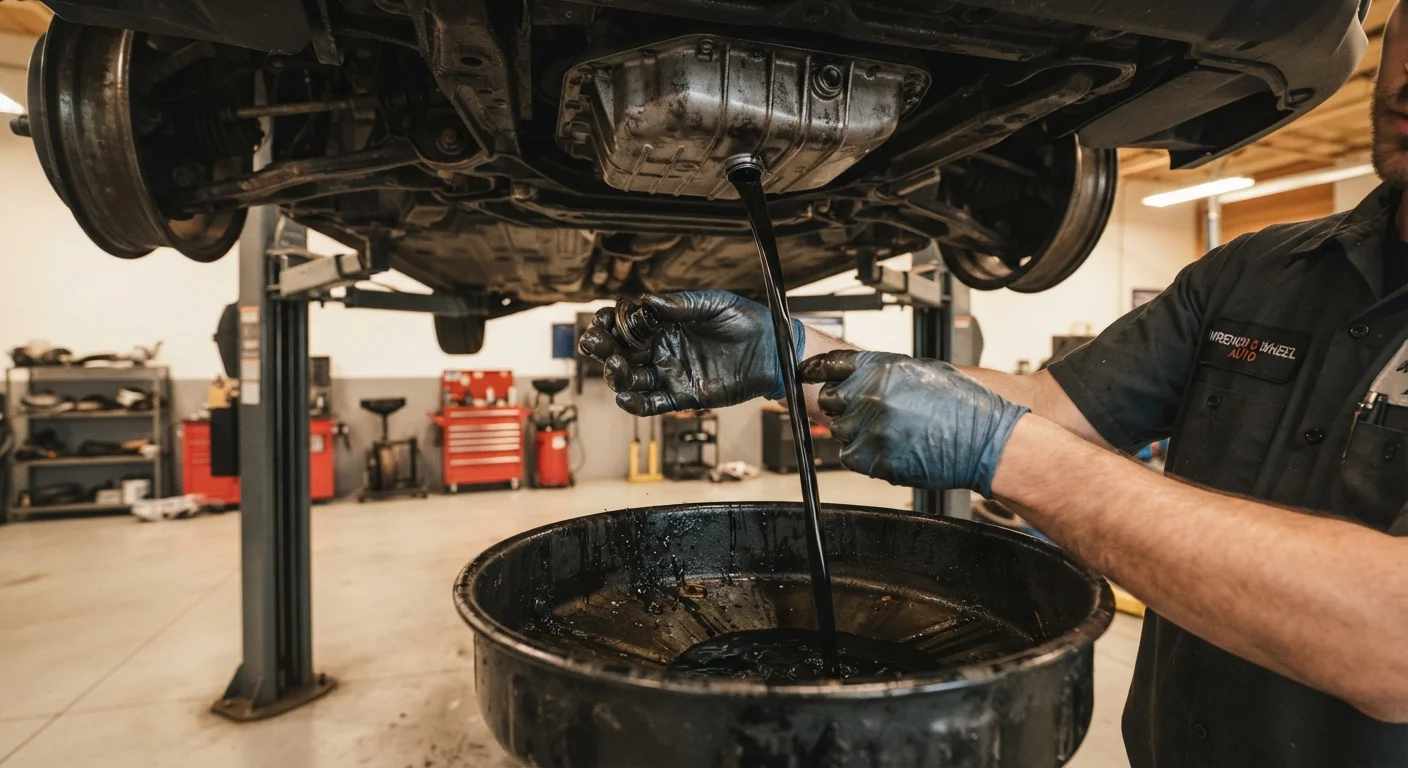
A routine oil change has three core steps, regardless of whether it's performed at a dealership, quick-lube shop, or independent garage: draining the used motor oil, replacing the oil filter, and refilling the engine with fresh oil that meets your vehicle's specification.
Beyond those three steps, a technician typically checks the oil drain plug and gasket for condition, torques the plug to specification, and resets the oil life monitor if your vehicle has one. That's the job. Everything else - however routine it may seem on a service menu - is an addition to that core scope.
The filter replacement is non-negotiable. A clogged or bypassed filter allows unfiltered oil to circulate through precision engine components, accelerating wear. Some quick-lube operations advertise extremely low prices but use a lower-grade filter; it's reasonable to ask what brand and grade of filter is being installed.
Keep a Simple Maintenance Log
Record the date, mileage, oil type used, and filter brand at every oil change. A simple notes app or glove-box card works fine. This record is useful for warranty purposes, resale documentation, and spotting intervals that are approaching.
The Multi-Point Inspection: Useful Check or Upsell Gateway?
Most service facilities perform a multi-point inspection (MPI) alongside an oil change. A technician walks through a checklist covering tire tread depth and pressure, brake pad thickness, belt and hose condition, fluid levels, lights, wiper blades, and air filters. The results are typically color-coded: green (acceptable), yellow (monitor or due soon), or red (requires attention).
The MPI itself is a genuine service - having a trained eye on your vehicle's overall condition is valuable, and many serious issues are caught this way. The complication arises in how findings are communicated. A yellow flag on cabin air filter condition does not mean you need a new filter today. It means the item is worth monitoring or scheduling when the interval calls for it.
Request the inspection report in writing before approving any additional work - this gives you time to verify recommendations against your owner's manual rather than deciding at the counter.
Verbal summaries can compress nuance; a written checklist with condition ratings lets you make side-by-side comparisons and spot patterns across multiple service visits.
Before your appointment, note your current mileage and cross-reference it against your owner's manual maintenance schedule - you'll arrive knowing exactly what is actually due.
Service advisors work from general mileage triggers; your owner's manual reflects the specific engineering requirements for your vehicle's components and fluids.
Ask for the printed or digital inspection report rather than a verbal summary. A written record lets you compare findings across visits, track deterioration rates, and make informed decisions without time pressure.
Services Commonly Bundled - and Whether They Belong There
Service facilities frequently present additional items at the point of oil change. Some are genuinely timely; others are recommended on schedules far more aggressive than manufacturers specify. Here's how the most common add-ons break down:
- Air filter replacement: Engine air filters typically need replacement every 15,000-30,000 miles, depending on driving conditions. This is easy to inspect visually and straightforward to decline or approve based on actual condition.
- Cabin air filter replacement: A separate filter from the engine air filter. Intervals vary - check your owner's manual. Dusty environments shorten the life; highway driving extends it.
- Tire rotation: Legitimately recommended at most oil change intervals (commonly every 5,000-7,500 miles). See our guide to tire rotation, balancing, and alignment for a full breakdown of what each service does.
- Fuel system cleaning: Rarely required at oil change frequency. Most modern gasoline already contains detergent additives. Manufacturer-specified intervals, where they exist, are typically much longer.
- Transmission fluid flush: A legitimate service, but interval varies widely by vehicle - some manufacturers specify 30,000 miles, others 100,000, and some sealed transmissions are designated as lifetime fill. Verify against your owner's manual before approving.
- Coolant flush: A real maintenance item, but typically scheduled every two to five years depending on coolant type, not at every oil change.
~$25-$75
Typical cost range for a standard oil change
Cost varies by oil type (conventional vs. synthetic), filter quality, and geographic market; synthetic oil changes typically sit at the higher end of that range.
5,000-7,500 mi
Common manufacturer interval for modern vehicles
Many newer vehicles using full synthetic oil can safely extend to this range; older models or severe-duty use may call for more frequent changes - always confirm with your owner's manual.
3
Core steps in every standard oil change
Drain used oil, replace the oil filter, and refill with fresh oil to the correct specification - all other services are additions to this core scope.
How to Evaluate Any Recommended Add-On
When a service advisor recommends an additional service, you have a simple three-question framework available to you:
- What does my owner's manual say? The manufacturer's maintenance schedule - not the shop's recommendation - is the baseline. Review our guide to maintenance intervals for a reference across common services.
- What is the current condition? For fluid-based services, ask to see the dipstick or a sample. For filters, ask to see the old one. Condition evidence is more credible than mileage estimates alone.
- What is the consequence of waiting? Some items deteriorate gradually; others create safety risk if ignored. Understanding the severity helps you prioritize without feeling pressured.
Your Owner's Manual Overrides Shop Recommendations
Manufacturer maintenance schedules are developed through engineering testing specific to your vehicle. A service facility's recommendations may be well-intentioned but are not calibrated to your car's design. When the two conflict, the owner's manual takes precedence. If you don't have a physical copy, most manufacturers make digital versions available through their websites.
For decisions about where to have work performed, our comparison of dealer service centers and independent mechanics covers how warranty status, vehicle age, and repair complexity affect which option makes sense.
Choosing the Right Oil for Your Engine
The oil specification - viscosity grade and whether synthetic or conventional is required - is set by the manufacturer, not the service facility. It is printed in your owner's manual and often on a sticker under the hood. Using the wrong viscosity or a lower grade than specified is not a neutral choice; it can affect warranty coverage and, over time, engine longevity.
Full synthetic oil generally costs more than conventional but offers improved performance at temperature extremes and longer drain intervals. Some engines require it; others perform adequately on conventional. The decision isn't about marketing claims - it's about what your vehicle's manufacturer specifies. Our explanation of synthetic vs. conventional oil covers this in detail, including what your owner's manual is actually telling you.
What Happens If You Delay an Oil Change
Motor oil degrades through use. Heat cycles break down the base oil and additives; combustion byproducts contaminate it; metal particles from normal engine wear accumulate. As oil deteriorates, its ability to form a protective film between moving parts decreases - metal-to-metal contact increases, wear accelerates, and heat management suffers.
Extended neglect leads to sludge - a thick, tar-like deposit that restricts oil flow through passages and can starve critical components of lubrication. Sludge damage is expensive and often irreversible without significant engine work. The hidden costs of deferred maintenance extend well beyond the oil change itself.
Don't Confuse Declining Add-Ons With Skipping Maintenance
Saying no to a fuel system cleaner you don't need is smart. Leaving the shop without an oil change because the price seemed high is a different decision with real consequences. Always complete the core oil and filter service on schedule, even if you defer or decline every other item on the menu.
Following the manufacturer's recommended interval - whether that's 3,000, 5,000, 7,500, or 10,000 miles depending on your vehicle and oil type - is one of the most cost-effective things an owner can do. The oil change itself is inexpensive relative to the engine damage that can result from neglect.