

Key Takeaways
Our Verdict
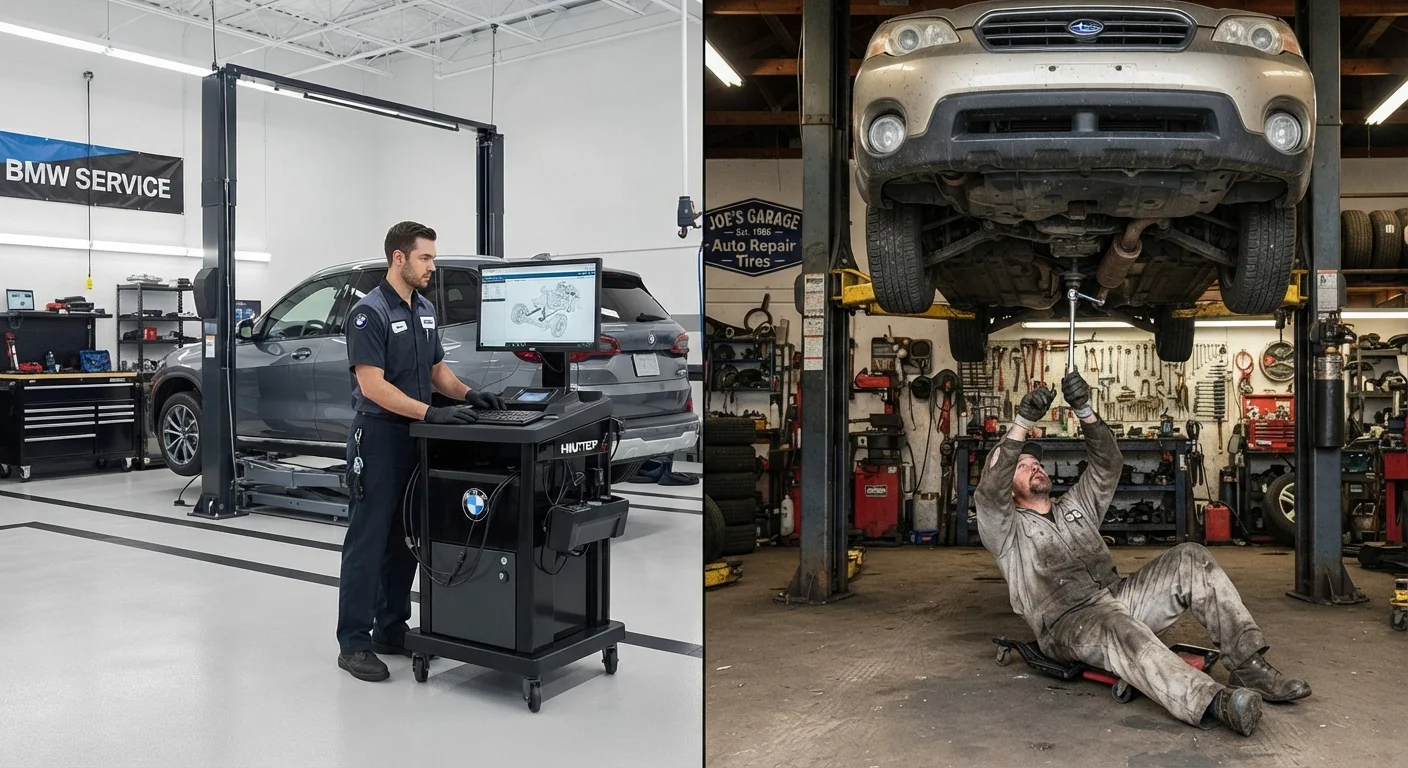
Neither dealer service centers nor independent mechanics hold a universal advantage - the right choice shifts based on your vehicle's warranty status, age, and the nature of the repair. Dealers bring brand-specific expertise and OEM parts, while independent shops typically offer greater cost flexibility and personalized service for everyday maintenance and repairs.
| Best for | Recommended |
|---|---|
| Vehicles under an active manufacturer or powertrain warranty | Dealer Service Center |
| Routine maintenance on older, out-of-warranty vehicles | Independent Mechanic |
| Complex, model-specific diagnostic or software repairs | Dealer Service Center |
| Owners prioritizing cost control and flexible scheduling | Independent Mechanic |
Why the Choice Isn't One-Size-Fits-All
Most car owners face this question at some point: take the vehicle to the dealership's service department, or find a trusted independent shop? The honest answer is that both are legitimate options - and the better one depends heavily on your specific situation rather than a blanket rule.
Several factors should guide the decision: whether your vehicle is still under warranty, how old and complex it is, what kind of repair or service you need, and how much pricing transparency matters to you. Understanding how dealer service centers and independent mechanics differ on each of these dimensions puts you in control of the outcome.
For context on what the service shopping experience looks like at the broader vehicle level, see our guide on how buying from a dealer differs from buying from a private seller.
Warranty Coverage: The Clearest Decision Factor
If your vehicle is still covered by an active factory warranty, the dealer service center is often the most practical choice for warranty-related repairs - not because the law requires it, but because dealers are the ones authorized to perform warranty work at no cost to you.
That said, a common misconception is that using an independent shop for routine maintenance automatically voids your warranty. It does not. Under the Magnuson-Moss Warranty Act, manufacturers cannot void a warranty simply because you had maintenance performed at an independent facility, provided that the work meets the manufacturer's specifications and is documented properly. Keep receipts and service records whenever you use an independent shop during your warranty period.
Where dealers hold a clear edge is for repairs that involve warranty claims, technical service bulletins (TSBs), or software updates - all of which must go through the manufacturer's authorized network.
Keep Documentation Regardless of Where You Go
Whether you use a dealer or an independent shop, always request a detailed service receipt and keep it with your vehicle records. Documented maintenance history protects you under warranty claims, supports resale value, and gives future mechanics an accurate picture of what's been done.
Vehicle Age, Complexity, and Specialized Tools
Newer vehicles increasingly rely on proprietary software and model-specific diagnostic systems. Some advanced calibrations - such as recalibrating advanced driver-assistance systems (ADAS) after a windshield replacement or suspension work - require equipment that many independent shops may not have. For these jobs, a dealer with factory-level scan tools and trained technicians for your specific brand is often the more capable option.
Older vehicles generally present the opposite dynamic. An experienced independent mechanic who specializes in a vehicle's era or powertrain type may actually bring deeper hands-on knowledge than a dealership technician whose training is manufacturer-current. Parts availability also shifts: aftermarket and salvage parts for older vehicles are often easier and less expensive to source outside the dealer network, and independent shops can pass those savings along.
For guidance on how maintenance needs evolve over a vehicle's life, our vehicle maintenance interval reference covers common service milestones by mileage and time.
| Dealer Service Center | Independent Mechanic | |
|---|---|---|
| Warranty repairs | Authorized for factory warranty claims | Not authorized for manufacturer warranty work |
| Labor rates | Generally higher | Often lower |
| Parts used | OEM parts standard | OEM or quality aftermarket available |
| Diagnostic tools | Factory-level, model-specific | Varies by shop; may lack proprietary tools |
| Best for vehicle age | Newer, under-warranty vehicles | Older, out-of-warranty vehicles |
| Personalization & flexibility | More standardized process | Often more flexible and relationship-based |
| Software/TSB updates | Handled in-house | May require dealer referral |
Cost, Transparency, and What to Expect on the Estimate
Dealer service centers typically charge higher labor rates than independent shops - this reflects overhead costs associated with operating a franchised facility, along with the use of OEM (original equipment manufacturer) parts, which carry a manufacturer guarantee but come at a premium. Independent mechanics often have access to quality aftermarket or OEM-equivalent parts at lower price points, and their labor rates frequently run lower as well.
Neither higher nor lower cost automatically signals better or worse service. What matters more is understanding what you're paying for. Before authorizing any repair at either type of shop, review the estimate line by line - labor hours, parts cost, and any shop fees should all be clearly itemized. Our guide on reading a repair estimate before you sign explains what each line means and what questions to ask.
Verbal Authorizations Can Cause Disputes
Authorizing additional work over the phone without a revised written estimate is a common source of billing surprises. Before a shop expands the scope of a repair beyond the original estimate, ask them to submit a revised written estimate for your approval. Most states legally require shops to obtain authorization before exceeding the original quoted amount.
Making the Most of Either Option
Whichever type of shop you choose, your ability to describe the problem accurately directly affects the quality of the diagnosis. Vague descriptions lead to guesswork and, sometimes, unnecessary repairs. Our guide to communicating clearly with a mechanic walks through how to describe symptoms precisely so technicians can work efficiently.
A few practical considerations apply regardless of where you take the vehicle:
- Ask whether the shop uses OEM or aftermarket parts, and what the parts warranty covers.
- Request a written estimate before any work begins - both dealer service departments and independent shops are required to provide one in most states.
- Keep a consistent service record regardless of where maintenance is performed; documentation protects you if a warranty question arises later.
- For CPO vehicles, review what the certified pre-owned warranty requires in terms of authorized service providers - see our overview of new, used, and CPO vehicle differences for more context.
This article is for general informational purposes only and does not constitute professional automotive or legal advice. Consult a qualified mechanic or legal professional for guidance specific to your situation.