

Key Takeaways
Check Engine Light (CEL)
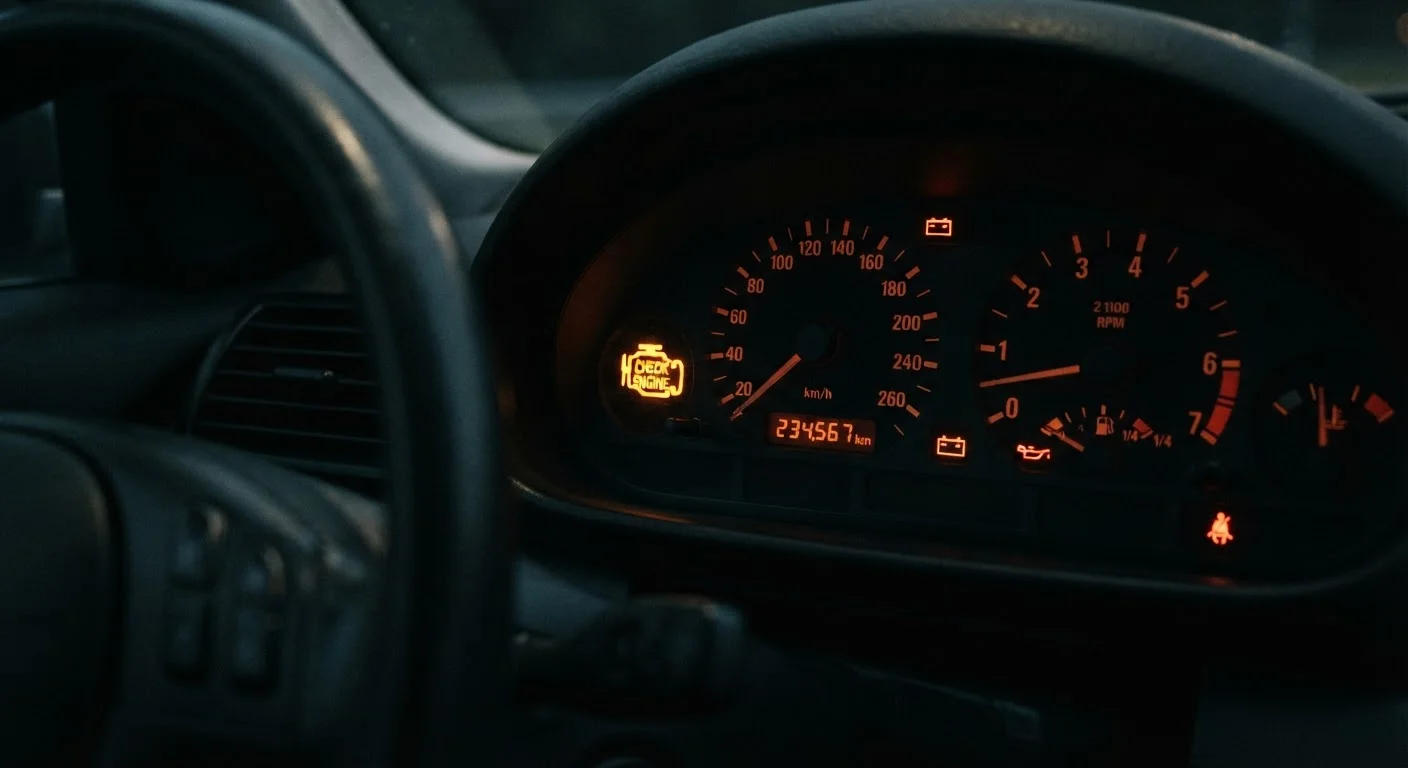
The check engine light - formally called the Malfunction Indicator Lamp (MIL) - is a dashboard warning that signals your vehicle's onboard diagnostic system has detected a fault in the engine, emissions, or related systems. It can be triggered by anything from a loose gas cap to a failing catalytic converter. The light itself does not tell you what is wrong; it simply alerts you that a diagnostic trouble code (DTC) has been stored in the vehicle's computer.
Modern vehicles use the OBD-II (On-Board Diagnostics II) standard, mandatory in the U.S. since 1996, which allows any compatible scanner to read the stored fault codes.
How the System Works
Every vehicle sold in the U.S. since 1996 runs a continuous self-diagnosis process through its OBD-II system. Dozens of sensors monitor parameters including fuel mixture, exhaust composition, ignition timing, and transmission behavior. When a reading falls outside acceptable limits - even briefly - the system logs a diagnostic trouble code (DTC) and illuminates the check engine light.
The light itself comes in two states that carry very different meanings:
- Solid light: A fault has been detected, but it is not causing immediate, severe damage. You have time to schedule a proper diagnosis, though you should not defer it indefinitely.
- Flashing light: An active, serious fault - most commonly an engine misfire that can rapidly damage the catalytic converter - is occurring right now. Reduce speed, minimize engine load, and have the vehicle inspected as soon as possible.
Understanding this distinction is the first and most practical thing any driver can take away from this topic.
Common Triggers You Should Know
The check engine light can be generated by more than 1,000 different fault codes, but a relatively small set of causes accounts for the majority of real-world incidents:
1,000+
Possible OBD-II diagnostic trouble codes
The SAE and ISO standard OBD-II protocol defines over 1,000 generic and manufacturer-specific fault codes that can trigger the check engine light.
Top 3
Most common check engine causes
Oxygen sensor faults, loose or damaged gas caps, and catalytic converter issues are consistently cited among the leading check engine light triggers in U.S. vehicle data.
1996
Year OBD-II became mandatory in the U.S.
The EPA required all passenger cars and light trucks sold in the United States to comply with the OBD-II standard beginning with model year 1996.
- Loose or faulty gas cap: The evaporative emission control system (EVAP) monitors fuel vapor. A cap that isn't fully tightened can trigger a code quickly and is the simplest fix to rule out first.
- Oxygen (O2) sensor failure: O2 sensors measure exhaust gas composition and help the engine management system optimize fuel delivery. A degraded sensor causes inefficient combustion and elevated emissions.
- Catalytic converter degradation: Usually a downstream effect of other neglected issues (such as a bad O2 sensor or persistent misfires), a failing converter triggers its own code and often causes a noticeable drop in fuel economy.
- Mass airflow (MAF) sensor fault: The MAF sensor measures incoming air volume. Contamination or failure produces rough running and poor acceleration.
- Ignition system problems: Worn spark plugs or failing ignition coils cause misfires - the scenario most likely to produce a flashing light.
Staying current on routine service can prevent several of these triggers. See our vehicle maintenance interval guide for typical service schedules based on manufacturer guidance.
Rule Out the Easy Fix First
Before scheduling a diagnostic appointment, check your gas cap. Remove it completely, inspect the rubber seal for cracks or debris, reinstall it firmly until it clicks, and drive normally for a day or two. If a loose cap was the culprit, the light will clear on its own. This takes two minutes and costs nothing.
When to Pull Over Immediately
The check engine light does not operate in isolation. Pay close attention to other gauges and warning indicators at the same time. If the check engine light appears alongside any of the following, treat it as an emergency:
- Temperature gauge climbing toward the red zone (possible overheating - see our guide on diagnosing an overheating engine before it causes serious damage)
- Oil pressure warning light
- Significant loss of power or a rough, stumbling idle
- Unusual smells, especially burning or fuel odor
In these situations, the check engine light is a corroborating signal that something serious is underway. Continuing to drive risks compounding the damage substantially.
Check Engine vs. Other Warning Lights
The check engine light is specifically tied to the OBD-II emissions and engine management system. It is separate from the oil pressure light, battery warning, or temperature gauge - each of which monitors its own system. A check engine light alone does not mean oil pressure is low or that the engine is overheating; always look at the full dashboard picture before deciding on urgency.
Getting the Code Read and Taking Next Steps
Once the light is on and you have ruled out an emergency, your next step is retrieving the stored code. Many auto parts retailers offer complimentary OBD-II scans. The code alone is a starting point, not a complete diagnosis - a code like P0300 (random misfire detected) tells you a category of problem, not the exact faulty part.
When you bring your vehicle to a mechanic, the code read gives you a meaningful basis for conversation. Our article on communicating clearly with a mechanic covers how to convey symptoms accurately so you get reliable repairs without unnecessary guesswork.
“A check engine light is your car trying to communicate. The worst thing a driver can do is put tape over it. Read the code - it's the beginning of the conversation, not the end.”
— Automotive Diagnostics Industry Guidance, General principle reflected across ASE-certified technician training materials
Document any symptoms you noticed before or after the light came on - unusual sounds, changes in fuel economy, or hesitation under acceleration. This context helps a technician narrow down the diagnosis efficiently and accurately.