

Key Takeaways
Option A
The 50/30/20 Rule
The flexible, percentage-based framework for modern budgeters.
Best for: People who want a simple structure without tracking every dollar.
Option B
Envelope Budgeting
The hands-on, cash-first system for disciplined spenders.
Best for: People who overspend in specific categories and need a hard stop.
If you want a low-maintenance budget with broad guardrails
The 50/30/20 Rule
The percentage framework requires minimal upkeep and still keeps your savings and essentials covered without micromanaging every purchase.
If you consistently overspend on dining, entertainment, or shopping
Envelope Budgeting
A hard cash limit per category physically prevents overspending in your problem areas, making it the stronger corrective tool.
If your income is irregular or varies month to month
Envelope Budgeting
Allocating what you actually have each period - rather than fixed percentages of a fluctuating base - keeps your plan grounded in reality.
If you are new to budgeting and want to start simply
The 50/30/20 Rule
Three broad buckets are easier to set up and maintain than managing a dozen separate envelopes, lowering the barrier to starting.
If you want to build stronger day-to-day spending awareness
Envelope Budgeting
Physically handling or allocating cash to specific categories creates a direct, tangible connection between spending decisions and remaining funds.
How Each System Works
If you are building your first budget or rethinking an existing one, start with a clear understanding of both approaches. For a broader foundation, see our introduction to personal budgeting.
The 50/30/20 Rule
Popularized by Senator Elizabeth Warren and her daughter Amelia Warren Tyagi in their 2005 book, the 50/30/20 rule divides your monthly after-tax income into three buckets:
- 50% for needs: rent or mortgage, utilities, groceries, insurance, minimum debt payments.
- 30% for wants: dining out, streaming subscriptions, travel, hobbies.
- 20% for savings and debt repayment: emergency fund contributions, retirement accounts, paying down credit card balances beyond the minimum.
You do not track individual purchases - only whether each broad category stays within its percentage. That simplicity is the rule's greatest strength.
Envelope Budgeting
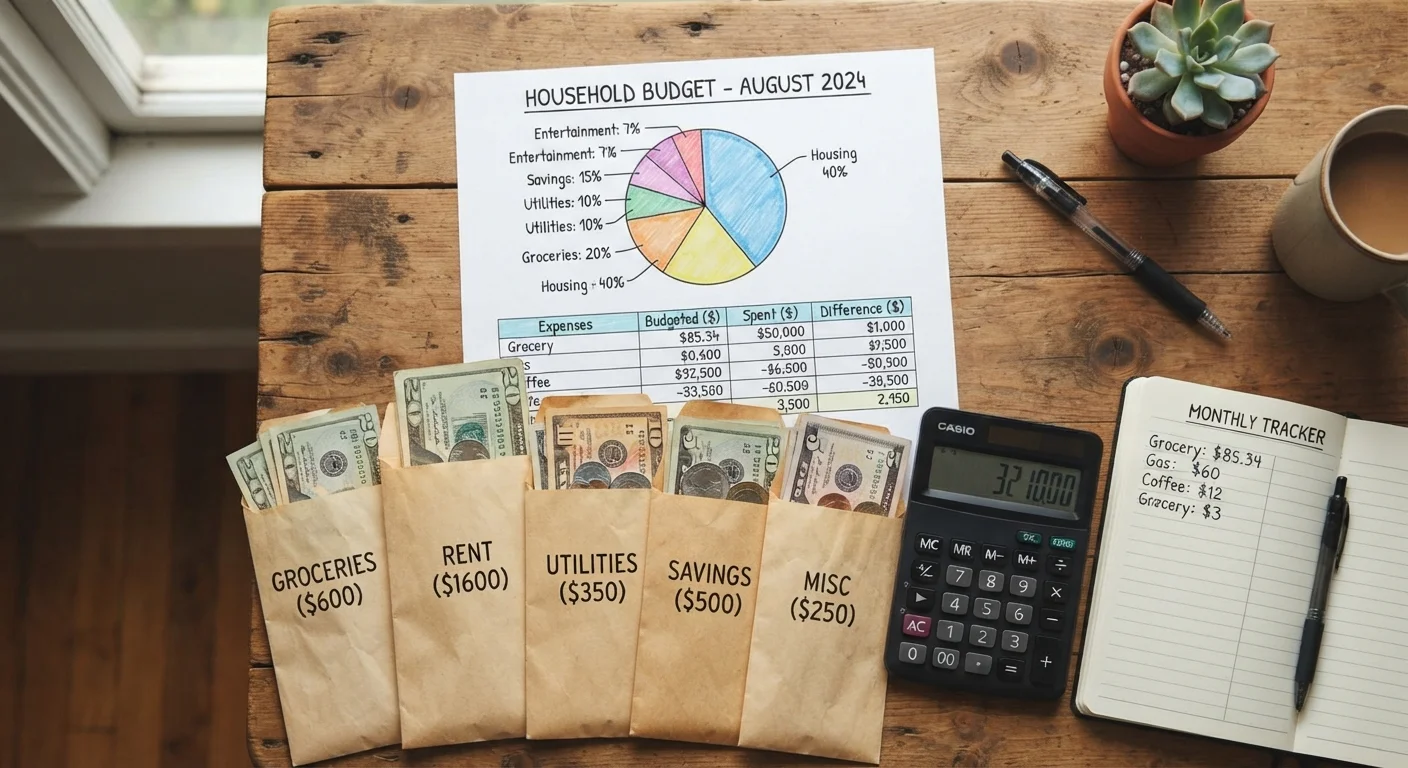
Envelope budgeting, long associated with personal finance educator Dave Ramsey, works by pre-allocating cash into labeled envelopes - one per spending category - at the start of each pay period. When an envelope runs out, spending in that category stops until the next period. No balance, no borrowing from other envelopes.
Digital versions of the system replicate this mechanic using apps or spreadsheets with virtual envelopes, making it practical for households that rarely use physical cash.
| Criterion | 50/30/20 Rule | Envelope Budgeting |
|---|---|---|
| Structure | 3 broad percentage buckets | Multiple specific spending categories |
| Tracking effort | Low - monthly statement review | High - ongoing per-category tracking |
| Flexibility | High within each bucket | Low - hard stop per envelope |
| Best income type | Stable, predictable income | Variable or irregular income |
| Physical cash required | No | Optional (digital versions exist) |
| Learning curve | Low | Moderate |
| Overspending prevention | Moderate - broad guardrails only | Strong - category-level hard limits |
Key Differences That Shape Your Experience
The structural gap between these two methods affects how you feel day-to-day, not just how they look on paper.
Flexibility vs. Constraint
The 50/30/20 rule allows you to shift freely within your wants bucket - spending more on a concert this month and less on restaurants is fine, as long as the 30% total holds. Envelope budgeting does the opposite: each category has its own hard ceiling. That rigidity can feel frustrating but is precisely what prevents category-level overspending.
Level of Detail Required
With the 50/30/20 rule, you need a rough tally of needs, wants, and savings - not a line-by-line ledger. Envelope budgeting demands that you decide in advance how much you will spend on groceries, gas, clothing, and entertainment as separate categories. That upfront thinking takes more time but also reveals spending patterns you may not have noticed. First-time budgeters often underestimate irregular expenses - envelope budgeting forces you to confront them early.
Tracking Method
The 50/30/20 rule pairs naturally with a monthly bank statement review or a simple spreadsheet. Envelope budgeting, whether analog or digital, typically requires more frequent check-ins - weekly at minimum - to know what each envelope still holds. If you are weighing analog versus digital tools for either system, our comparison of pen-and-paper budgeting vs. budgeting apps walks through the real trade-offs.
~74%
Americans living paycheck to paycheck at some point
A 2023 LendingClub report found approximately 74% of U.S. consumers reported living paycheck to paycheck at some point, underscoring the stakes of choosing a workable budgeting system.
1 in 3
U.S. adults with no written budget
Gallup polling has consistently found roughly one-third of American adults do not maintain any formal household budget, leaving spending largely untracked.
Choosing the Right Fit - and Making It Stick
No budget succeeds on design alone - consistency matters more than the method. A few practical considerations:
- Test before committing. Run the 50/30/20 rule for one month by reviewing last month's statements. Run a simplified envelope setup for the following month with five to seven key categories. Compare how each felt.
- Watch for category bleed. The 50/30/20 rule's broad buckets make it easy to rationalize wants as needs. Be honest when classifying expenses - a streaming service is a want, even if it feels essential.
- Adjust the percentages for your situation. If you live in a high cost-of-living area, 50% for needs may not be realistic. The 50/30/20 proportions are a starting point, not a rule of nature. Envelope budgeting can be similarly customized - your grocery envelope does not have to match anyone else's.
Whichever approach you choose, a regular monthly review keeps it honest. Our monthly budget review checklist gives you a structured way to catch overspending and realign categories before small slippage becomes a bigger problem. And if you find strict category limits creating more stress than clarity, it is worth reading about the honest trade-offs of rigid budget categories before deciding how tightly to structure your plan.
Hybrid Approaches Are Legitimate
Some households use the 50/30/20 framework to set top-level targets, then apply envelope-style sub-categories within the wants bucket only - combining simplicity at the macro level with discipline in high-risk spending zones. There is no rule against adapting either system to reflect your actual life. The money mindset hub has additional resources on building financial habits that last.
This article is for general informational and educational purposes only and does not constitute personalized financial advice. Consider speaking with a qualified financial professional about budgeting strategies suited to your specific circumstances.