

Key Takeaways
Option A
High-Yield Savings Account (HYSA)
The higher-rate, often online-based savings option.
Best for: Savers who want meaningfully more interest on their emergency fund or short-term savings without taking on investment risk.
Option B
Traditional Savings Account
The familiar, branch-based account most Americans open first.
Best for: Savers who prioritize convenience, in-person banking access, or are just beginning to build a savings habit.
If you want to maximize interest on your emergency fund
High-Yield Savings Account (HYSA)
HYSAs typically offer rates many times higher than traditional accounts, meaning your idle cash works harder without added risk.
If you value in-person service and branch access
Traditional Savings Account
Traditional bank branches offer face-to-face support and the ability to handle transactions and questions in person.
If you're comfortable banking entirely online
High-Yield Savings Account (HYSA)
Online banks offering HYSAs have robust mobile apps and customer service tools that make branch access largely unnecessary for everyday saving.
If you're just starting to save and want simplicity
Traditional Savings Account
Opening a savings account at your existing bank is fast and familiar, helping you build the habit before optimizing for rate.
If you're balancing savings with paying down debt
High-Yield Savings Account (HYSA)
Every extra dollar of interest earned reduces the net cost of carrying debt - a HYSA squeezes more value from the savings portion of your budget.
The Core Difference: Interest Rates
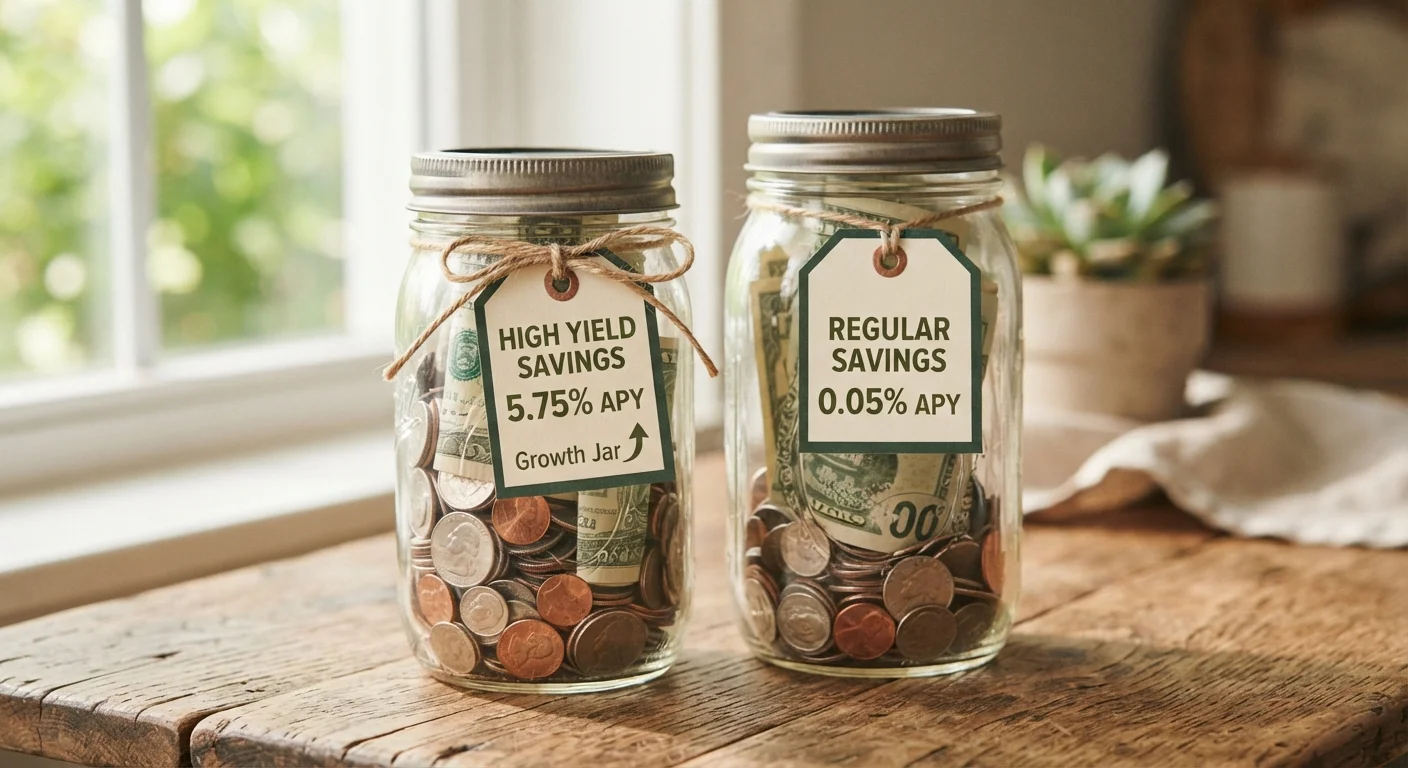
The most significant gap between these two account types is the annual percentage yield (APY) - the rate at which your balance earns interest over a year, including compounding.
Traditional savings accounts at large brick-and-mortar banks have historically offered very low APYs, often a fraction of a percent. High-yield savings accounts, by contrast, can pay APYs that are substantially higher - sometimes ten to twenty times the national average for traditional accounts, depending on the rate environment.
This gap exists largely because online banks, which dominate the HYSA market, operate without the overhead costs of maintaining physical branch networks. Those savings get passed along to depositors in the form of better rates.
It's important to note that rates on both account types are variable - they move with broader interest rate conditions set by the Federal Reserve and can change without notice. A high rate today is not a guarantee of the same rate in six months. For more on how compounding affects your savings over time, see what compound interest does to your savings.
| Criterion | High-Yield Savings Account | Traditional Savings Account |
|---|---|---|
| Typical APY | Significantly above national average | Often near or below national average |
| Where offered | Primarily online banks and fintechs | Brick-and-mortar and regional banks |
| FDIC / NCUA insured | Yes, up to $250,000 | Yes, up to $250,000 |
| Branch access | Usually none | Yes, in-person service available |
| Transfer speed to checking | 1-3 business days (external transfer) | Immediate (same-bank transfer) |
| Minimum balance requirements | Often low or none | Varies; some require minimums |
| Rate stability | Variable; changes with rate environment | Variable; generally slower to change |
Access, Safety, and Everyday Practicality
Both account types are typically FDIC-insured up to $250,000 per depositor, per institution - meaning your principal is protected even if the bank fails. Credit union equivalents are covered by the NCUA up to the same limit. Safety is not a meaningful differentiator here; what matters more is where you bank and how you access your money.
$250,000
FDIC insurance limit per depositor, per bank
The FDIC insures deposits at member banks up to this limit per ownership category, covering both traditional and high-yield savings accounts.
~0.46%
National average APY for traditional savings accounts
The FDIC publishes a national deposit rate average for savings accounts; as of mid-2024, the national average sat well below rates available at many online banks offering HYSAs.
Traditional savings accounts generally sit alongside a checking account at the same bank, making internal transfers immediate and frictionless. High-yield accounts at online banks often require a transfer to an external checking account, which can take one to three business days - a minor but real consideration if you need fast access to funds.
Online HYSAs typically offer robust mobile apps, digital customer service, and ATM reimbursements where applicable. However, if you prefer speaking with someone in person or need to deposit cash regularly, a traditional bank may be more practical.
If you're building a savings habit on a tight budget, the friction of a separate online account can actually work in your favor - it makes it slightly harder to dip into savings on impulse.
This article provides general financial information for educational purposes only and is not personalized financial advice. Consult a qualified financial professional for guidance specific to your situation.
Which Account Fits Your Goals?
The right account depends on what you're saving for and how you prefer to manage your money. For an emergency fund or short-term savings goal, a HYSA is generally a straightforward way to earn more on money that's already sitting idle. For someone who is just starting out, or whose primary concern is keeping things simple, a traditional savings account at an existing bank removes barriers to getting started.
If you're simultaneously trying to save while paying down debt, every additional dollar of interest your savings earns slightly offsets the cost of carrying that debt. In that context, a higher-rate account has a measurable, if modest, advantage.
You can also hold both: a traditional account for day-to-day liquidity and a HYSA for a dedicated emergency fund or savings goal. Many people find that separating pools of money by purpose - and by institution - helps them avoid spending what they intended to save. Whatever you choose, the habit of saving consistently matters more than the account type. See our budgeting basics hub for practical frameworks to support that habit.
Rate Shopping Is Worth the Effort
APYs on high-yield savings accounts vary meaningfully from one institution to another, and rates change over time. It's worth comparing current rates periodically rather than assuming the account you opened is still among the more competitive options. Checking your account's rate annually takes only a few minutes and can have a real impact on how much your savings earn over months and years.