

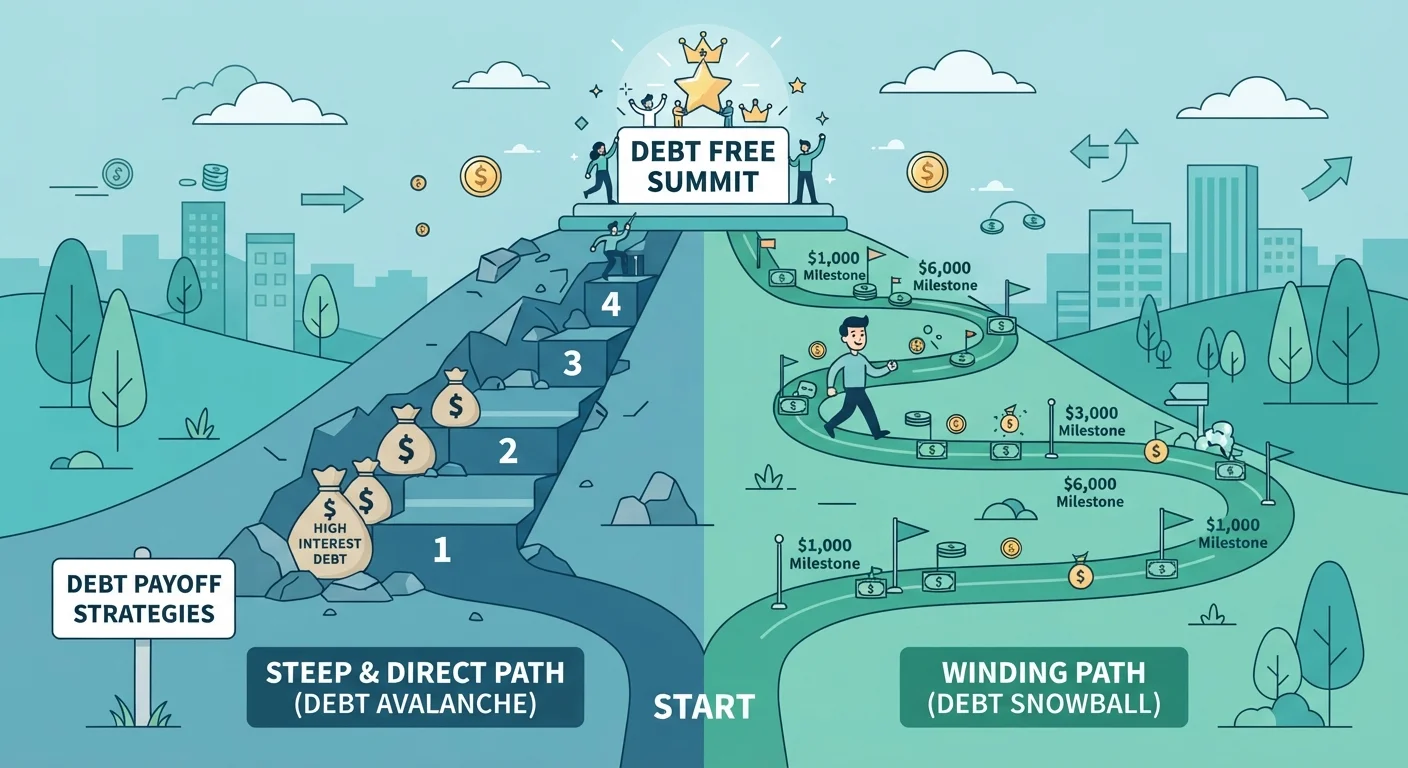
Key Takeaways
Option A
Debt Avalanche
The mathematically optimal approach to eliminating debt.
Best for: Disciplined savers who want to minimize total interest paid over time.
Option B
Debt Snowball
The motivation-driven method built on early wins.
Best for: Anyone who needs visible progress and quick victories to stay on track.
If you're motivated by numbers and want to pay the least interest possible
Debt Avalanche
Targeting high-rate debt first directly reduces the total cost of your debt. If you can stay patient through slower early progress, the avalanche saves the most money.
If you've tried debt payoff before and lost momentum
Debt Snowball
Knocking out small balances quickly builds confidence and keeps the plan alive. Consistency beats theoretical optimality if the alternative is abandoning the strategy.
If your highest-interest debt also happens to be your smallest balance
Debt Avalanche
In this case both methods point to the same debt first, so you get the psychological win and the mathematical benefit simultaneously.
If you're managing many small accounts across multiple creditors
Debt Snowball
Eliminating individual accounts reduces complexity and the mental load of tracking multiple minimum payments, which can make budgeting easier.
How Each Strategy Actually Works
Both methods share the same mechanical foundation: you make minimum payments on all debts, then direct any remaining available money toward one target debt at a time. When that debt is gone, you roll its payment into the next target. The difference is entirely in how you choose the order.
With the Debt Avalanche, you rank your debts by interest rate, highest to lowest. Your extra dollars go to the highest-rate balance first. Once it's paid off, you redirect that freed-up payment to the next highest rate, and so on. Because high-rate debt compounds the fastest, eliminating it early shrinks the total interest that accumulates across your entire debt load.
With the Debt Snowball, popularized by financial educator Dave Ramsey, you rank debts by balance, smallest to largest - ignoring interest rates. You attack the smallest balance first. When it's gone, you roll that payment into the next smallest. The idea is that clearing accounts quickly creates momentum and a sense of progress that keeps people engaged with the process.
Before choosing either approach, it helps to have a complete picture of what you owe. See a rundown of common consumer debt types for a breakdown of how different debt categories work and vary in cost.
| Criterion | Debt Avalanche | Debt Snowball |
|---|---|---|
| Payoff order | Highest interest rate first | Smallest balance first |
| Total interest paid | Lower (mathematically optimal) | Potentially higher |
| Time to first paid-off debt | Slower (if high-rate debt is large) | Faster (targets small balances) |
| Motivational structure | Reward comes later; requires patience | Early wins boost momentum |
| Best suited for | Analytical, disciplined payoff style | Motivation-driven, habit-building style |
| Complexity | Requires tracking rates carefully | Simple balance ranking |
The Real Cost Difference - and Why Behavior Often Overrides Math
The avalanche method is mathematically superior, full stop. By neutralizing your most expensive debt first, you reduce the interest accruing on your overall balance more quickly. Depending on the size and rates of your debts, the savings can be meaningful - potentially hundreds to thousands of dollars in interest over the life of a repayment plan.
The snowball, by contrast, may cost more in total interest because low-balance accounts aren't necessarily low-rate accounts. You might be leaving a high-rate debt compounding while you clear a smaller, cheaper one.
~$1,000+
Potential interest savings with avalanche vs. snowball
Independent financial modeling studies suggest avalanche savers can avoid hundreds to over a thousand dollars in interest, depending on debt size, rates, and timeline.
33%
U.S. adults who carry credit card debt month to month
According to the Federal Reserve's Survey of Consumer Finances, roughly one-third of American households carry revolving credit card balances, making payoff strategy a widely relevant decision.
But the honest reality is that the best strategy is the one you follow through on. Research in behavioral finance consistently shows that people underestimate the role motivation plays in financial follow-through. If the avalanche method means staring at a large, barely-shrinking balance for 18 months before seeing your first win, many people quit - and an abandoned plan costs far more than a suboptimal one that's completed.
Your money mindset - how you relate to progress, setbacks, and delayed gratification - is a legitimate factor in choosing between these strategies, not just a soft consideration to set aside.
Putting Either Method Into Practice
Whichever method you choose, the setup steps are the same:
- List every debt - balance, minimum payment, and interest rate.
- Calculate your total minimum payments and confirm they fit your budget.
- Identify your extra monthly payment capacity - even $50 or $100 compounds into real progress.
- Rank debts by your chosen criterion (rate for avalanche, balance for snowball) and target the first one.
- Automate minimums on everything else to avoid missed payments.
Solid budgeting basics are the foundation that makes either approach workable. Without a clear picture of monthly cash flow, there's no reliable extra payment to direct anywhere.
It's also worth noting that both strategies can run alongside other financial goals. For a practical framework on balancing debt payoff with saving, see our guide on whether to pay off debt or save first. And if you're considering consolidating multiple debts before picking a payoff order, understand what debt consolidation actually changes - and what it doesn't before committing.
You're Not Locked Into One Method
Some people start with the snowball to clear a few small accounts, then switch to the avalanche once they feel confident. This hybrid approach isn't common in personal finance literature, but there's no rule against it. What matters is that you're making deliberate, consistent extra payments - the exact order is secondary to the habit itself.
This article is for general informational and educational purposes only and does not constitute personalized financial or legal advice. Consult a qualified financial professional for guidance tailored to your individual circumstances.