

Key Takeaways
Our Verdict
There is no single correct answer, but the interest rate spread between your debt and available savings rates gives you the clearest signal. High-interest debt demands priority; low-rate debt can be paid alongside saving. The framework below helps you apply these principles to your own numbers rather than guessing.
| Best for | Recommended |
|---|---|
| Those carrying high-interest credit card or personal loan debt | Prioritize debt payoff |
| Those with access to employer retirement matching | Capture the match first, then address debt |
| Those with low-rate debt and a stable income | Build savings alongside debt repayment |
| Those with no emergency buffer whatsoever | Build a starter emergency fund first |
Why This Decision Is Harder Than It Looks
When money is tight, putting every spare dollar toward debt feels disciplined. But arriving at an empty savings account when a car repair or medical bill hits often forces people back into the same debt they were escaping. On the other hand, parking cash in a savings account while carrying 24% APR credit card debt means your savings interest never keeps pace with what the debt is costing you.
The tension is real, and the right answer depends on your specific interest rates, job security, and access to credit - not a one-size-fits-all rule. What helps most is a repeatable framework rather than a gut feeling. See how your overall spending patterns and debt load stack up before you start shifting dollars around.
Start With Your Interest Rates in Writing
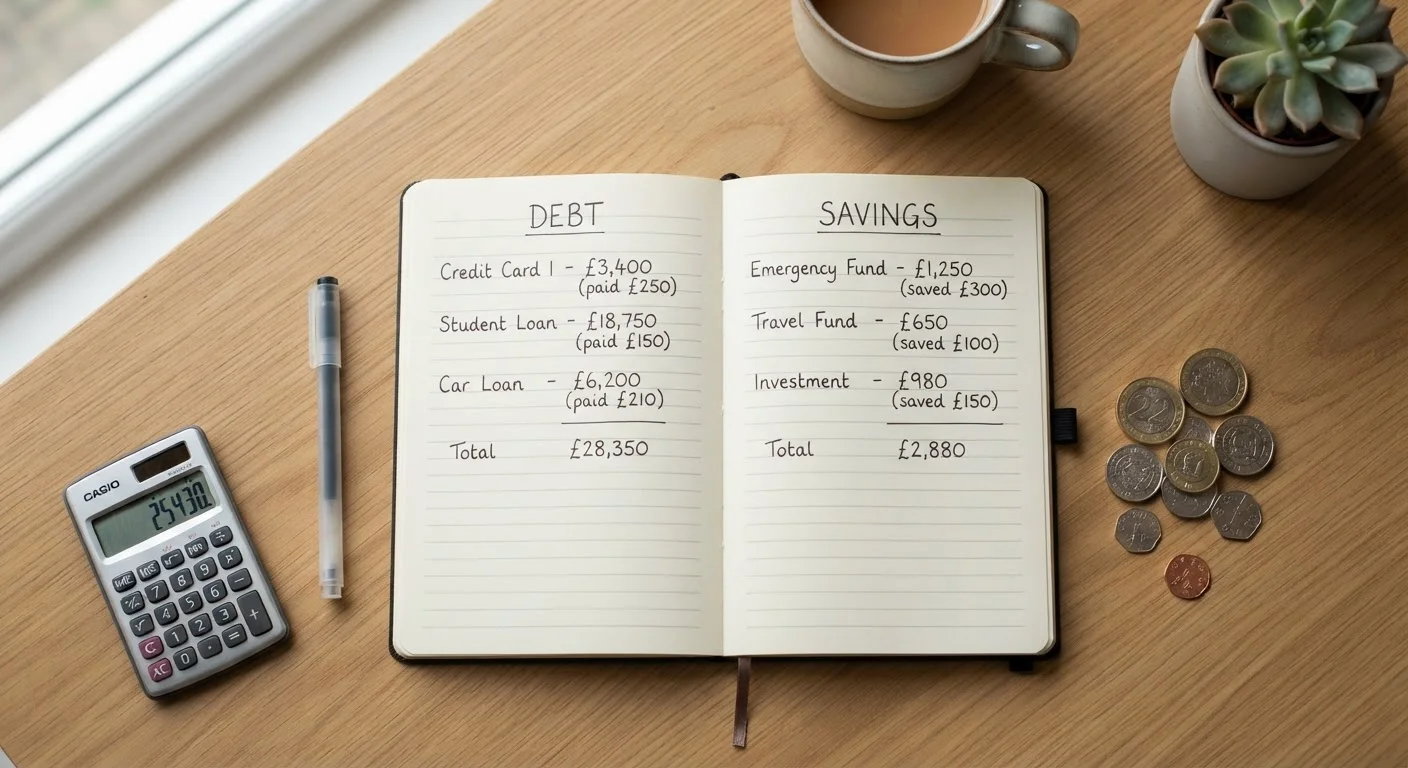
Pull your most recent statements and list every debt alongside its current APR. Then note the rate on any savings or investment account you have. The gap between these numbers - not a general rule - should drive your initial decision. Updating this list every six months keeps your strategy current as rates and balances change.
The Interest Rate Test: Your Core Decision Tool
The single most reliable way to compare debt payoff against saving is to compare interest rates. When the rate you pay on debt exceeds the rate you can reliably earn on savings, paying down debt produces a better mathematical outcome - effectively a guaranteed, risk-free return equal to the debt's interest rate.
A commonly used threshold sits around 6-7%. Debt costing more than that threshold - most credit cards, many personal loans - is generally worth prioritizing. Debt below that range, such as federal student loans at older fixed rates or a 30-year mortgage, may reasonably be carried while you build savings simultaneously.
| Factor | Prioritize Debt Payoff | Prioritize Saving | |
|---|---|---|---|
| Debt interest rate | Above ~6-7% APR | Below ~6-7% APR | |
| Emergency fund status | No cushion - build $500-$1K first | Starter fund already in place | |
| Employer retirement match | Capture match first, then pay debt | Contribute enough to get full match | |
| Job/income stability | Stable - accelerate debt payoff | Uncertain - grow cash reserves | |
| Guaranteed return | Equals debt interest rate - risk-free | Depends on account/market rate | |
| Psychological benefit | Reduces stress from growing balances | Provides security and flexibility |
To understand exactly how carrying a balance compounds against you over time, see our breakdown of how credit card interest actually accumulates.
Build a Starter Emergency Fund First - No Matter What
Financial planners broadly agree on one non-negotiable step: before accelerating debt payoff beyond minimums, accumulate a small cash cushion - commonly cited as $500 to $1,000 minimum. This isn't about building wealth; it's about preventing the debt spiral that occurs when an unplanned expense has nowhere to go but a credit card.
Once that starter buffer is in place, you can redirect energy toward the interest rate decision. If building even a small fund feels impossible right now, the article on saving consistently on a tight budget covers practical ways to find small amounts to set aside.
Don't Skip the Emergency Fund to Pay Off Debt Faster
Directing every spare dollar to debt without any savings cushion is a common and costly mistake. A single unexpected expense - car trouble, a medical co-pay, a home repair - can force new high-interest borrowing, erasing months of payoff progress. Even a modest cash buffer dramatically reduces this risk. If minimum payments feel like the only option right now, address that first before trying to accelerate payoff.
The Employer Match Exception
If your employer offers a 401(k) match and you are not capturing it, you are leaving compensation on the table. A 50% or 100% match represents an immediate, guaranteed return on your contribution - far exceeding even high-interest debt rates in the short term. Most financial educators suggest contributing at least enough to get the full match before directing extra money toward debt.
Beyond the match, additional retirement contributions become a judgment call based on your debt rate, tax situation, and timeline to retirement. This is a general framework; a licensed financial adviser can help you weigh your specific circumstances.
Doing Both: When a Split Strategy Makes Sense
Once you have a starter emergency fund and are capturing any employer match, a split approach often makes sense. Allocating a fixed portion of discretionary income to debt while simultaneously directing a smaller portion to savings builds both habits and resilience at the same time.
A simple starting structure: make minimum payments on all debts, then direct extra cash first toward your highest-rate debt. For a deeper look at how to order your payoff targets, see our comparison of the debt avalanche versus debt snowball methods. If you are ready to coordinate both goals simultaneously from the start, how to divide income between saving and debt payoff offers a practical starting point.
This article provides general financial education and is not personalised financial, investment, or tax advice. Consult a qualified financial professional for guidance tailored to your situation.