

Key Takeaways
Option A
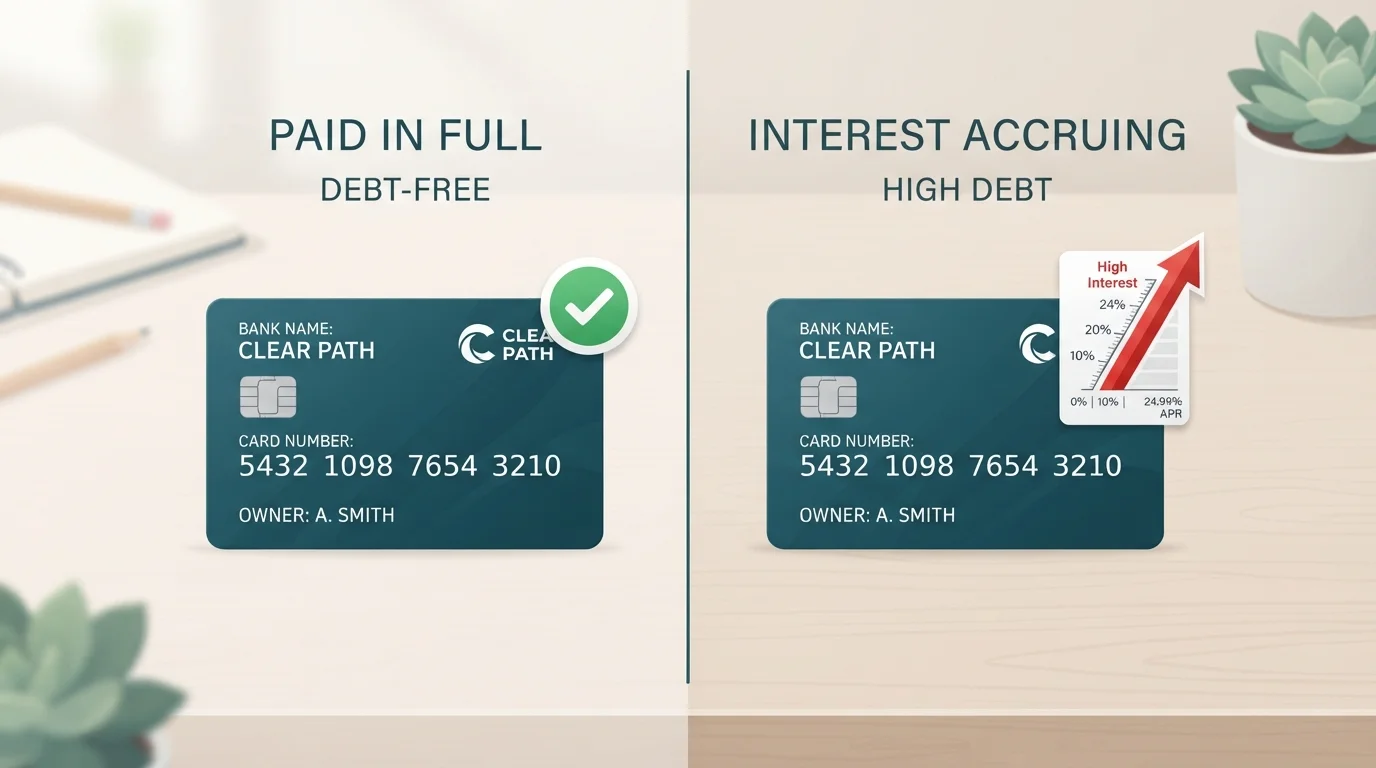
Carrying a Balance
The costly convenience of deferred payment.
Best for: Situations where cash flow is genuinely constrained - though interest costs make it an expensive habit over time.
Option B
Paying in Full
The no-interest approach that keeps costs at zero.
Best for: Anyone who can cover their statement balance each month and wants to avoid compounding interest entirely.
If you can cover your full statement balance each month
Paying in Full
You pay no interest and keep the full value of every dollar you spend. This is the most cost-efficient way to use a credit card.
If you're in a short-term cash crunch and must carry a balance
Carrying a Balance (temporarily)
It may be unavoidable in a genuine emergency, but treat it as a short-term measure - pay it down aggressively as soon as cash flow allows.
If you're deciding whether to save or pay down credit card debt
Paying in Full
A 24% APR on credit card debt almost always outpaces what any savings account or low-risk investment can return. Eliminating the balance first is usually the stronger financial move.
If you rely on minimum payments to get by each month
Carrying a Balance (with a payoff plan)
Minimum payments keep your account current, but barely dent principal. A structured payoff plan - even adding a small fixed amount above the minimum - dramatically reduces total interest paid.
How Credit Card Interest Actually Works
When you don't pay your full statement balance by the due date, your card issuer begins charging interest on the remaining amount. Most cards calculate interest using a daily periodic rate - your annual percentage rate (APR) divided by 365 - applied to your average daily balance. That means interest accrues every single day, not just at month's end.
This is a form of compounding: unpaid interest gets added to your balance, and the next day's interest is calculated on that larger amount. To understand how this dynamic plays out over time, see what compound interest does to your savings and debt.
Example: A $1,000 balance at 24% APR carries a daily rate of roughly 0.066%. After one month, you'd owe approximately $20 in interest - before any new purchases. After six months of paying only the minimum, that $1,000 charge could cost well over $150 in interest alone, depending on the minimum payment formula your issuer uses.
| Criterion | Carrying a Balance | Paying in Full |
|---|---|---|
| Interest charged | Yes - daily compounding applies | None - grace period protects you |
| Typical APR range | 20%-30% annually | N/A - APR irrelevant if paid in full |
| Total cost of a $1,000 purchase | Can exceed $1,200+ with minimum payments | Exactly $1,000 |
| Impact on credit utilization | Higher reported balance each month | Lower or zero reported balance |
| Repayment timeline | Months to years on minimums | Cleared each billing cycle |
| Rewards value retained | Offset or erased by interest costs | Full rewards value kept |
| Financial flexibility | Reduced - interest consumes cash flow | Maintained - no ongoing interest drain |
The Minimum Payment Trap
Card issuers typically set minimum payments as a small percentage of the outstanding balance - often 1-2% - or a flat dollar floor, whichever is greater. This keeps your account in good standing but does almost nothing to reduce principal at high APRs.
~$6,500
Average U.S. credit card balance per cardholder
According to Federal Reserve and TransUnion data, average revolving balances have risen steadily through the mid-2020s.
20%+
Average credit card APR in the U.S.
The Federal Reserve tracks average credit card interest rates; rates climbed above 20% following the rate-tightening cycle that began in 2022.
10+ years
Payoff timeline making only minimum payments
Consumer Financial Protection Bureau (CFPB) calculators illustrate how a $3,000 balance at high APR can take a decade or more to clear on minimum payments alone.
On a $3,000 balance at 22% APR, paying only the minimum each month could take more than a decade to pay off and result in over $2,000 in interest charges - nearly doubling the original purchase cost. Increasing that payment by even $50 per month compresses the timeline and cuts total interest significantly.
If minimum payments feel like the only realistic option right now, there are concrete steps worth exploring - see what to do when minimum payments feel like the only option.
Why Paying in Full Changes the Math Entirely
Federal law requires credit card issuers to provide a grace period - typically 21 to 25 days after the statement closes - during which no interest accrues on new purchases, provided you paid your previous statement balance in full. Pay the full balance every cycle and you effectively borrow interest-free.
This changes the cost equation entirely. You get the purchasing convenience of a credit card - including any rewards your card may offer - without paying a dollar in interest. The card works for you rather than against you.
Compare this to carrying a balance: even a modest $500 rolling balance at 20% APR costs roughly $100 per year in interest, with no goods or services received in return. That's money paid purely for the privilege of deferred payment.
Credit card debt is also worth understanding in context of other debt types. Not all consumer debt works the same way - credit cards typically carry some of the highest rates you'll encounter.
Balancing Debt Payoff With Saving Goals
One of the most common money dilemmas: should you put extra dollars toward your credit card balance or into savings? The math generally favors eliminating high-interest credit card debt first - earning 4-5% in a high-yield savings account while paying 22-28% APR on a card balance is a net loss of 17-24 percentage points per year.
That said, a small emergency fund matters before you go all-in on payoff. Without liquid savings, a car repair or medical bill could push you right back into card debt. The goal is a workable balance, not a rigid rule. A framework for deciding whether to pay off debt or build savings first can help you weigh your specific interest rates, risk tolerance, and financial stability.
If you've accumulated balances across multiple cards, debt consolidation may be worth evaluating - it can simplify repayment and lower your effective rate, though it doesn't erase the underlying debt. Whatever approach you take, building a spending plan that accounts for both goals is foundational. See budgeting basics for strategies to track where your money goes.
This article is for general informational and educational purposes only and does not constitute personalized financial advice. Consult a qualified financial professional for guidance specific to your situation.