

| Core organizing method | Zone system — group items by activity |
| Most misunderstood term | Negative space (intentional, not accidental emptiness) |
| Maintenance strategy | One-in, one-out rule |
| Relates to | Functional home design, interior styling, decluttering |
Why a Shared Vocabulary Matters
Whether you're watching an organization video, reading a home styling guide, or describing a problem to a professional organizer, the same terms keep appearing: decanting, negative space, zone system. When those words are unfamiliar, the advice that follows them lands nowhere.
This glossary translates the most commonly used home organization and interior styling terms into plain English. It's designed as a lookup reference — no assumed background required. Once you have the language, concepts like functional home design become easier to apply in practice.
Zone System
An organizing approach that divides a room into dedicated activity areas, each stocked with the tools or items needed for that activity. Reduces searching and helps multiple people maintain a shared space.
Decanting
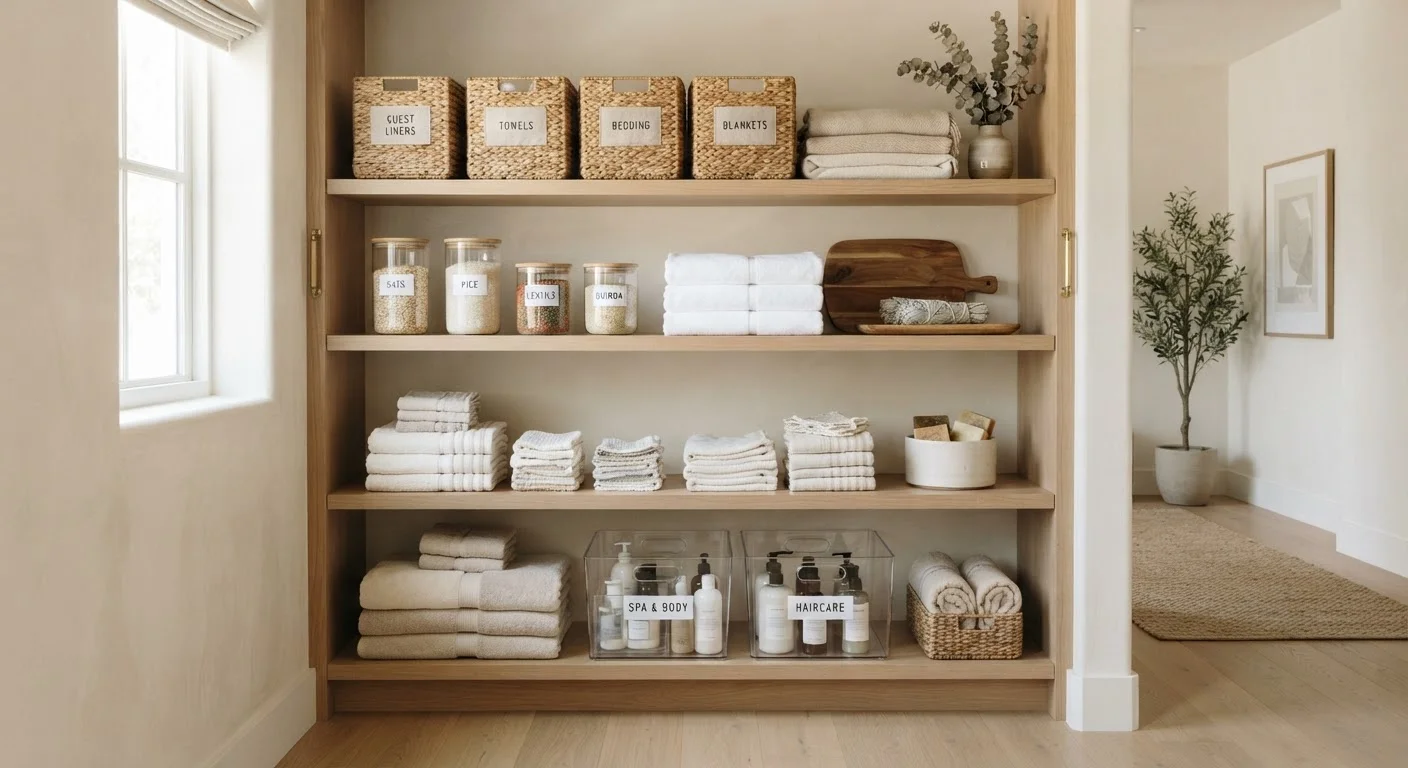
The practice of transferring items from original retail packaging into uniform or purpose-built containers. Common in pantries, bathrooms, and laundry rooms to standardize storage and improve spatial efficiency.
Negative Space
The deliberate empty area left around stored or displayed items. In organizing, negative space signals a system is not over capacity and makes it easier to retrieve and return items consistently.
One-in, One-out Rule
A maintenance strategy where adding any new item to a category requires removing an existing one. Designed to prevent gradual accumulation over time.
Editing (Curating)
The selective, ongoing process of choosing what remains in a space. Unlike a one-time purge, editing implies regular, thoughtful refinement of what a space contains.
Clutter
Items that occupy space without serving a current function or providing genuine value to the occupant. The definition is subjective and context-dependent rather than universal.
Flow
The ease with which a person can move through and use a space. Good flow means common tasks don't require navigating around obstacles or searching across multiple areas.
Vertical Storage
Using wall height rather than floor area to store items — through shelving, hooks, pegboards, or stacked containers. Particularly useful in small spaces where floor square footage is limited.
Staging
Arranging a space for a specific purpose, often visual presentation. In real estate, staging means furnishing a home to appeal to buyers; in everyday organizing, it can mean setting up a surface for a task and resetting it after.
Vignette
A small, intentionally arranged grouping of objects — typically on a surface like a shelf or side table — that creates a visually cohesive moment. Used in interior styling to add personality without visual chaos.
Dead Zone
Areas of a home that are underused or difficult to access — high cabinet shelves, corners, under stairs. Identifying dead zones is often the first step in expanding usable storage.
Containerizing
Placing loose or similar items into a defined container — a bin, basket, or box — to create a clear boundary for a category of items. Containerizing makes categories visible and prevents overflow into adjacent areas.
Core Organizing Concepts
These terms describe the foundational ideas behind how organized spaces are built and maintained.
| Core organizing method | Zone system — group items by activity |
| Most misunderstood term | Negative space (intentional, not accidental emptiness) |
| Maintenance strategy | One-in, one-out rule |
| Relates to | Functional home design, interior styling, decluttering |
A zone system groups activities and the items that support them into dedicated areas of a room. A kitchen might have a coffee zone, a baking zone, and a meal-prep zone — each with its own tools kept close at hand. Zone systems reduce decision fatigue and make it easier for every household member to maintain order independently.
Decanting means transferring products from their original retail packaging into uniform containers. Dry goods moved from bags into sealed canisters, or cleaning supplies consolidated into matching bottles, are both examples. The goal is consistency and efficient use of shelf space — not aesthetics for its own sake.
Negative space is the intentional empty area left around objects. In storage, it signals that a system isn't at capacity and has room to breathe. Overcrowded shelves and drawers are harder to navigate and easier to mess up. Leaving negative space is an active organizing choice, not an oversight.
For a deeper look at how these ideas translate room by room, see the room-by-room organization guide.
Terms You'll Encounter in Decluttering
Decluttering has its own vocabulary, much of it borrowed from minimalism and behavioral psychology. Understanding what these terms actually mean — rather than how they're sometimes misused — helps you approach the process more realistically.
Clutter is typically defined as anything that takes up space without serving a current function or bringing genuine value. The word is often misapplied to any visible item; in practice, whether something counts as clutter depends on the person and the context.
Editing (or curating) refers to the selective process of choosing what stays in a space, analogous to how an editor trims a manuscript. It implies ongoing refinement rather than a single purge.
One-in, one-out is a maintenance rule: for every new item brought into a category, one existing item leaves. It's a practical ceiling on accumulation, particularly useful for clothing, books, and kitchen tools.
Not all popular advice around these concepts is well-founded. The home organization myths article addresses several widely repeated ideas that frequently backfire.
Organization Language Is Not Universal
Terms like 'clutter,' 'minimalism,' and even 'clean' carry cultural and personal meanings that vary widely. What counts as organized in one household may feel sterile or impractical in another. This glossary defines terms as they are most commonly used in American home organization contexts — not as absolute standards. Apply definitions in ways that fit your actual living situation and household needs.