

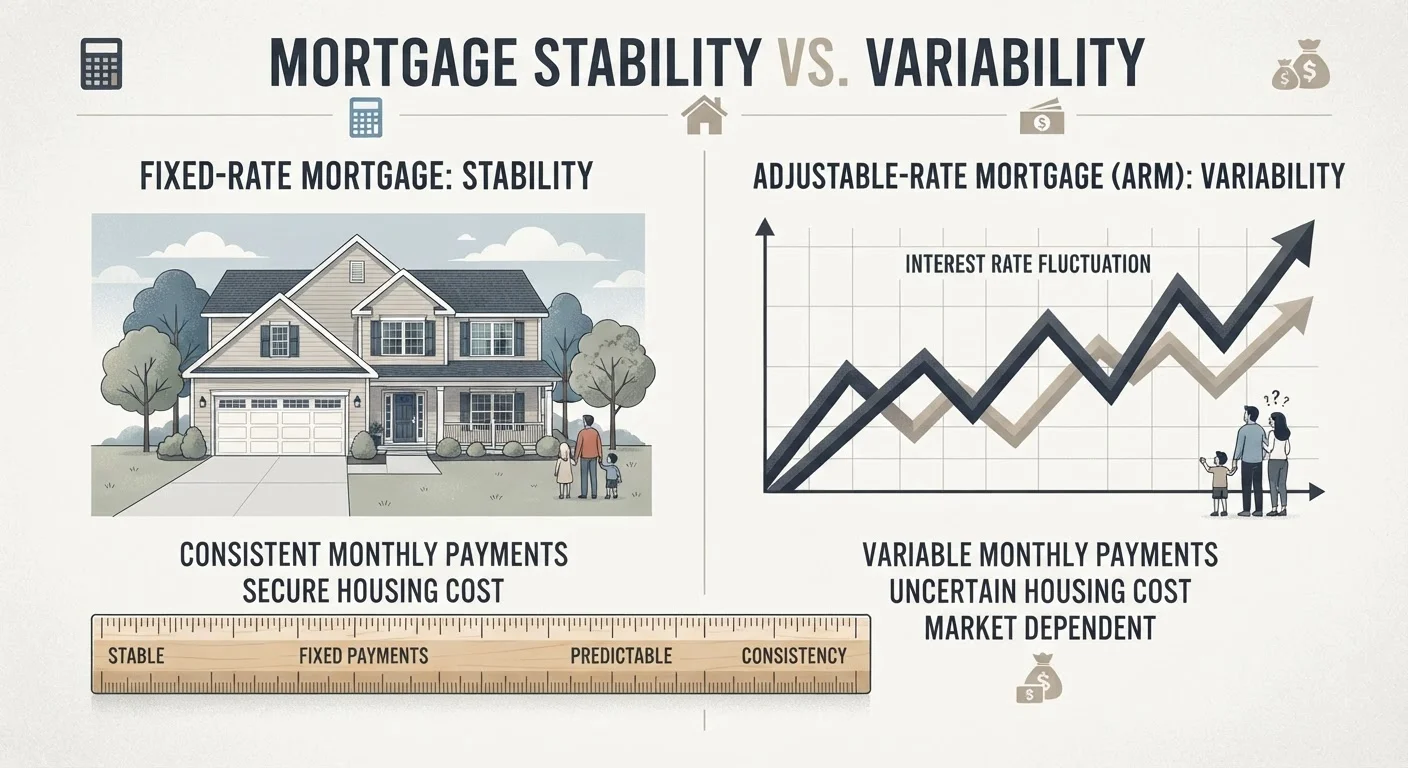
Key Takeaways
Option A
Fixed-Rate Mortgage (FRM)
The predictable, long-term stability choice.
Best for: Buyers planning to stay in a home long-term who want consistent monthly payments regardless of market shifts.
Option B
Adjustable-Rate Mortgage (ARM)
The lower initial rate, variable-future alternative.
Best for: Buyers with shorter time horizons or those confident rates will drop, who can accept payment variability after an initial fixed period.
If you plan to stay in the home for 10 or more years
Fixed-Rate Mortgage (FRM)
Locking in a rate protects you from future rate increases and makes long-term budgeting straightforward and reliable.
If you expect to sell or refinance within 5–7 years
Adjustable-Rate Mortgage (ARM)
You can benefit from the lower introductory rate without exposure to adjustments if you exit the loan before the variable period begins substantially.
If payment predictability is a top financial priority
Fixed-Rate Mortgage (FRM)
Fixed payments make it easier to plan your household budget month to month, with no surprises tied to market index movements.
If you believe interest rates will fall significantly in coming years
Adjustable-Rate Mortgage (ARM)
An ARM allows your rate to decrease when the benchmark index drops, potentially reducing your payment without the cost of refinancing.
If you are a first-time buyer with a limited financial cushion
Fixed-Rate Mortgage (FRM)
The stability of a fixed payment reduces financial risk for buyers who may not have reserves to absorb a significant rate adjustment.
How Each Mortgage Type Is Structured
A fixed-rate mortgage (FRM) sets your interest rate at closing and keeps it identical for the full loan term — whether that is 15, 20, or 30 years. Your monthly principal and interest payment never changes, regardless of what happens to broader interest rates. This predictability makes FRMs the most common mortgage type in the United States.
An adjustable-rate mortgage (ARM) begins with a fixed introductory period — typically 3, 5, 7, or 10 years — during which the rate is locked. After that period, the rate adjusts at regular intervals (often annually) based on a benchmark index, such as the SOFR, plus a lender-set margin. A 5/1 ARM, for example, carries a fixed rate for five years, then adjusts once per year afterward.
ARMs include rate caps to limit how dramatically your payment can shift. A typical cap structure might be expressed as 2/2/5, meaning the rate cannot rise more than 2 percentage points at the first adjustment, no more than 2 points at any subsequent adjustment, and no more than 5 points above the initial rate over the life of the loan. Understanding how these caps apply is essential before committing to an ARM. For a broader look at how loan mechanics interact, see how principal, interest, and loan term interact.
| Criterion | Fixed-Rate Mortgage | Adjustable-Rate Mortgage |
|---|---|---|
| Interest Rate Over Time | Stays the same for the full term | Fixed initially, then adjusts periodically |
| Initial Rate Level | Typically higher at origination | Typically lower during intro period |
| Payment Predictability | Completely stable principal + interest | Stable initially, variable afterward |
| Rate Caps | Not applicable | Per-adjustment and lifetime caps apply |
| Best Horizon | Long-term homeownership (10+ years) | Short-to-medium term (under 7–10 years) |
| Interest Rate Risk | Borne entirely by lender | Partially transferred to borrower |
| Common Terms | 15, 20, or 30 years | 3/1, 5/1, 7/1, or 10/1 ARM structures |
Cost Differences and Rate Environment
At any given time, ARMs generally offer a lower initial interest rate than comparable fixed-rate loans — sometimes meaningfully lower. That gap reflects the risk you accept: the lender transfers some interest-rate uncertainty to you after the introductory period. When fixed rates are elevated, the initial savings on an ARM can be substantial enough to influence the purchase decision.
Over a full 30-year term, an FRM borrower who never refinances will pay a known total in interest from day one. An ARM borrower's total interest cost is genuinely unknown — it could end up lower if rates fall, or significantly higher if rates rise. Running calculations on multiple rate scenarios, not just the introductory rate, is important when evaluating an ARM.
~90%
Share of US mortgages that are fixed-rate
According to the Federal Reserve's consumer finance data, the vast majority of American homeowners with mortgages hold fixed-rate loans, reflecting the preference for payment stability.
1–2%
Typical initial rate discount for ARMs vs. FRMs
The spread between introductory ARM rates and comparable fixed rates varies with market conditions but has historically ranged from roughly 1 to 2 percentage points at origination.
5 pts
Maximum lifetime rate cap common in ARMs
Many standard ARM products carry a lifetime cap of 5 percentage points above the initial rate, though cap structures vary by lender and product — always confirm the specific terms in your loan estimate.
Keep in mind that your mortgage rate also depends heavily on your credit profile. How lenders use credit scores to determine mortgage terms is worth reviewing before you apply, since a stronger score can improve the rate offered on either loan type.
Deciding Which Structure Fits Your Situation
The most important variable is how long you expect to hold the loan. If you are confident you will sell or refinance before the ARM's fixed period ends, you may capture the lower introductory rate with limited exposure to future adjustments. If you are buying what you expect to be a long-term home, the certainty of an FRM is generally worth the slightly higher starting rate.
Risk tolerance matters equally. If an unexpected payment increase would strain your household budget, an FRM provides protection an ARM cannot. Think of your mortgage payment as a fixed expense in your monthly budget — with an FRM, it genuinely behaves like one; with an ARM, it eventually does not.
The rate environment at the time of purchase also plays a role. When prevailing fixed rates are historically low, locking in can be advantageous for decades. When fixed rates are high relative to historical norms, an ARM's initial savings may be more compelling, especially if a rate decrease in the medium term is plausible — though no one can predict rate movements reliably.
Refinancing Can Change the Equation
Choosing an ARM does not lock you into variable payments forever, and choosing an FRM does not mean you are stuck if rates fall. Refinancing allows borrowers to switch loan types or secure a new rate — though it involves closing costs, a new application, and underwriting. Factor the likelihood of refinancing and its associated costs into your long-term comparison rather than treating either mortgage as a permanent, unchangeable commitment.
Before deciding, consider whether buying is the right move at all for your current financial situation, since the mortgage type question only matters once you have concluded that homeownership is the appropriate next step.
This article is for general educational purposes only and does not constitute financial or mortgage advice. Consult a licensed mortgage professional or financial adviser before making decisions about your loan structure.