

Key Takeaways
Why Crate Training Works — When Done Right
Dogs are den animals by nature. Given a safe, enclosed space that smells familiar and feels secure, most will seek it out voluntarily for rest. The problem is not the crate itself — it is the way many owners introduce it. Locking a puppy inside before any positive association has been built predictably produces crying, which then leads owners to abandon the process entirely.
Crate training done correctly gives your puppy a reliable refuge from household chaos, simplifies housetraining by leveraging a puppy's natural reluctance to soil their sleeping space, and protects your home during unsupervised periods. It is one of the most practical early investments you can make in your puppy's development. If you are just getting started, reviewing common first-month mistakes can help you avoid the missteps that make training harder than it needs to be.
Never Use the Crate as Punishment
Sending a puppy to their crate after a mistake teaches them to associate it with fear or isolation. This undermines the entire training process and can cause lasting anxiety. The crate must always be a neutral or positive place. Corrections belong elsewhere in your training approach.
Before you start, gather what you need:
What you will need
What You'll Need
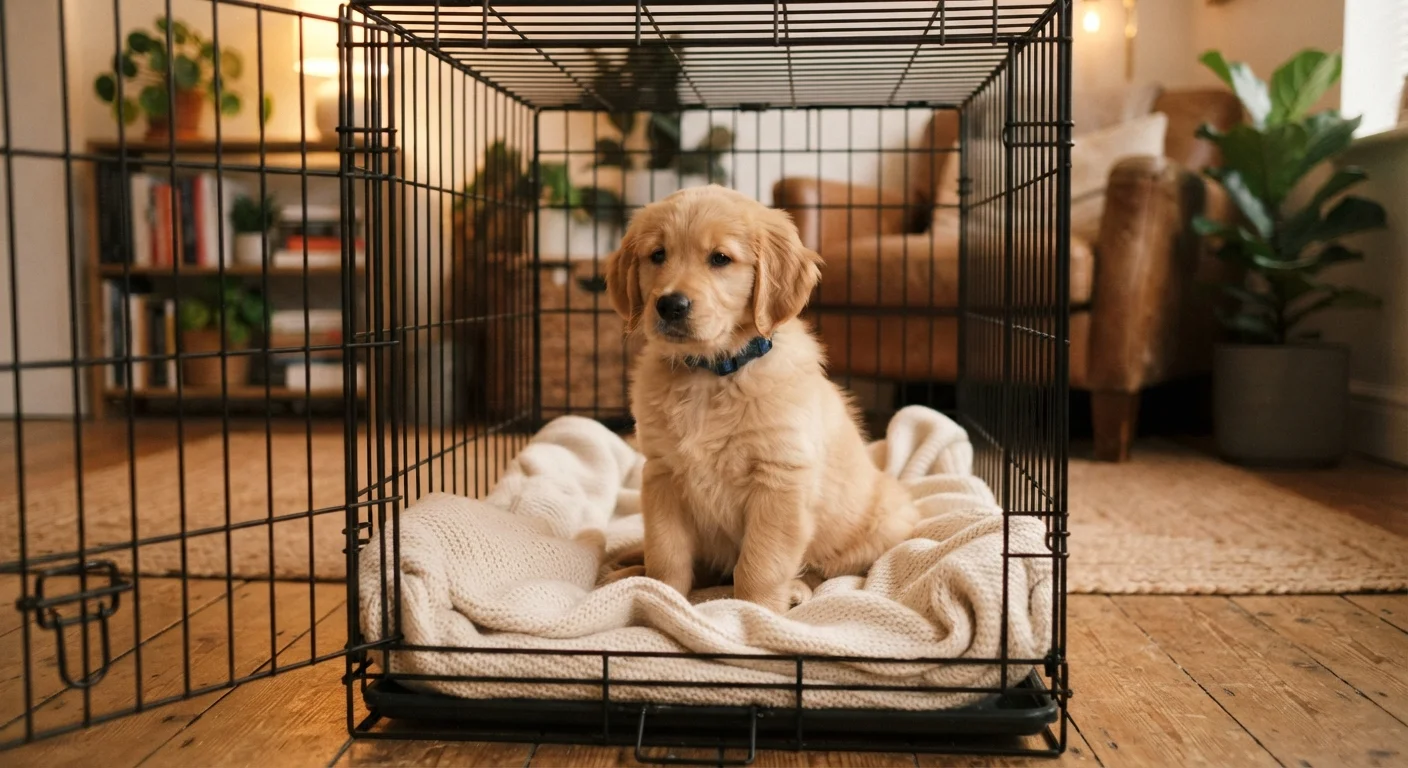
Appropriately Sized Crate
Provides a space large enough for the puppy to stand, turn, and lie down — but not so large they can eliminate in one corner and sleep in another.
Soft Bedding or Crate Mat
Makes the crate comfortable and encourages the puppy to rest inside willingly.
Small High-Value Training Treats
Used to reward calm, voluntary entry into the crate during each training phase.
Chew Toy or Kong-Style Puzzle
Provides mental engagement inside the crate, helping the puppy associate it with enjoyment rather than boredom.
White Noise Machine or Fan
Masks household sounds that can startle a puppy during early overnight crating.
Crate size matters more than most owners realize. A crate that is too large allows a puppy to use one end as a bathroom, which defeats the housetraining purpose entirely. If you are buying a larger crate to grow into, use a divider panel to restrict the interior to an appropriately snug space during early training.
Make the Crate Smell Familiar
Place an unwashed t-shirt or small blanket carrying your scent inside the crate from day one. Familiar smells are calming for puppies who are adjusting to a new environment. This simple step can reduce anxiety during the first nights significantly.
Step-by-Step: Building a Positive Crate Association
Place the Crate in a Social Area
Set the crate in a room where your family spends regular time — a living room or kitchen works well. Leave the door open and let the puppy investigate at their own pace. Do not force them inside. Simply having the crate present in a calm, familiar setting begins the desensitization process.
Feed Meals Near — Then Inside — the Crate
Start by placing your puppy's food bowl just outside the crate entrance. Over several meals, gradually move the bowl closer to the opening, then just inside, and eventually toward the back. This builds a direct, positive association between the crate and something the puppy already loves.
Practice Short Crate Sessions During the Day
With the puppy calm and not overly energetic, lure them into the crate with a treat and a verbal cue such as "crate" or "bed." Reward them the moment they enter, close the door for 30 to 60 seconds, then open it. Gradually extend these sessions over several days. Always end before the puppy becomes anxious.
Introduce Overnight Crating Gradually
Place the crate in or near your bedroom for the first week. Puppies separated entirely from human proximity at night experience more distress. Letting them hear and smell you nearby reduces anxiety considerably. Take the puppy out for a bathroom break once or twice overnight based on their age and bladder capacity.
Establish a Predictable Crate Routine
Puppies thrive on predictability. Pair crate time with natural rest windows — after meals, after play sessions, or mid-morning and mid-afternoon. A structured routine helps the puppy anticipate when crate time is coming, which reduces protest. Over time, many puppies will enter the crate on their own when they are tired.
Phase Out Constant Use as the Puppy Matures
Once your puppy is reliably housetrained and shows no destructive behavior when briefly unsupervised, you can begin leaving the crate door open and allowing more freedom. Many dogs continue to use their crate voluntarily as a resting spot well into adulthood — the goal is always a dog who chooses to be there, not one who must be.
Watch Crate Time Limits Closely
Young puppies have very limited bladder control. A general guideline is one hour per month of age, plus one — so an eight-week-old puppy should not be crated for more than two to three hours at a stretch during the day. Exceeding this forces the puppy to soil their space, which sets back housetraining and increases stress.
Consistency across everyone in the household is essential. If one family member lets the puppy out every time it cries, the training stalls. Align on the approach before you begin. For households introducing a second dog, the same principles apply — see our guide on bringing a second dog home for space management strategies that work alongside crate routines.
Common Setbacks and How to Handle Them
Even with a careful approach, most owners hit at least one rough patch. Here is how to navigate the most frequent obstacles:
- Persistent overnight crying: Confirm the puppy has been taken outside recently. If bladder needs are met, avoid immediately opening the crate. A calm verbal reassurance — without making eye contact or picking them up — can settle many puppies.
- Refusal to enter voluntarily: Return to step one. Move more slowly through the meal-feeding progression before adding door closure again.
- Elimination inside the crate: Either the crate is too large, sessions are running too long, or the feeding and bathroom schedule needs adjustment. Review the timing and reduce the crate footprint if needed.
- Anxiety that does not improve: Some puppies have underlying separation anxiety that warrants professional guidance. A certified applied animal behaviorist or your veterinarian can help distinguish normal adjustment from a deeper issue that needs targeted intervention.
Crate training pairs well with broader routine-building. Once your puppy is reliable in the crate, integrating it into a structured daily schedule — covering feeding, exercise, and training windows — sets the foundation for a well-adjusted adult dog. Our article on building a daily routine your dog can rely on walks through exactly how to do that.