

Key Takeaways
Mental Enrichment for Pets
Mental enrichment refers to activities, challenges, and environmental conditions that engage an animal's mind — encouraging problem-solving, exploration, and natural instinctual behavior. For companion animals like dogs and cats, it goes beyond physical exercise to address cognitive and emotional needs. A mentally enriched pet is actively thinking, investigating, and making choices, not simply existing in a space.
In applied animal behavior science, enrichment is categorized into types including cognitive (puzzle-solving), sensory (novel smells, textures), social (human or animal interaction), and feeding enrichment — each targeting different aspects of behavioral health.
The Hidden Cost of an Under-Stimulated Pet
Most pet owners diligently schedule walks, playtime, and regular vet visits — but one critical need often goes unaddressed: mental stimulation. The assumption that a tired pet is a well-cared-for pet overlooks a fundamental truth of animal behavior. Cognitive engagement is not optional. It is a biological requirement.
Dogs were bred over thousands of years for demanding cognitive work — herding, hunting, tracking, retrieving. Cats are natural predators wired for stalking, problem-solving, and environmental exploration. When companion animals spend long hours in unchanging, unstimulating environments, the brain doesn't simply idle. It finds outlets — often destructive or distressing ones.
Chronic boredom in pets is associated with a recognizable cluster of behavioral problems: furniture destruction, excessive vocalization, compulsive licking or chewing, aggression, and separation anxiety. These behaviors are frequently misread as stubbornness or poor temperament when the underlying cause is unmet cognitive need. See our evidence-based look at physical and cognitive enrichment for more on how both dimensions connect to behavioral health and longevity.
23%
Dogs showing anxiety-related behavior issues
A study published in Scientific Reports (2020) found that approximately 72.5% of dogs exhibited anxiety-like behaviors, with noise sensitivity and separation anxiety among the most common — conditions often worsened by under-stimulation.
5–10 min
Minimum effective daily training session length
Animal behavior experts generally recommend multiple short training sessions per day rather than one long session, as brief focused engagement produces better retention and mental fatigue in pets.
Up to 40%
Reduction in stress behaviors with enrichment
Research in shelter animal environments has documented significant reductions in stress indicators — including pacing, vocalization, and self-directed behavior — when structured enrichment programs are introduced.
What Mental Enrichment Actually Looks Like
Enrichment doesn't require elaborate setups or significant expense. At its core, it means giving your pet opportunities to think, choose, explore, and problem-solve. Applied animal behaviorists recognize several broad categories of enrichment that work for companion animals:
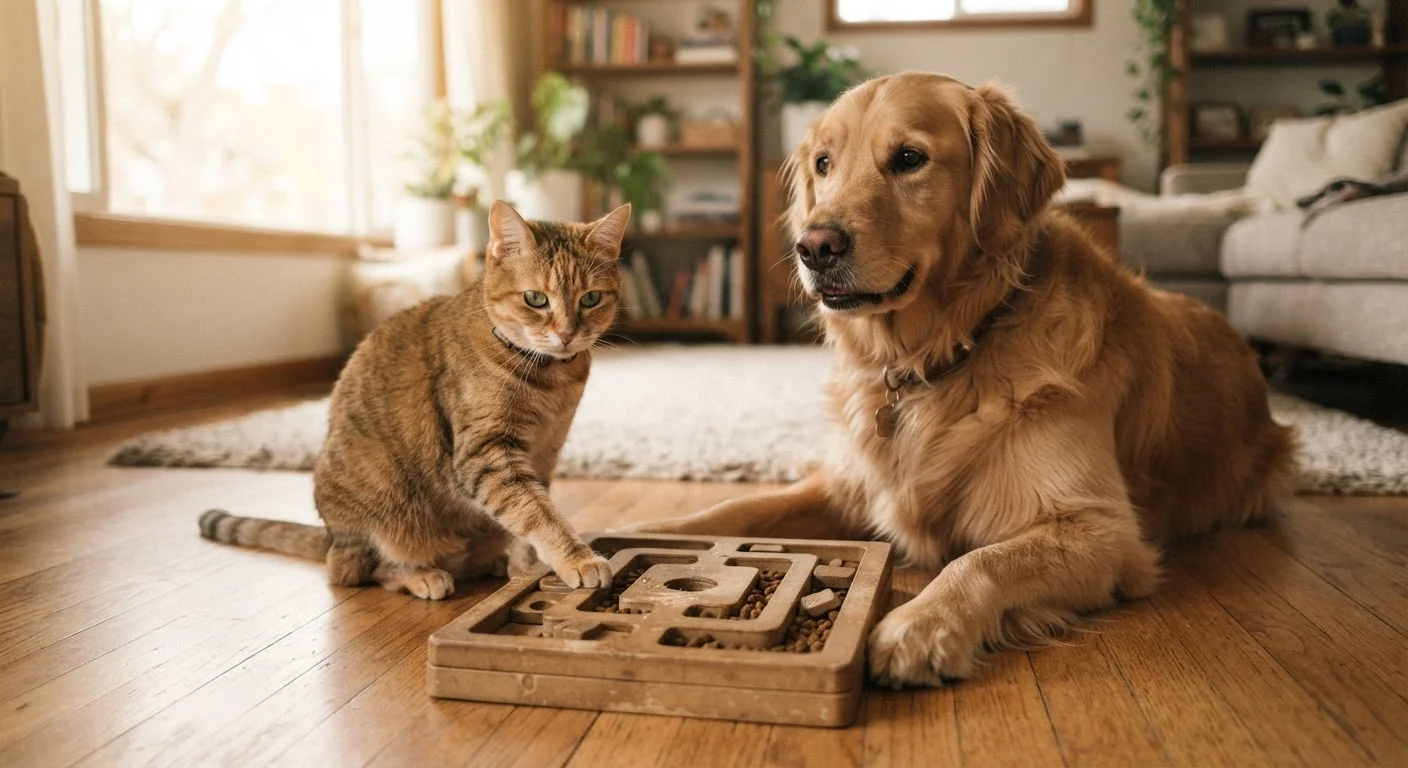
- Feeding enrichment: Food puzzles, lick mats, scatter feeding, and slow feeders turn mealtime into a problem-solving activity. These are particularly effective for dogs prone to anxiety or hyperactivity.
- Sensory enrichment: Rotating novel scents, textures, and sounds engages a pet's environment in meaningful ways. For cats especially, even a cardboard box or paper bag constitutes genuine enrichment.
- Cognitive enrichment: Training sessions — even five to ten minutes — tax the brain in productive ways. Learning new cues or tricks challenges dogs to focus and respond, creating a satisfying cognitive workout.
- Social enrichment: Structured interaction with people, other animals, or novel experiences provides stimulation that a solitary environment cannot replicate.
For indoor cats, enrichment is particularly important. The absence of outdoor stimulation means owners must actively build complexity into the home environment. Our article on indoor vs. outdoor cat health and lifespan explores how enrichment fits into that equation.
Start Simple: Rotate, Don't Accumulate
You don't need to introduce dozens of new toys or tools. Instead, rotate a small collection of items so each feels novel when reintroduced. A toy that's been hidden for two weeks registers as a new experience to most pets. Novelty itself is enriching — variety in presentation matters as much as the item itself.
Boredom vs. Other Behavioral Causes: Getting the Diagnosis Right
Not every problematic behavior is rooted in boredom, and it's important not to over-attribute. Medical conditions, pain, fear, and inadequate training can all produce similar-looking behaviors. If your pet has developed sudden or severe behavioral changes, a veterinary evaluation should come first.
That said, boredom-driven behavior tends to follow a recognizable pattern: it escalates when the pet is left alone, improves when enrichment is introduced, and correlates with environments that offer little variety or stimulation. A dog that chews baseboards while alone but settles immediately when given a food puzzle is demonstrating a clear enrichment deficit.
When to Involve a Professional
If behavioral problems are severe, sudden, or don't respond to enrichment changes within a few weeks, consult your veterinarian or a certified applied animal behaviorist. Some behavioral issues have medical underpinnings — pain, hormonal changes, or neurological concerns — that require professional assessment before enrichment strategies will be effective.
Enrichment also plays a role in routine. Building a structured daily routine for your dog that incorporates mental stimulation — not just exercise and feeding — creates predictability that reduces baseline anxiety. Consistent enrichment windows, like a post-dinner training session or a morning puzzle feeder, help regulate a pet's behavioral expectations across the day.
Age, Breed, and Individual Variation
Enrichment needs are not one-size-fits-all. High-drive working breeds — Border Collies, Belgian Malinois, Australian Shepherds — have significantly higher cognitive needs than lower-energy companion breeds. A Border Collie left without mental challenge is more likely to develop serious behavioral problems than a Basset Hound in the same situation, though both benefit from enrichment.
Age is equally important. Puppies and kittens require frequent, varied stimulation matched to their developmental stage. Adult pets need consistent daily engagement. And older animals, rather than needing less enrichment, need it adapted to their physical capabilities. Cognitive decline — recognized in dogs as Canine Cognitive Dysfunction — is a genuine veterinary concern, and mental engagement is considered a supportive measure. Our article on senior pet nutrition and aging touches on how overall health needs evolve in older animals.
This article is for informational purposes only and does not constitute veterinary advice. Always consult a qualified veterinarian for guidance specific to your pet's health and behavior.