

Key Takeaways
How the Over-Layering Habit Forms
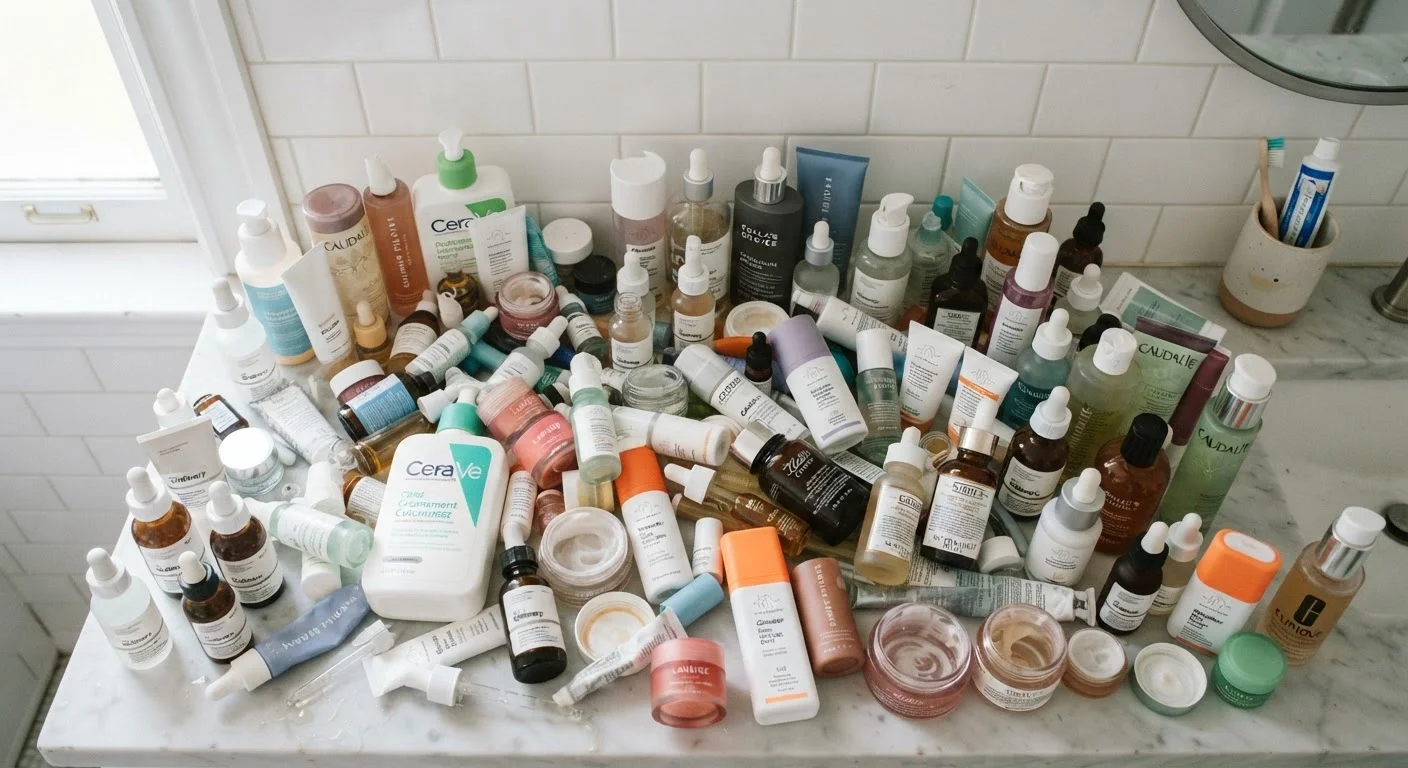
Skincare routines have quietly ballooned from a few straightforward steps into elaborate rituals — and the beauty industry has played a significant role in that shift. Each new serum, essence, and treatment oil arrives with compelling language about transformation, making it genuinely hard to resist adding just one more step. The result, for many people, is a shelf full of products and a routine that's become more ritual than results-driven.
The problem isn't enthusiasm — it's the assumption that more is always better. Skin has a finite capacity to absorb ingredients at any given time. When that limit is exceeded, products either sit on the surface, interact with each other in unintended ways, or dilute the efficacy of ingredients that actually need to penetrate. For a reality check on some of the claims driving these habits, see the most persistent skincare myths, fact-checked.
Don't Assume More Steps Equal More Benefits
The beauty industry frequently positions multi-step routines as a marker of sophisticated self-care. In practice, the skin can only absorb so much at once, and certain formulas simply don't layer well together. A longer routine isn't inherently a better one — and for some skin types, it can actively cause harm.
Common Mistakes That Undermine Your Routine
Most over-layering errors aren't obvious in the moment — they feel like due diligence. The mistakes below are the ones that show up most consistently, and recognizing them is the first step toward a routine that actually works for your skin rather than against it.
Applying too many actives in a single routine, expecting compounded results.
Why it happens: Marketing often frames each ingredient — vitamin C, retinol, AHAs, niacinamide — as a must-have, making it tempting to use all of them together. The assumption is that more active ingredients equal faster improvement.
Adding a new product every week, making it impossible to assess what's working.
Why it happens: New launches, social media recommendations, and the fear of missing out on a breakthrough ingredient push people to continuously add rather than evaluate.
Layering products in the wrong order, blocking absorption of lighter formulas.
Why it happens: Without clear guidance, people often apply products based on preference or habit rather than molecular weight and formulation type, unknowingly trapping lighter serums under thick creams.
Continuing a complex routine during a breakout or reaction, hoping one product will rescue the situation.
Why it happens: It feels counterintuitive to remove products when skin seems to need help. People often pile on spot treatments, soothing serums, and barrier creams simultaneously, which can compound irritation.
Ignoring product expiration and hygiene while expanding a routine.
Why it happens: A larger product collection makes it harder to track what's been open and for how long. Older formulas can degrade, lose efficacy, or introduce bacteria to skin.
Skin Irritation Is a Signal Worth Heeding
If your skin is consistently red, flaky, or breaking out and you're using multiple products, over-layering may be a contributing factor. Scaling back your routine is not a step backward — it's a diagnostic tool. If irritation is severe or persistent, consult a dermatologist rather than continuing to experiment on your own.
Building a Smarter, Simpler Approach
Scaling down a routine doesn't mean sacrificing results. It means being intentional. Start by identifying the one or two concerns you most want to address — hydration, uneven tone, texture — and choose formulas with a strong evidence base for those specific needs. A routine with three to five well-matched products will almost always outperform a ten-step regimen assembled from trend-driven purchases.
Layering strategy also matters for products like base makeup. Understanding how skincare interacts with coverage products can prevent pilling and uneven finish — our breakdown of foundation vs. tinted moisturizer walks through how different formulas sit on skin. The same principle of less-but-better applies across your entire beauty toolkit: a focused collection you understand is always more useful than a crowded one you've stopped keeping track of.
60%+
Dermatologists attributing barrier damage to over-cleansing and over-layering
Surveys of board-certified dermatologists consistently find that compromised skin barriers are frequently linked to excessive product use rather than under-doing a routine.
28 days
Typical skin cell turnover cycle
Because skin renews itself roughly every four weeks, most products need at least that window to show a measurable effect — reinforcing the case for patience over product-stacking.