

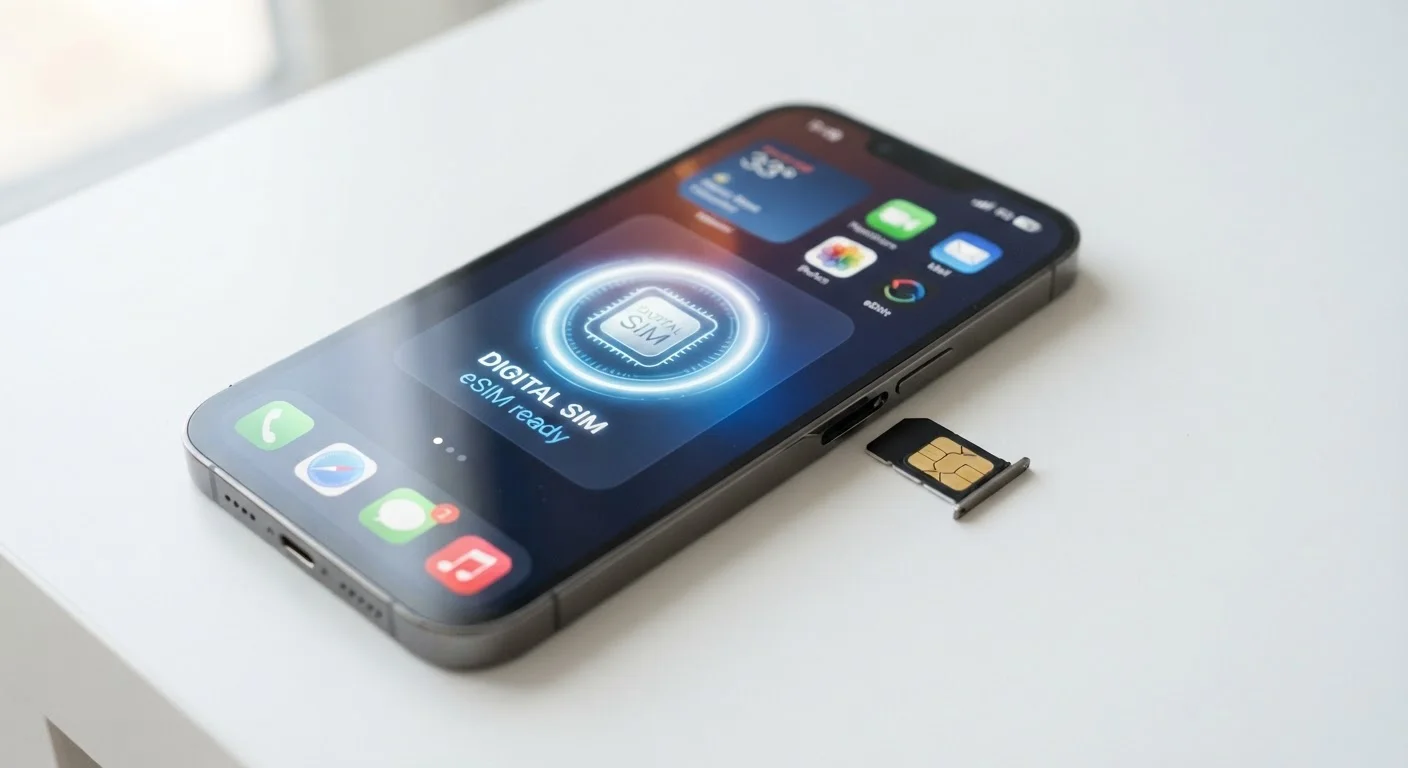
Key Takeaways
Option A
eSIM
The embedded, software-based SIM built directly into modern devices.
Best for: Travelers, frequent carrier switchers, and users with newer flagship devices who value flexibility and convenience.
Option B
Physical SIM Card
The removable, universal standard that has powered mobile connectivity for decades.
Best for: Users with older devices, those in regions with limited eSIM support, or anyone who prefers tangible, transferable connectivity.
If you travel internationally and want flexible local data plans
eSIM
eSIM lets you add a local carrier plan digitally without swapping cards or carrying multiple SIMs, which is especially useful abroad.
If you use an older or budget smartphone
Physical SIM Card
Most older and lower-cost phones do not include eSIM hardware, making a physical SIM the only practical option.
If you switch carriers frequently and want a streamlined process
eSIM
Carrier activation via eSIM can be completed entirely through your phone's settings, often in minutes, with no store visit required.
If you share a phone between family members or resell devices often
Physical SIM Card
A physical SIM can simply be moved to another device, making handoffs simpler without relying on carrier eSIM transfer processes.
If you want to run two numbers on one device
eSIM
Dual-SIM phones can pair an eSIM with a physical SIM (or two eSIM profiles), letting you maintain separate personal and work lines on one handset.
How Each SIM Format Actually Works
A physical SIM card (Subscriber Identity Module) is a small removable chip — most commonly a nano-SIM today — that stores your carrier credentials and identifies your device on a mobile network. When you get service from a carrier, they issue you a card; you insert it, and your phone connects. Moving to a new carrier means getting a new card.
An eSIM (embedded SIM) is a chip soldered directly into your device's motherboard. Instead of swapping a card, you download a carrier profile digitally — through a QR code, a carrier app, or an activation code. The underlying network technology is identical; the difference is entirely in how your identity credentials are stored and delivered. For a plain-language breakdown of related connectivity terms, see our connectivity reference guide.
Critically, eSIM supports multiple stored profiles. Your phone can hold several carrier profiles simultaneously and switch between them in settings — though only one (or two on dual-SIM models) is active at a time.
Side-by-Side: Key Differences at a Glance
The practical differences between eSIM and physical SIM come down to convenience, compatibility, and flexibility. Here's how they compare across the factors most relevant to everyday users:
| Criterion | eSIM | Physical SIM Card |
|---|---|---|
| Form factor | Embedded chip, no slot needed | Removable nano-SIM card |
| Activation method | QR code, app, or digital code | Insert card, auto-activates |
| Carrier switching | Done in phone settings | Requires new physical card |
| Multiple profiles | Yes, store several at once | One carrier per card |
| Device compatibility | Newer flagships (post-2018) | Nearly universal |
| International usability | Add foreign plan digitally | Buy/swap local SIM on arrival |
| Transferability | Requires carrier-assisted transfer | Move card to any compatible phone |
| Water resistance impact | No slot improves sealing | SIM tray is a potential weak point |
One nuance worth noting: network performance — download speeds, call clarity, signal strength — is not determined by SIM format. Both connect to the same carrier towers using the same radio bands. The SIM format only affects how your credentials are stored and activated.
What's Driving the Shift Toward eSIM
Device makers have clear incentives to move toward eSIM. Removing the physical tray frees up internal space for larger batteries or slimmer designs, and it eliminates a hardware vulnerability — the SIM slot is one of the few openings in a phone's chassis, affecting water resistance ratings.
eSIM-only
US iPhone models sold after September 2022
Apple removed the physical SIM tray from iPhones sold in the United States starting with the iPhone 14 lineup, making the US market one of the first major eSIM-only rollouts.
200+
Countries with at least some eSIM carrier support
According to the GSMA, eSIM support has expanded rapidly across carrier networks globally, though depth of support varies significantly by region and carrier.
Dual-SIM
Common setup pairing eSIM and physical SIM
Many Android flagships support simultaneous eSIM and physical SIM use, allowing users to maintain two active numbers or data plans on one device.
For consumers, the clearest benefit is travel flexibility. Rather than hunting for a local SIM card at an airport kiosk, eSIM users can purchase and activate a local data plan from their phone before landing. If you want to understand how this fits into broader international travel planning, our guide to planning trips abroad covers the broader logistics involved.
Carrier switching also becomes simpler. The process of porting your number and activating service on a new carrier can happen entirely within your phone's settings. For a full walkthrough of what that process involves, our carrier-switching guide covers each step in detail.
eSIM Profiles Are Carrier-Controlled
While eSIM allows multiple stored profiles, carriers can place restrictions on how and when profiles are transferred or deleted. Some US carriers require you to contact them before moving an eSIM profile to a new device. It's worth checking your carrier's specific eSIM policy before assuming the process is fully self-service.
Where Physical SIMs Still Have the Advantage
Despite the momentum behind eSIM, physical SIM cards remain the more universally supported format globally. Many carriers in developing markets have not yet rolled out eSIM infrastructure, meaning a removable SIM is the only option for local service in those regions.
Physical SIMs also offer a straightforward solution when a device malfunctions. If your phone's screen breaks but the SIM is intact, you can move it to another phone immediately — no carrier call or digital transfer required. For users who regularly hand off or resell phones, this tangibility has real practical value.
Compatibility is another consideration. If you're using a phone purchased more than three or four years ago, it likely lacks eSIM hardware entirely. Budget and mid-range devices in the US market also vary widely in eSIM support — it's worth checking a device's spec sheet before assuming the feature is available. This is closely related to whether a phone is carrier-locked; understanding locked vs. unlocked phones can help clarify what your options are before you commit to a plan.
If you're new to smartphones and navigating these choices for the first time, our first-time smartphone owner guide provides grounded context on setting up connectivity from scratch.