

Key Takeaways
Cell Phone Plan Line Items
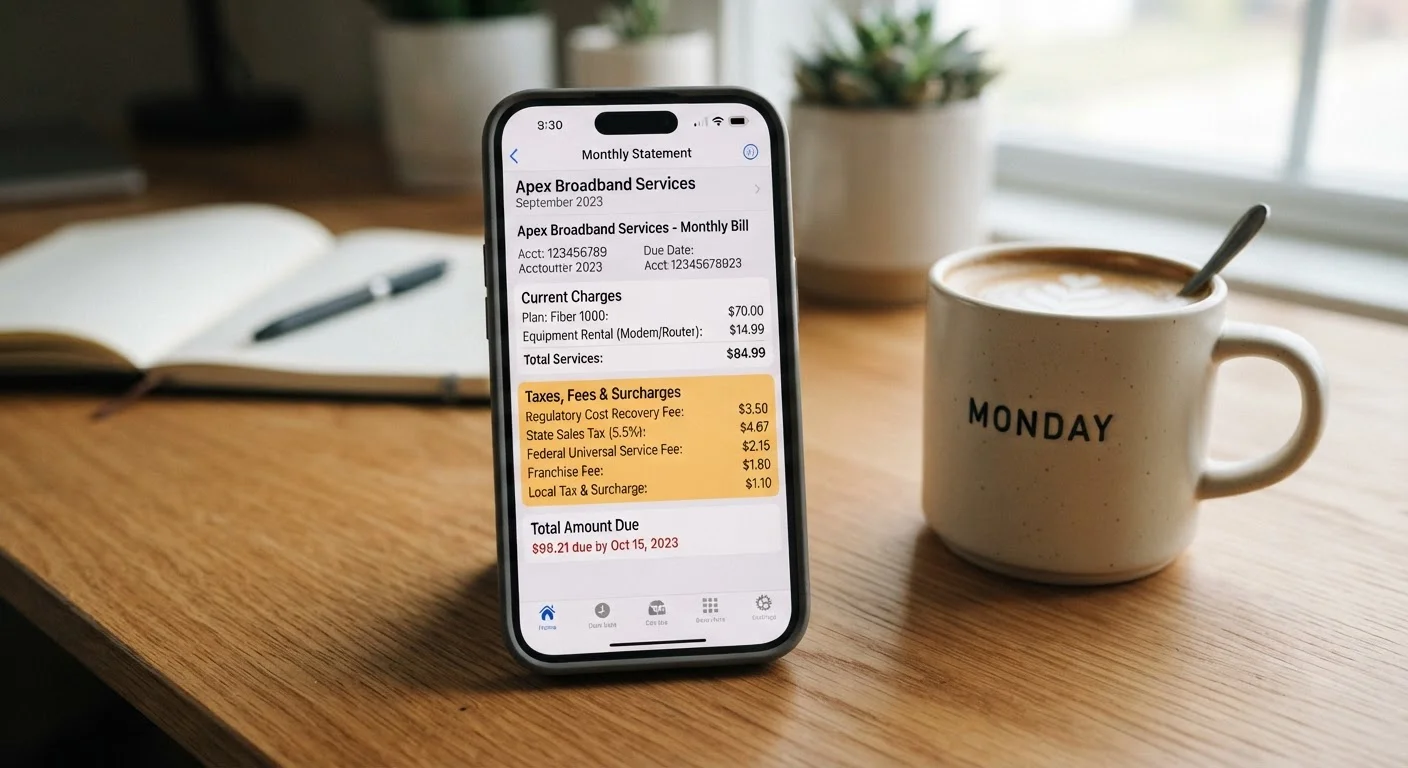
A cell phone bill is broken into individual charges called line items — each representing a specific cost, fee, tax, or discount applied to your account. The advertised plan price is rarely what you actually pay. Surcharges, government taxes, and carrier-added fees routinely push the total 20–30% above the headline number.
Carriers distinguish between 'taxes' (mandated by government) and 'fees' or 'surcharges' (set by the carrier itself). The latter are legal revenue streams, not government requirements, though they often appear alongside true taxes on a bill.
The Gap Between Advertised Price and Actual Bill
When a carrier promotes a plan at a specific monthly rate, that figure almost never reflects your final charge. Taxes and fees layered on top can add anywhere from $10 to $25 or more per line depending on where you live. Understanding the structure of those charges is the starting point for knowing what you're actually paying for.
Your bill generally splits into three buckets: the base plan cost, government-imposed taxes, and carrier-imposed surcharges. Each behaves differently — and only the first two are truly fixed from a consumer standpoint.
~24%
Average effective tax and fee rate on US phone bills
Research by the Tax Foundation has consistently found that combined taxes, fees, and government surcharges on wireless bills average around 24% nationally, though rates vary significantly by state.
$10–$25
Typical monthly add-on above advertised plan price
The gap between a carrier's advertised plan rate and actual monthly charge typically falls in this range for a single line, depending on state, city, and carrier surcharge structure.
3–5
Distinct fee categories on a typical phone bill
Most US wireless bills include separate line items for base plan cost, government taxes, federal surcharges, carrier administrative fees, and device installment charges — each calculated independently.
Government Taxes vs. Carrier Surcharges
True government taxes on phone bills include federal, state, and local charges such as the Federal Universal Service Fund (USF) contribution, state sales tax, and municipal telecommunications taxes. These vary significantly by location — a customer in one state may pay meaningfully more than someone on the same plan in another state.
Carrier surcharges, by contrast, are fees the carrier itself sets and collects. Common examples include administrative fees, regulatory recovery fees, and network access charges. These are legal, but they are not government mandates — carriers determine the amount. This distinction matters when comparing plan costs across carriers, because one carrier's surcharge lineup can be substantially higher than another's for an identical government tax burden.
Carrier Fees Are Not Government Taxes
Terms like 'regulatory recovery fee' or 'administrative charge' can look official, but these are carrier-determined amounts — not government-mandated taxes. The carrier collects and retains them. When comparing total plan costs across carriers, these fees are a legitimate variable to factor in, since carriers set their own amounts independently.
What 'Unlimited' Actually Means on Your Bill
The word 'unlimited' on a phone plan describes voice and text accurately — both are genuinely unlimited in the traditional sense. Data, however, is more nuanced. Most unlimited plans include a premium data threshold (often labeled as such on your bill) — the amount of high-speed data you receive before network management policies may apply.
Once you exceed that threshold, your data is not cut off, but it can be deprioritized during network congestion. This is commonly called throttling, though carriers prefer 'network management.' The threshold varies by plan tier — entry-level unlimited plans typically have lower thresholds than premium tiers. Your bill may not state the threshold explicitly; that information is usually found in your plan's terms or the carrier's website. For a fuller explanation of how mobile data works alongside Wi-Fi and calling, see our plain-language connectivity reference.
Autopay, Paperless Billing, and Discount Conditions
Many carriers advertise a per-line discount contingent on enrolling in autopay and paperless billing. This discount — often $5–$10 per line — is already baked into most advertised prices, meaning if you pay by check or don't enroll in paperless billing, your actual rate will be higher than advertised.
A critical detail: autopay discounts frequently require a bank account or debit card as the payment method. Linking a credit card may not qualify. If you switch payment methods mid-cycle, verify whether your discount is preserved. These conditions are stated in your plan's terms but are easy to overlook at sign-up.
Confirm Your Autopay Discount Qualifies
Before assuming your autopay enrollment is saving you money, verify which payment method your carrier requires for the discount. Log into your account, check your current payment method, and compare it against the carrier's stated discount conditions. Switching from a credit card to a debit card or bank account could reduce your monthly bill immediately.
Device Payment Plans and Line Access Fees
If you're paying off a phone through the carrier, your bill includes a separate device payment installment line — typically a 24- or 36-month installment. This is distinct from your plan cost, though carriers often bundle promotional credits against it that depend on staying on a qualifying plan. Leaving the plan early or switching carriers before the installment period ends may void remaining credits, meaning you'd owe the remaining device balance.
On family or multi-line accounts, each line also carries a line access fee — the per-line charge for connecting a device to the plan. These fees frequently decrease as you add more lines, which is why per-line costs on family plans look lower than individual plans. If you're evaluating whether a family plan makes financial sense, see budgeting basics for a framework to compare recurring monthly costs.
For readers new to managing a smartphone and its associated costs, our first smartphone owner's guide covers plan fundamentals alongside device setup.
Reading Your Bill Proactively
Billing errors are more common than most consumers realize — duplicate charges, dropped discounts, and incorrect plan rates all occur. Reviewing your itemized bill each month takes only a few minutes and is the most reliable way to catch problems early.
Look specifically for: changes to your base plan rate, any new fees that weren't present the previous month, and whether your autopay or loyalty discounts are still applying. Carriers are required to credit legitimate billing errors, but the burden of identifying them rests with you.
Managing your phone bill is part of the broader picture of tracking monthly subscriptions and fixed costs — a habit covered in practical terms through strategies for managing everyday expenses. And if you're considering a device upgrade, understanding refurbished phone trade-offs can help you weigh the financial upside against potential risks.