

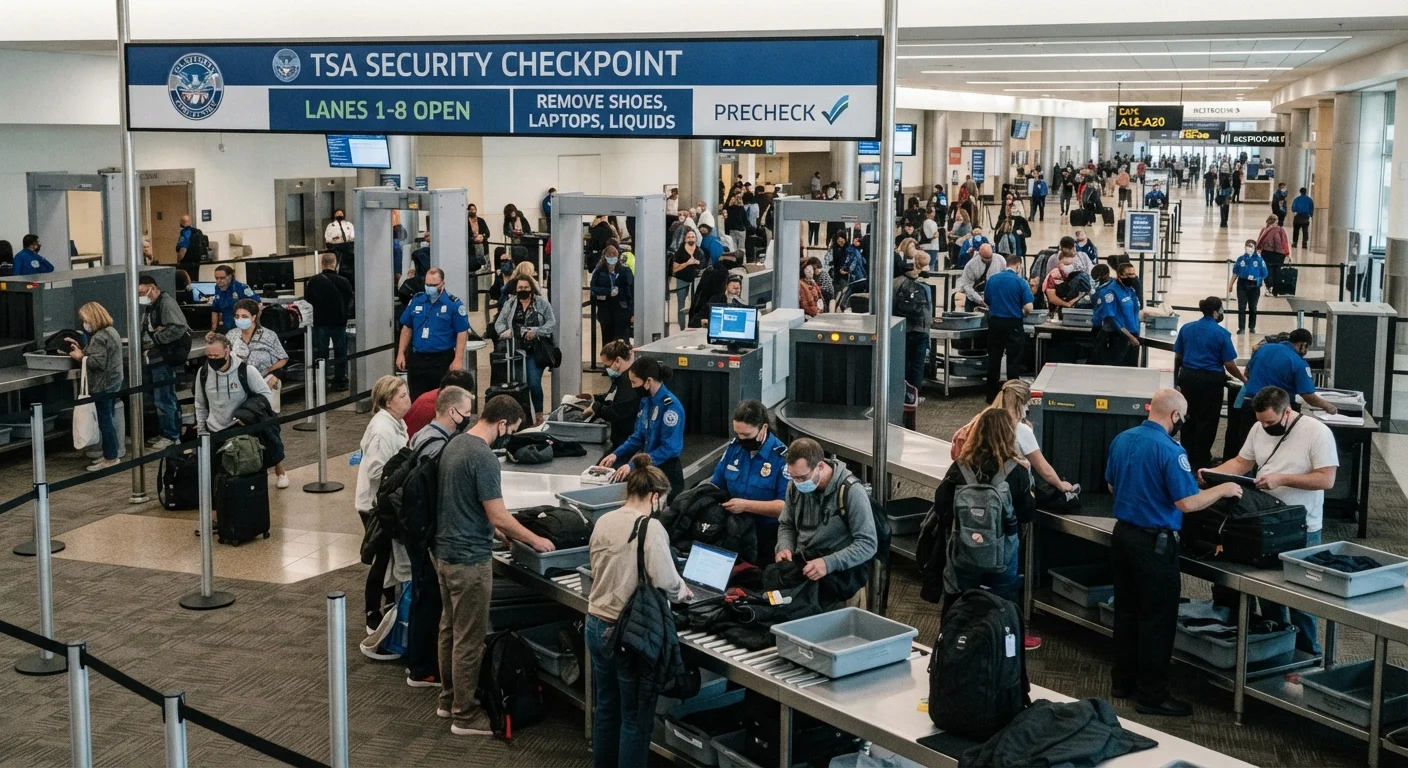
Key Takeaways
Why TSA Myths Persist
Airport security is one of those experiences nearly every American traveler dreads but rarely fully understands. Rules evolve, signage is inconsistent, and advice passed between friends often gets garbled along the way. The result? A persistent cloud of half-truths that slow you down, cause unnecessary stress, and sometimes lead to confiscated items you didn't need to lose.
Getting the details right actually matters. According to the TSA, officers screen roughly 2.5 million passengers per day across U.S. airports. Small misunderstandings — repeated millions of times — add up to real delays. The myths below are among the most widely believed, and correcting them can make your next checkpoint experience significantly smoother. For a deeper dive into packing rules, our full carry-on guide walks through liquids, electronics, and medications in practical detail.
~2.5M
Passengers screened by TSA daily
According to the TSA's publicly reported throughput data, approximately 2.5 million travelers pass through U.S. checkpoints on a typical day.
15M+
Active TSA PreCheck members
The TSA has reported that enrollment in the PreCheck trusted traveler program has grown to more than 15 million members across the United States.
The Myths, Corrected
From the liquids rule to PreCheck assumptions, here's what travelers consistently get wrong — and what the TSA's own published guidance actually says.
Myth
You must remove your shoes at every TSA checkpoint, no exceptions.
Fact
Travelers enrolled in TSA PreCheck are generally not required to remove shoes. Children 12 and under and adults 75 and older also receive modified screening procedures.
The shoe-removal rule dates to post-2001 security updates, but it has never applied uniformly to all passengers. TSA PreCheck lanes explicitly allow travelers to keep their shoes on, along with their belts and light jackets. Even in standard lanes, TSA officers can use judgment when screening certain passengers. If you travel frequently, PreCheck enrollment is the most reliable way to sidestep shoe removal consistently.
Myth
The 3-1-1 rule means no liquid over 3.4 oz — no exceptions whatsoever.
Fact
Medically necessary liquids, infant formula, breast milk, and certain food items are exempt from the standard 3-1-1 limitations and do not need to fit inside the quart-sized bag.
The 3-1-1 rule (containers of 3.4 oz or less, in one quart-sized clear bag, one bag per passenger) applies to standard carry-on liquids. However, TSA explicitly exempts medically necessary liquids such as medications, as well as breast milk, infant formula, and juice for young children. These items may exceed 3.4 oz and should be declared to an officer at the checkpoint. Additional screening such as X-ray or testing may still apply. Always carry documentation for medications when traveling, especially internationally.
Myth
TSA PreCheck means you'll always get through faster than the standard line.
Fact
PreCheck lanes are typically faster, but there's no guarantee — during peak travel periods, PreCheck lanes can sometimes be longer than standard lanes at certain airports.
TSA PreCheck provides access to dedicated, expedited lanes where you keep shoes on, laptops in bags, and liquids packed. But enrollment doesn't generate a personal fast pass. PreCheck lanes can fill up, and not every checkpoint at every airport has a dedicated PreCheck lane open at all hours. Additionally, your PreCheck status isn't printed on every ticket automatically — travelers sometimes forget to ensure their Known Traveler Number (KTN) is linked to their airline reservation before booking.
Myth
Only laptops need to come out of your bag at security.
Fact
In standard (non-PreCheck) lanes, all personal electronics larger than a cell phone — including tablets, e-readers, and portable game consoles — must be removed and placed in a bin.
The TSA expanded its electronics screening guidelines, and the "laptops only" assumption is outdated for standard screening lanes. Tablets, e-readers, and similarly sized devices are included. In PreCheck lanes, none of this applies — electronics stay in your bag. The distinction is worth knowing before you reach the belt, because fumbling to find a tablet buried in your bag is one of the most common causes of slowdowns at the checkpoint.
Myth
Packing neatly means your bag won't get flagged for additional screening.
Fact
Bag organization affects scan clarity, but TSA screening decisions are based on what's inside, not how orderly it looks.
While a densely packed, disorganized bag can create imaging ambiguity that prompts a hand-check, neat packing alone doesn't prevent secondary screening. What triggers additional review is the presence of dense or overlapping items that obscure the X-ray image — think stacks of books, bundled cables, or clustered food items. Separating these categories into different areas of your bag (or a dedicated outer pocket) genuinely helps the image read more clearly, but it's no guarantee of a wave-through.
Don't Rely on Fellow Travelers for Security Rules
Advice overheard in security lines — or passed along by well-meaning friends — is frequently outdated. TSA policies are updated without wide public notice, and what was true two years ago may not apply today. Always verify current rules directly on the TSA's official website (tsa.gov) before your travel date, especially for unusual items like sporting equipment, tools, or specialty foods.
It's also worth noting that individual officers retain discretion to request additional screening even when you've followed every rule perfectly. Policies are applied consistently in principle, but checkpoint conditions vary. For peace of mind on connected logistics — like how early to actually arrive — experienced travelers confirm these details in advance.
And if you've bought into money-saving travel myths beyond the checkpoint, some popular travel savings beliefs don't hold up either.
Your Known Traveler Number Must Be on Your Ticket
Enrolling in TSA PreCheck doesn't automatically apply your benefits to every flight you book. You must enter your Known Traveler Number (KTN) when booking or add it to your frequent flyer profile so it transfers to your boarding pass. If the KTN doesn't appear on your ticket, you'll be directed to a standard lane regardless of your enrollment status. Check your boarding pass before reaching the airport.