

Key Takeaways
The 3-1-1 Liquids Rule: What It Actually Means
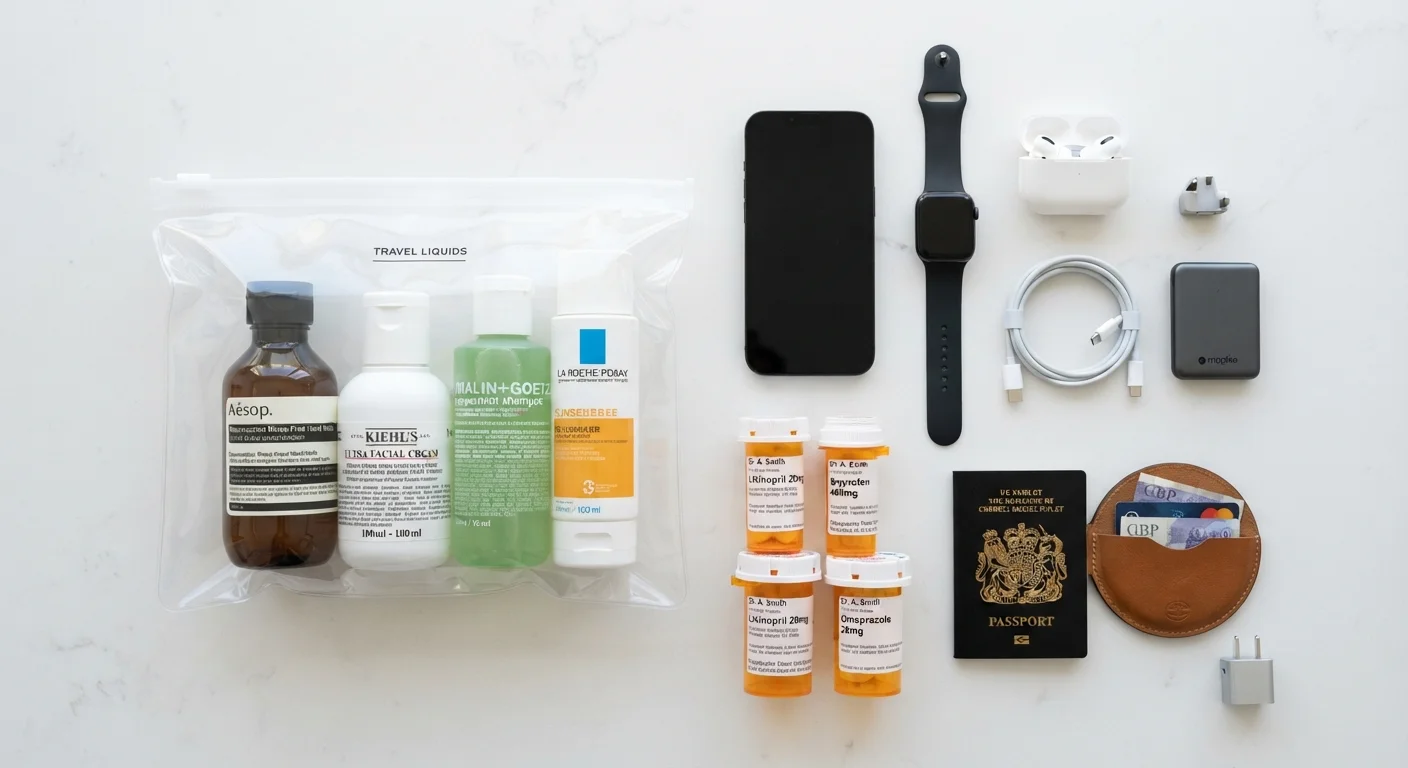
The TSA's 3-1-1 rule governs what liquids you can bring through a standard checkpoint in a carry-on bag. The formula breaks down like this: each liquid, gel, or aerosol must be in a container of 3.4 ounces (100 milliliters) or less. All containers must fit inside one quart-sized, clear, zip-top plastic bag. Each passenger is limited to one such bag.
The rule applies to anything with a liquid or gel consistency — shampoo, toothpaste, sunscreen, liquid foundation, hair gel, and even peanut butter. The size limit refers to the container's labeled capacity, not how full it is. A 4 oz bottle with only a teaspoon of lotion inside still fails the rule.
Go Solid When You Can
Solid toiletry formats — bar shampoo, solid conditioner, powdered sunscreen, solid deodorant — don't count as liquids under TSA rules and never need to fit in your quart bag. Switching even two or three items to solid form can free up significant space in your one-bag allowance for items that truly must be liquid.
Solid alternatives sidestep the rule entirely. Solid shaving soap, bar shampoo, powder sunscreen, and solid deodorant don't count as liquids and don't need to go in your quart bag — a useful trick for longer trips. For a comprehensive packing strategy, see our carry-on packing guide for two-week trips.
Exceptions to the Liquids Rule You Should Know
Not everything liquid-like is subject to the 3-1-1 rule. The TSA recognizes several important carve-outs that many travelers don't realize apply to them.
- Baby formula, breast milk, and juice for infants: These are allowed in quantities exceeding 3.4 oz. They must be declared at the checkpoint and may undergo additional screening.
- Liquid medications and medical necessities: Covered in more depth below, but they are permitted beyond the 3.4 oz limit when declared.
- Duty-free liquids purchased past security: Bottles purchased in duty-free shops beyond the security checkpoint, or during a layover abroad, may be allowed if they remain in a sealed, tamper-evident bag with the receipt visible. Rules vary by airline and connecting country — verify before you travel.
3.4 oz
Maximum liquid container size allowed
Per TSA policy, each individual liquid container in a carry-on must hold 3.4 oz (100 ml) or less.
1 quart
Total bag size for all carry-on liquids
All compliant liquid containers must fit within a single, clear, quart-sized zip-top bag per traveler.
100 Wh
Lithium battery watt-hour limit (most airlines)
Many carriers allow lithium-ion batteries up to 100 Wh without prior approval; check with your specific airline for limits.
If you're unsure whether a specific item is allowed, the TSA's What Can I Bring? tool on their official website lets you search by item and get a current ruling. Rules do occasionally shift, so checking before departure is worthwhile. Also see common TSA myths debunked for a fuller picture of what travelers frequently get wrong.
Traveling with Electronics: What Gets Screened
Electronics require a bit of choreography at the checkpoint. Under standard TSA screening, laptops must be removed from your bag and placed alone in a bin. The same applies to large tablets and e-readers — though TSA officers have discretion on smaller devices.
Other electronics that may require removal include external battery packs, gaming consoles, and DSLR cameras. Smaller items like phones and earbuds can typically stay in your bag, but when in doubt, remove them to avoid a rescan delay.
Pack your power bank in your personal item rather than your carry-on roller bag. If TSA flags it for a secondary check, you won't have to fully unpack your main bag.
Spare lithium batteries must travel in the cabin and are one of the most commonly flagged items at the checkpoint, making quick access essential.
Travel with a printed or photographed copy of your prescription for any liquid medication that exceeds 3.4 oz. It won't always be required, but having it available removes uncertainty.
While TSA doesn't mandate prescription documentation for domestic flights, having it on hand can smooth interactions at the checkpoint and is often required at international borders.
Power banks and lithium-ion batteries have their own rules. Spare (uninstalled) lithium batteries must go in carry-on luggage — they are not permitted in checked bags. Devices with batteries can be checked, but spare batteries cannot. The FAA regulates lithium battery quantities and watt-hour ratings, and airlines may have stricter limits, so check with your carrier for high-capacity power banks.
TSA PreCheck members enjoy a notable perk: electronics can stay inside bags during screening. If you travel frequently, enrollment in a trusted traveler program can meaningfully reduce checkpoint friction. The pre-departure traveler checklist walks through how to prep your documents and devices well before airport day.
Medications in Your Carry-On: The Real Rules
Traveling with medications — prescription or over-the-counter — is generally straightforward, but a few specifics are worth knowing.
The TSA allows medications in pill, liquid, or injectable form in carry-on bags. Liquid medications are exempt from the 3.4 oz rule, but you must declare them separately at the checkpoint. Officers may need to inspect them, so keep medications accessible and don't pack them deep in your bag.
- Prescription medications: You are not required by TSA to carry medications in their original labeled bottles, though doing so can simplify both the checkpoint process and any questions that arise at international borders.
- Insulin and sharps: Insulin, syringes, lancets, and related supplies are permitted when traveling with diabetes equipment. Notify the officer before screening begins.
- Controlled substances: TSA's primary focus is security, not law enforcement, but controlled substances must comply with all applicable federal and state laws. When traveling internationally, always carry documentation and verify the destination country's import rules, as some medications legal in the US are restricted or prohibited abroad.
Medications: Check the Law, Not Just the TSA Rule
TSA permitting a medication through a domestic checkpoint does not mean that medication is legal to carry into another country. Some substances that are prescription-legal in the United States are classified as controlled or prohibited in other nations. Before traveling internationally with any prescription drug, verify the destination country's import requirements through their official embassy or consulate — not just travel blogs or forums.
This article provides general TSA guidance and is not medical or legal advice. For questions about traveling with specific medications — especially controlled substances, injectable therapies, or large supplies — consult your prescribing healthcare provider and verify current regulations with official government sources before you travel. See also our companion piece on planning trips around health needs.
Packing Smart to Breeze Through the Checkpoint
The biggest checkpoint slowdowns are almost always preventable. A few deliberate packing habits can eliminate rescan requests and keep the line moving.
- Put your quart liquids bag on top. It should be the first thing you grab when you open your carry-on. Officers need to see it easily.
- Layer electronics near the top. If standard screening applies, your laptop and large devices need to come out fast. Stash them in the outermost compartment.
- Bag your medications separately. A small dedicated pouch keeps them accessible for declaration without requiring you to unpack everything else.
- Empty your pockets before you get to the conveyor. Coins, keys, and forgotten items in pockets are a common source of delays.
- Know your program status. TSA PreCheck, Global Entry, and CLEAR each offer different benefits and apply at different parts of the airport process. Make sure your Known Traveler Number is on your reservation.
For a broader checklist — from documents and prescriptions to home security before you leave — the pre-travel checklist for overlooked items is worth bookmarking. With a little preparation, the checkpoint becomes one of the least stressful parts of your journey.
This article is for general informational purposes only. TSA policies can change; always verify current rules at the official TSA website (tsa.gov) and consult relevant government agencies for entry requirements when traveling internationally.