

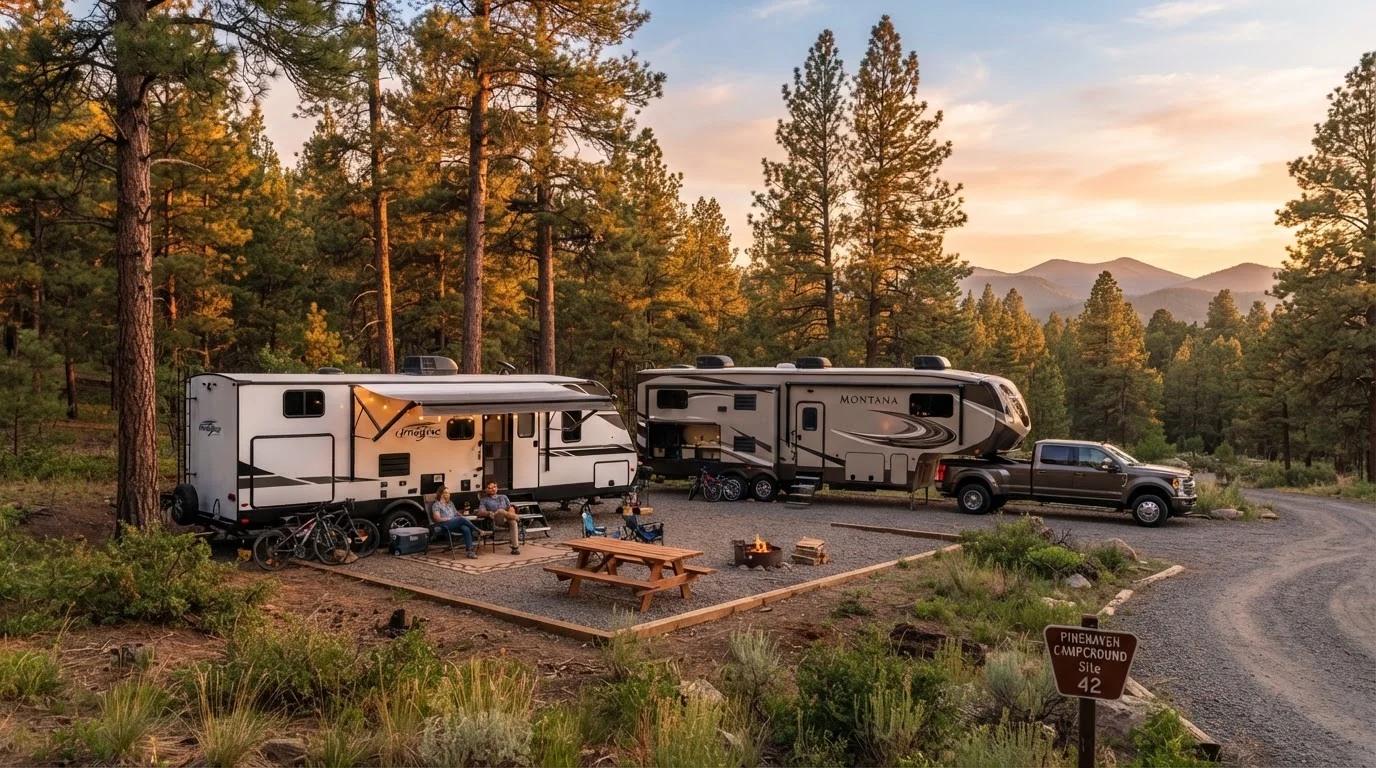
Key Takeaways
Option A
Travel Trailer
The versatile, broadly compatible choice.
Best for: Owners of a wide variety of tow vehicles who want flexibility and lower entry cost.
Option B
Fifth Wheel
The spacious, stable upgrade for serious haulers.
Best for: Pickup truck owners who prioritize livability, towing stability, and higher payload capacity.
If you already own an SUV or half-ton truck
Travel Trailer
Travel trailers work with a standard ball hitch, making them compatible with far more tow vehicles. A fifth wheel almost always requires a full-size pickup.
If you plan to live in your RV full-time or for extended periods
Fifth Wheel
Fifth wheels typically offer more square footage, better-separated living areas, and the kind of residential amenities that make long-term living practical.
If towing confidence at highway speeds is a priority
Fifth Wheel
The kingpin-and-hitch design places more of the trailer's weight over the rear axle, significantly improving stability and reducing sway risk.
If you want to keep upfront costs manageable
Travel Trailer
Entry-level travel trailers span a wide price range and are generally less expensive than fifth wheels of equivalent size.
If you need to use the truck bed for cargo during trips
Travel Trailer
A fifth wheel hitch permanently occupies much of the bed; a travel trailer leaves your truck bed fully available when uncoupled.
How the Two Hitching Systems Work
The most fundamental difference between a travel trailer and a fifth wheel is how each one connects to the tow vehicle. A travel trailer uses a ball-and-coupler hitch mounted to the vehicle's rear receiver. This design is common, widely compatible, and straightforward to operate - though it concentrates leverage at the very back of the tow vehicle, which can amplify sway if not properly managed with a weight-distribution hitch.
A fifth wheel uses a kingpin-and-plate hitch mounted in the bed of a pickup truck, directly above or just ahead of the rear axle. This geometry places a significant portion of the trailer's weight where the truck is structurally strongest, reducing sway and improving handling. The tradeoff: it requires a full-size pickup, and the in-bed hitch takes up meaningful bed space.
Before evaluating anything else, consult your tow vehicle's actual ratings. The advertised tow capacity is only part of the equation - payload, tongue weight limits, and Gross Combined Weight Rating (GCWR) all play a role. See our full guide on tow ratings for a detailed breakdown of why those numbers matter differently for each trailer type.
Space, Layout, and Livability Compared
Fifth wheels typically offer more usable interior space than travel trailers in the same price range. The raised front section - which extends over the truck bed - creates a dedicated bi-level floor plan, usually placing the master bedroom on an upper level separate from the main living area. This design is particularly valued by full-timers and those on extended trips.
Travel trailers come in an enormous range of sizes and floor plans, from compact 16-foot units to sprawling 35-foot models. They can work for weekend warriors and full-time travelers alike, but their single-level design means living areas, sleeping quarters, and kitchens share a more open (and sometimes cramped) footprint at comparable lengths.
| Criterion | Travel Trailer | Fifth Wheel |
|---|---|---|
| Hitch type | Ball-and-coupler (rear receiver) | Kingpin-and-plate (in-bed) |
| Required tow vehicle | SUV, half-ton, or larger truck | Full-size pickup (3/4-ton or 1-ton) |
| Typical weight range | 2,500-13,000 lbs | 12,000-20,000 lbs |
| Towing stability | Moderate; sway management required | High; weight over rear axle reduces sway |
| Living space layout | Single-level; wide variety of floor plans | Bi-level; bedroom elevated over hitch |
| Truck bed access | Bed fully available when uncoupled | Bed partially occupied by hitch |
| Entry-level cost | Generally lower | Generally higher |
| Best suited for | Weekend trips to extended travel | Extended or full-time living |
If you're weighing whether a tow-behind camper suits your lifestyle at all - versus a self-propelled motorhome - our comparison of motorhomes vs. towable campers covers that broader question.
Weight, Towing, and Vehicle Requirements
Travel trailers span a wide weight range - from under 3,000 lbs for lightweight models to over 12,000 lbs for large luxury units. This variety makes them compatible with crossovers, half-ton trucks, and even some minivans on the lighter end. However, heavier travel trailers still require significant tow capacity, and tongue weight (typically 10-15% of trailer weight) must fall within the tow vehicle's rated limit.
Fifth wheels are almost universally heavy, with most falling between 12,000 and 20,000 lbs loaded. They require a three-quarter-ton or one-ton pickup truck in the vast majority of cases. The benefit is that the hitch geometry keeps handling more predictable at those weights - but the vehicle investment is substantial if you don't already own a capable truck.
~10-15%
Tongue weight as share of trailer's loaded weight
Industry guidelines recommend tongue weight fall within 10-15% of total loaded trailer weight to maintain safe handling for ball-hitch trailers.
3/4-ton+
Minimum truck class for most fifth wheels
Most fifth wheel manufacturers specify a three-quarter-ton or heavier pickup to meet payload and hitch rating requirements for their units.
Safe towing habits matter regardless of which style you choose. Our guide to safe RV driving practices covers the habits experienced towers rely on for both trailer types.
Cost and Long-Term Ownership Considerations
Travel trailers generally carry lower purchase prices at equivalent lengths, and because they work with a broader range of tow vehicles, buyers don't always need to upgrade their truck. Total cost of ownership depends heavily on usage patterns, maintenance habits, and storage - both trailer types require similar upkeep in terms of roof sealing, slide-out maintenance, and LP system checks.
Fifth wheel owners should factor in the cost of a gooseneck or fifth wheel hitch installation (typically several hundred to over a thousand dollars depending on the system), plus the truck itself if an upgrade is needed. On the other hand, the added stability and residential amenities can justify the investment for those who use the rig frequently or full-time.
For anyone seriously considering full-time living in either format, our honest assessment of full-time RV life addresses the practical and financial realities before you commit. And if you're newer to RV culture altogether, our complete RV lifestyle introduction is a solid starting point.
Floor Plan Variety Is Wide in Both Categories
Both travel trailers and fifth wheels are available in dozens of floor plan configurations - bunkhouse, front kitchen, rear living, toy hauler, and more. Don't evaluate either type based solely on a single unit you've seen. Visiting a dealer lot or RV show to walk multiple layouts is one of the most practical steps before purchasing.