

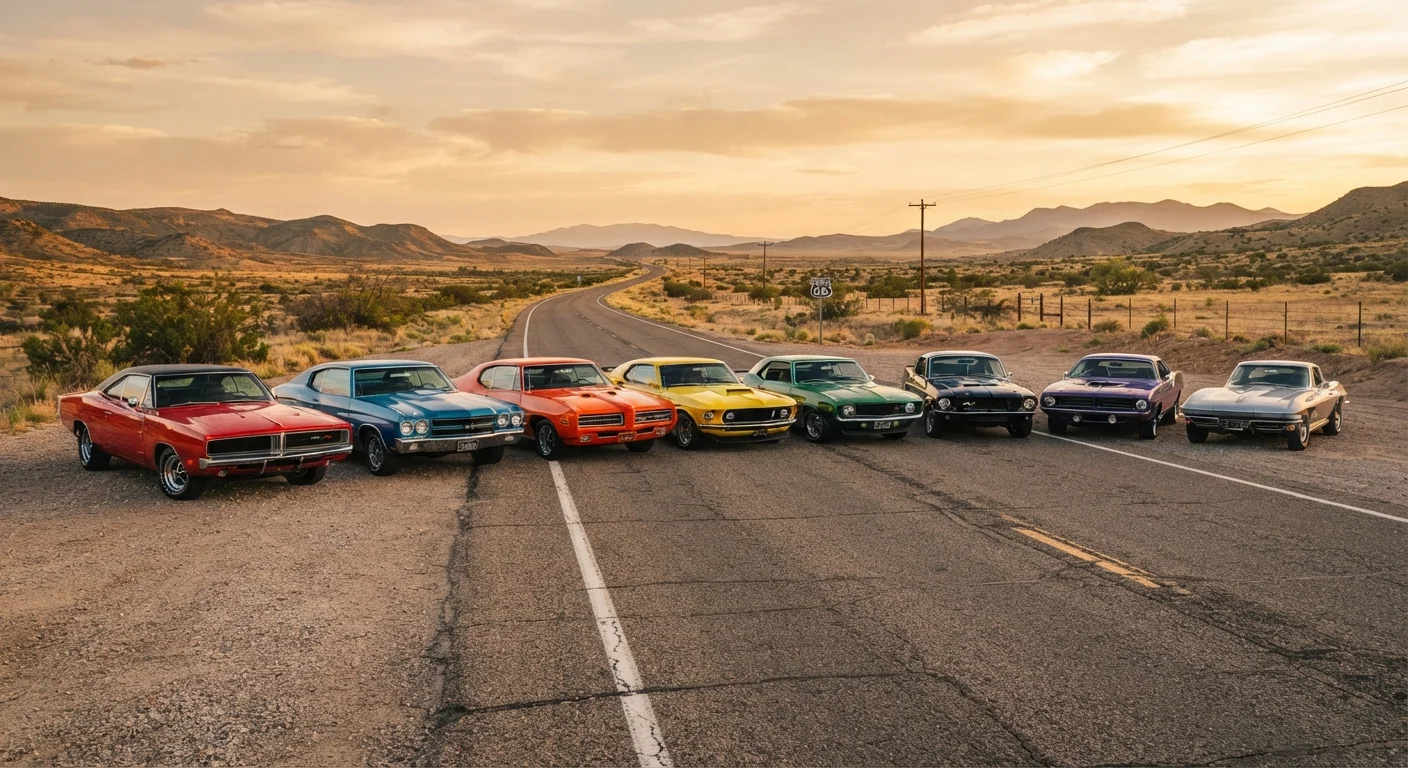
What Defines a Muscle Car
The term "muscle car" has a specific meaning in American automotive culture: a mid-size or full-size rear-wheel-drive vehicle, produced for the mass market, fitted with a large-displacement V8 engine originally intended for maximum straight-line performance. This formula distinguished muscle cars from purpose-built sports cars, which prioritized handling, and from luxury cars, which prioritized refinement.
Understanding the distinction matters for collectors and history enthusiasts alike. If you're new to this space, our classic car glossary breaks down the specific vocabulary used at shows and auctions. And for those just beginning to explore ownership, entering the classic car hobby is a practical starting point.
The 1950s: Seeds of Performance
The muscle car story doesn't begin with a single model - it begins with postwar optimism and a booming economy that gave American consumers disposable income and a desire for speed. By the mid-1950s, automakers were dropping larger, more powerful V8 engines into standard production cars as optional upgrades, responding to a grassroots hot-rod culture already flourishing on streets and drag strips.
The 1955 Chevrolet 265 cubic-inch small-block V8 is widely cited as a pivotal development - a compact, efficient, and powerful engine architecture that proved high performance didn't require a massive, heavy powerplant. Meanwhile, Chrysler's "letter series" performance cars hinted at what was possible when engineers were given latitude to push output figures. The decade planted the ideas; the 1960s would harvest them.
The 1960s: The Classic Muscle Era
Most automotive historians identify 1964 as the opening of muscle cars' golden age, marked by the debut of the Pontiac GTO - a full-size engine inserted into an intermediate-sized body and offered as a dealer option package. Its commercial success signaled to every major American manufacturer that performance could sell in volume.
1964
Year widely considered the start of the muscle car era
The Pontiac GTO's commercial debut that year is cited by most automotive historians as the catalyst.
400+
Factory-rated horsepower in select 1970 production engines
Multiple manufacturers offered engines officially rated above 400 hp during the 1970 model year.
~8 years
Duration of the classic muscle car era at full intensity
From roughly 1964 to 1972, before emissions rules and the oil embargo reshaped the market.
The mid-to-late 1960s saw a cascade of iconic nameplates enter production. Ford's Mustang, introduced in April 1964, created an adjacent category - the "pony car" - distinguished by its smaller footprint and lower price point, though high-output variants blurred the line significantly. Dodge, Plymouth, Buick, and Oldsmobile each fielded serious competitors throughout the decade, resulting in an era of genuine factory-backed performance that has never been fully replicated.
Insurance rates, drag strip culture, and the era's youthful consumer demographic all shaped product decisions. Engineers competed openly for horsepower figures, and displacement climbed steadily toward the end of the decade.
The Early 1970s: Power Peak and Rapid Decline
By 1970, factory-rated horsepower figures reached their historic zenith. Several production engines were officially rated above 400 horsepower - figures that, decades later, remain impressive benchmarks. The 1970 model year is frequently cited by collectors as the pinnacle of factory muscle output.
The decline came quickly and from multiple directions simultaneously. Insurance companies, responding to accident statistics involving high-powered vehicles driven by young men, imposed significant premium increases on performance cars. Federal emissions regulations, phased in beginning with the 1968 model year and tightening substantially by 1971-1972, forced manufacturers to retune engines for cleaner combustion - with notable reductions in output. The 1973 oil embargo then collapsed consumer demand for fuel-thirsty vehicles entirely.
By the mid-1970s, most muscle nameplates had been discontinued, significantly detuned, or transformed into appearance packages without corresponding performance. The era had lasted roughly a decade at full intensity.
Muscle Car
A mid-size or full-size, rear-wheel-drive American production vehicle fitted with a large V8 engine and sold to mainstream consumers at a relatively accessible price point, optimized for straight-line acceleration.
Pony Car
A smaller, lighter performance car with a long hood and short rear deck, pioneered by the Ford Mustang in 1964. Overlaps with but is distinct from the muscle car category.
Displacement
The total volume swept by all pistons in an engine, measured in cubic inches or liters. Higher displacement generally allows more fuel and air combustion, producing greater power output.
Numbers Matching
A term describing a vehicle whose major drivetrain components - engine, transmission, and rear axle - carry factory-stamped codes that correspond to the original build records for that specific car.
Detuning
The process of reducing an engine's power output, typically by lowering compression ratios or altering fuel and ignition calibration, often to meet emissions or fuel economy standards.
Letter Car
A nickname for Chrysler Corporation's high-performance limited-production models of the late 1950s, designated by letters (e.g., 300C, 300D), which were among the most powerful American production cars of their era.
For those interested in how a vehicle's documented production history affects its standing today, our piece on classic car provenance explains what makes paperwork so important in this hobby. Collectors weighing an original survivor against a fully restored example will also find useful perspective in our guide to barn finds vs. restored classics.