

Key Takeaways
Our Verdict
For most wet areas like full bathrooms and laundry rooms, tile remains the gold standard for moisture protection, while luxury vinyl plank is a practical, comfortable alternative where budget and comfort matter. Hardwood in any form is best kept away from consistently wet zones and reserved for low-humidity spaces where its warmth and character can thrive without the risk of moisture damage.
| Best for | Recommended |
|---|---|
| Full bathrooms and laundry rooms with frequent standing water | Tile |
| Homeowners wanting comfort underfoot and easy DIY installation | Luxury Vinyl Plank (LVP) |
| Low-humidity kitchens or half-baths where aesthetics are a priority | Engineered Hardwood |
Why Wet Area Flooring Deserves Extra Scrutiny
Wet areas — bathrooms, mudrooms, laundry rooms, and kitchens — expose flooring to moisture far more aggressively than living rooms or bedrooms. Water infiltration beneath a floor surface can cause subfloor rot, mold growth, and structural damage that costs far more to repair than the original flooring ever did. Choosing the wrong material isn't just an aesthetic mistake; it can be a costly structural one.
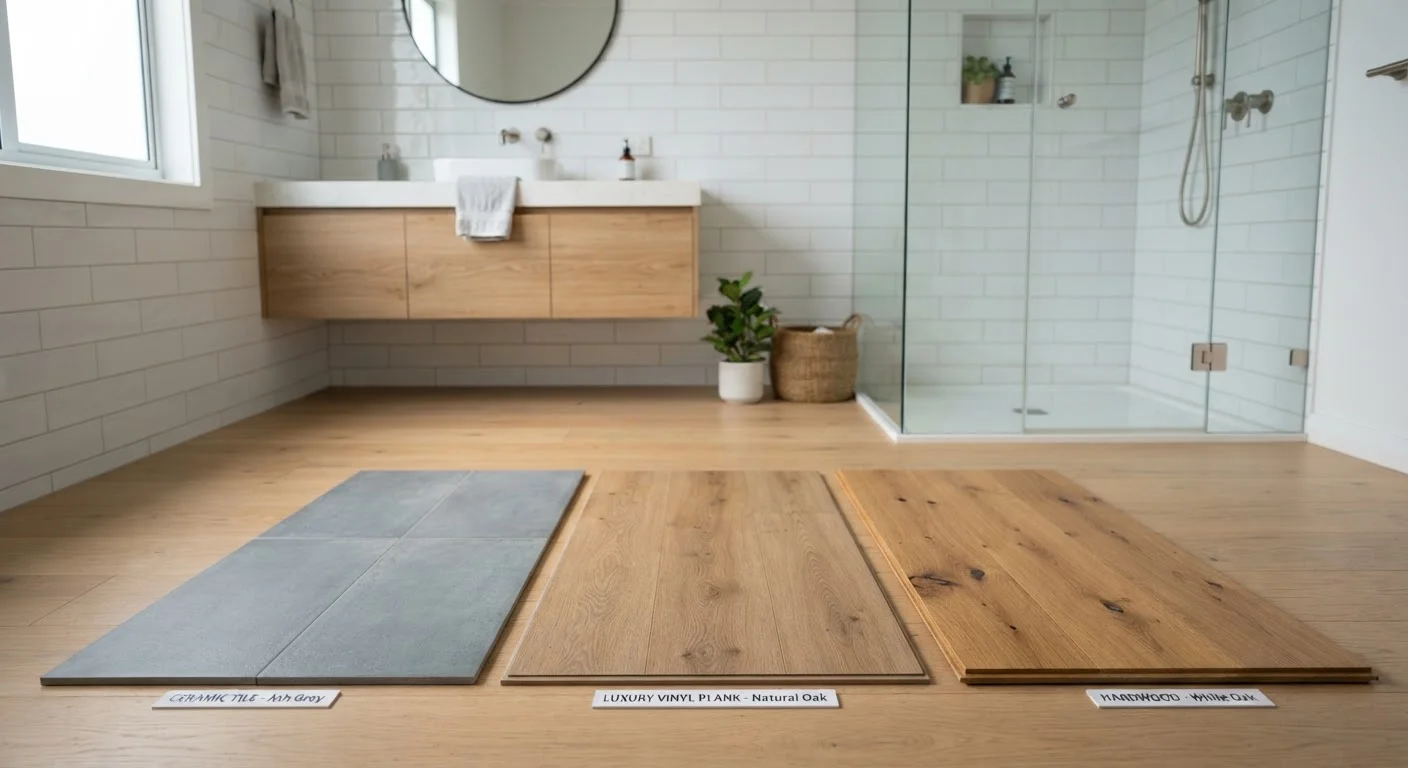
The three most commonly considered options for these spaces are ceramic or porcelain tile, luxury vinyl plank (LVP), and hardwood (either solid or engineered). Each performs very differently when humidity, splashing, and occasional standing water enter the picture. Understanding those differences is the foundation of a smart decision.
| Tile | Luxury Vinyl Plank | Engineered Hardwood | |
|---|---|---|---|
| Moisture Resistance | Excellent (near-impervious) | Excellent (waterproof core) | Moderate (not for standing water) |
| Durability | Very high (decades) | High (10–25 years) | Moderate (depends on finish) |
| Comfort Underfoot | Cold and hard | Warm and resilient | Warm and natural feel |
| DIY Friendliness | Low — skilled work required | High — click-lock system | Medium — varies by install type |
| Maintenance | Grout resealing needed | Easy to clean | Requires careful moisture management |
| Relative Cost (installed) | Moderate to high | Low to moderate | Moderate to high |
Tile: The Moisture-Proof Standard
Ceramic and porcelain tile are inherently water-resistant — the tile itself does not absorb moisture. Porcelain, with its denser composition, is considered nearly impervious to water, making it particularly well-suited for shower floors and areas with regular water exposure. Properly sealed grout lines close the remaining gap, though grout does require periodic resealing to maintain that protection.
Tile's durability is exceptional — a well-installed tile floor can last decades. It's also easy to clean and hygienic, which matters in bathrooms and kitchens. The tradeoffs are real, however: tile is cold and hard underfoot, grout lines trap dirt and require maintenance, and the installation process is demanding. Uneven subfloors must be corrected before installation, and cracking can occur if the subfloor flexes. Professional installation is often advisable, particularly for large-format tiles or complex patterns.
Don't Skip the Subfloor Assessment
One of the most common and costly mistakes in wet-area flooring projects is installing new material over a compromised subfloor. Soft spots, rot, existing moisture damage, or excessive flex can cause even premium tile or LVP to fail prematurely. Before any installation begins, have the subfloor inspected — and budget for repairs if needed. Skipping this step often leads to far more expensive corrections down the road.
Luxury Vinyl Plank: The Practical Middle Ground
Luxury vinyl plank has improved dramatically over the past decade. Modern LVP products are 100% waterproof through their core layers — unlike older vinyl that could delaminate — making them genuinely suitable for wet areas. They replicate the look of wood or stone convincingly and feel warmer and softer underfoot than tile.
Installation is generally more DIY-friendly than tile: most LVP uses a floating click-lock system that doesn't require adhesive across the full floor. This also makes future replacement simpler. LVP is typically less expensive than tile or hardwood on a per-square-foot basis when labor is included.
Limitations exist, though. LVP can be scratched by heavy furniture or sharp debris. In very high-temperature environments, some products may expand or buckle. And while the planks themselves are waterproof, water that seeps under the edges — through gaps at walls or thresholds — can still reach the subfloor and cause problems. Proper perimeter sealing is essential.
Seal the Perimeter on LVP Installations
Even though luxury vinyl plank planks are waterproof, gaps around the edges of a room — at baseboards, door thresholds, and transitions — can allow water to seep underneath and reach the subfloor. Use a waterproof caulk or silicone sealant along these perimeter areas after installation. This simple step significantly extends the life of the floor and protects the subfloor below.
Hardwood: Beautiful but Vulnerable
Solid hardwood is not recommended for wet areas. Wood expands and contracts with humidity changes, and repeated moisture exposure causes warping, cupping, and eventual decay. Most flooring professionals advise against solid hardwood in bathrooms or laundry rooms entirely.
Engineered hardwood — which has a real wood veneer over a plywood or composite core — is more dimensionally stable than solid wood and can tolerate moderate humidity better. Some homeowners use it in kitchens or powder rooms where the moisture exposure is limited and spills are wiped up promptly. However, it still cannot withstand standing water or consistent humidity the way tile or LVP can. Finish quality and core construction vary widely between products, so reading technical specifications carefully matters here.
The appeal of hardwood — warmth, character, and resale appeal — is genuine. Just as selecting the right paint finish affects long-term durability in other rooms (see our guide to interior paint finishes), matching material to environment is the foundational principle. For a broader look at how material choice affects durability in different contexts, our wood vs. composite decking comparison explores similar trade-offs outdoors.
Installation, Cost, and What to Ask a Contractor
Installation complexity affects both cost and outcome. Tile requires a stable, level subfloor — often requiring a cement backer board — and skilled application of mortar and grout. Mistakes are difficult and expensive to correct. LVP is more forgiving and can often float over an existing subfloor in good condition. Engineered hardwood may be glued, nailed, or floated depending on the manufacturer's specifications.
When getting contractor bids, ask specifically about subfloor preparation costs, since these are frequently omitted from initial estimates. Ask what moisture barrier (if any) will be used beneath the flooring. For tile, ask about grout type — epoxy grout is more stain- and moisture-resistant than sanded or unsanded cement grout, though it costs more and is harder to apply.
None of these materials come with a performance guarantee regardless of price. Local conditions — humidity levels, subfloor construction, and usage patterns — all influence how a floor will hold up over time. Consulting a licensed flooring contractor before committing is particularly worthwhile in older homes where subfloor condition may be unknown.