

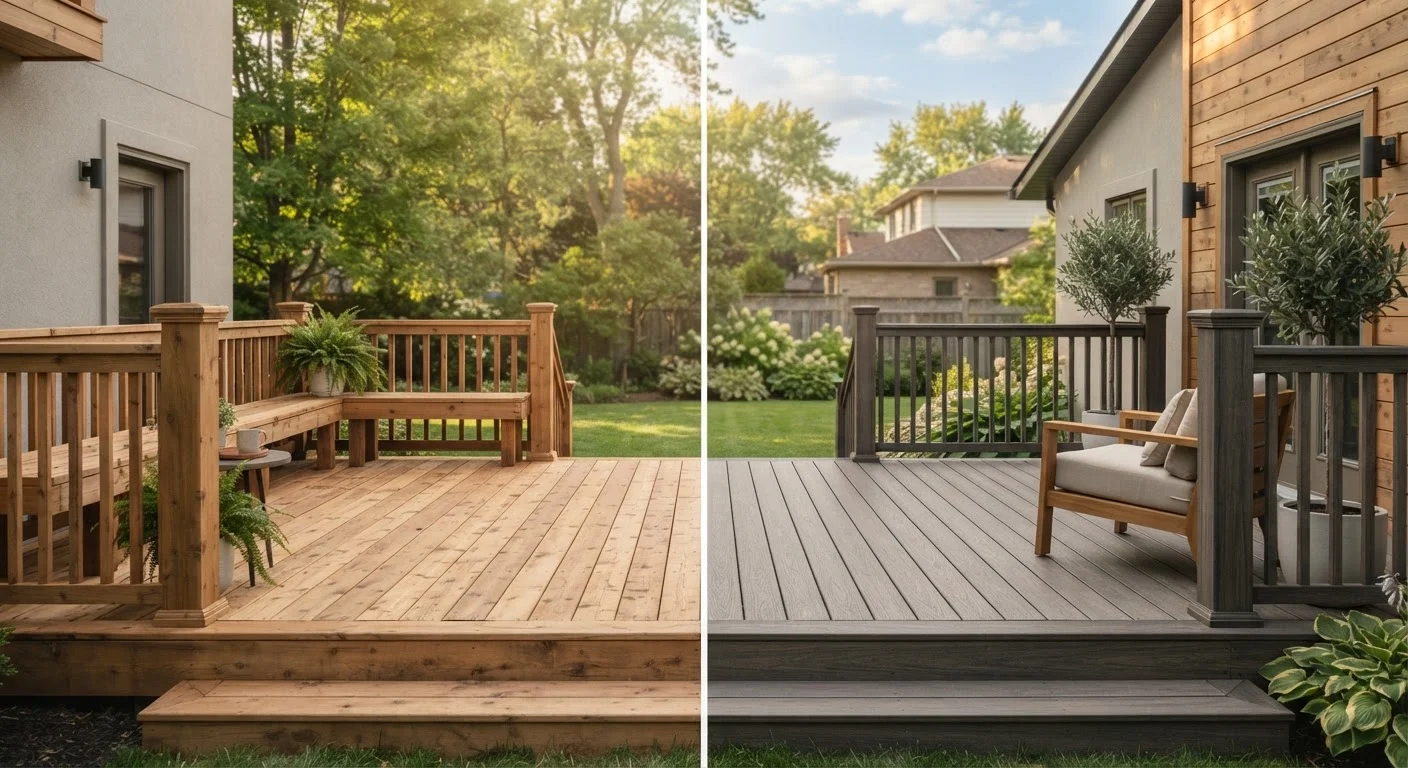
Key Takeaways
Option A
Wood Decking
The traditional, time-tested outdoor material.
Best for: Homeowners who want lower upfront costs and appreciate the authentic look of natural wood grain.
Option B
Composite Decking
The low-maintenance, engineered alternative.
Best for: Homeowners who want minimal upkeep and are comfortable with a higher initial investment for long-term durability.
If you have a tight initial budget
Wood Decking
Pressure-treated lumber typically costs significantly less per square foot installed than composite, making it more accessible for budget-conscious projects.
If you want to minimize annual upkeep
Composite Decking
Composite boards require only occasional cleaning and no sealing or staining, saving considerable time and recurring expense over the deck's life.
If you live in a high-moisture or extreme-weather climate
Composite Decking
Composite materials resist swelling, warping, and rot far better than natural wood in consistently wet or humid environments.
If authentic natural appearance is your top priority
Wood Decking
Natural wood offers genuine grain variation and a warmth that many homeowners find difficult to replicate with engineered composite boards.
If you plan to stain or paint to match changing design preferences
Wood Decking
Natural wood accepts stain and paint readily, giving you flexibility to change the deck's color or finish over time — composite boards cannot be stained after installation.
Cost: Upfront Spend vs. Total Ownership
Wood decking — most commonly pressure-treated pine, cedar, or redwood — typically runs lower on material and labor costs at installation. Pressure-treated pine is the most affordable entry point, while cedar and redwood carry a premium for their natural decay resistance and appearance. Composite boards, which blend wood fiber with recycled plastic polymers, generally cost more per square foot installed.
However, the full financial picture shifts over time. Wood requires sealing or staining every one to three years to prevent moisture damage, cracking, and graying. These recurring costs add up. Composite decking largely eliminates that annual spending, which can close — or even reverse — the cost gap over a 10- to 20-year ownership horizon. When evaluating bids, ask contractors to break out material, labor, and an honest estimate of annual maintenance so you can compare true lifetime costs rather than just the initial invoice.
| Criterion | Wood Decking | Composite Decking |
|---|---|---|
| Typical upfront cost | Lower (especially pressure-treated) | Higher per square foot installed |
| Annual maintenance | Sealing/staining every 1–3 years | Occasional cleaning only |
| Expected lifespan | 15–25 years with upkeep | 25–30+ years typical |
| Rot and insect resistance | Moderate (varies by species) | High (plastic content resists both) |
| Splinter risk | Yes, especially as wood ages | No |
| Stain/paint flexibility | Yes — accepts stain and paint | No — color is set at manufacturing |
| Heat retention in sun | Cooler underfoot | Can get hotter in direct sun |
| Natural appearance | Authentic grain and variation | Engineered to mimic wood |
Maintenance, Durability, and Lifespan
Wood decking demands consistent attention. Left untreated, even decay-resistant species like cedar will gray, crack, and eventually rot. A standard maintenance routine includes cleaning, sanding, and applying a water-repellent sealer or stain on a regular schedule. Splinters and fastener corrosion are additional practical concerns, particularly in households with bare-footed children or pets.
Composite decking largely sidesteps those issues. Its plastic content makes it impervious to rot and insect damage, and modern capped composite boards resist fading and surface staining better than earlier generations of the product. Routine care is mainly periodic washing with soap and water. That said, composite is not indestructible — heavy furniture, sharp objects, and extreme heat from grills can still cause surface damage. Well-maintained pressure-treated wood typically lasts 15–25 years; quality composite decking is generally rated for 25–30 years or more, though actual lifespan varies by product, climate, and care.
15–25 yrs
Typical lifespan of maintained wood decking
Pressure-treated lumber lifespan estimates are widely cited by building industry sources and vary based on climate and maintenance frequency.
25–30+ yrs
Common composite decking warranty range
Many composite decking manufacturers offer product warranties in the 25–30 year range, though actual performance depends on installation quality and local conditions.
1–3 yrs
Recommended wood sealing/staining interval
Industry guidance from painting and wood-care professionals generally recommends reapplying sealant or stain every one to three years depending on exposure.
For related material durability considerations in other parts of your home, see our guide to flooring choices in wet areas, which walks through moisture tolerance and longevity trade-offs across common indoor flooring types.
Appearance, Feel, and Environmental Considerations
Natural wood has an aesthetic advantage that remains genuinely difficult to engineer. The variation in grain, the warmth underfoot, and the way wood weathers into a silver-gray patina (if left unsealed) appeal to many homeowners as authentic and timeless. It also tends to stay cooler underfoot in direct sun compared to some composite products, which can absorb and retain more heat on hot summer days.
Composite manufacturers have invested heavily in surface texturing and color variation to mimic wood grain, and the results have improved considerably. Still, trained eyes can often distinguish composite from natural wood up close. On the environmental side, the picture is nuanced: composite boards frequently incorporate recycled plastic content, reducing landfill waste, but their manufacturing process is more energy-intensive than milling lumber. Responsibly sourced wood — look for certifications like FSC (Forest Stewardship Council) — can be a strong environmental choice if verified. Neither material has a clear, universal environmental edge; the answer depends on sourcing and end-of-life disposal in your region.
A Note on FSC and Sustainability Claims
FSC (Forest Stewardship Council) certification is one of the most recognized markers for responsibly harvested lumber in the US market. When a contractor or retailer references sustainable wood, asking specifically for FSC documentation is a reasonable step. Composite boards made with recycled content may carry their own third-party environmental certifications, but these vary by manufacturer, so it's worth requesting specifics rather than accepting general claims at face value.
Just as fiber composition shapes the performance of textiles — as explored in our comparison of natural and synthetic fabrics — the material makeup of decking boards directly determines how they perform in daily conditions.