

| Regulatory body for label standards | AAFCO (Association of American Feed Control Officials) |
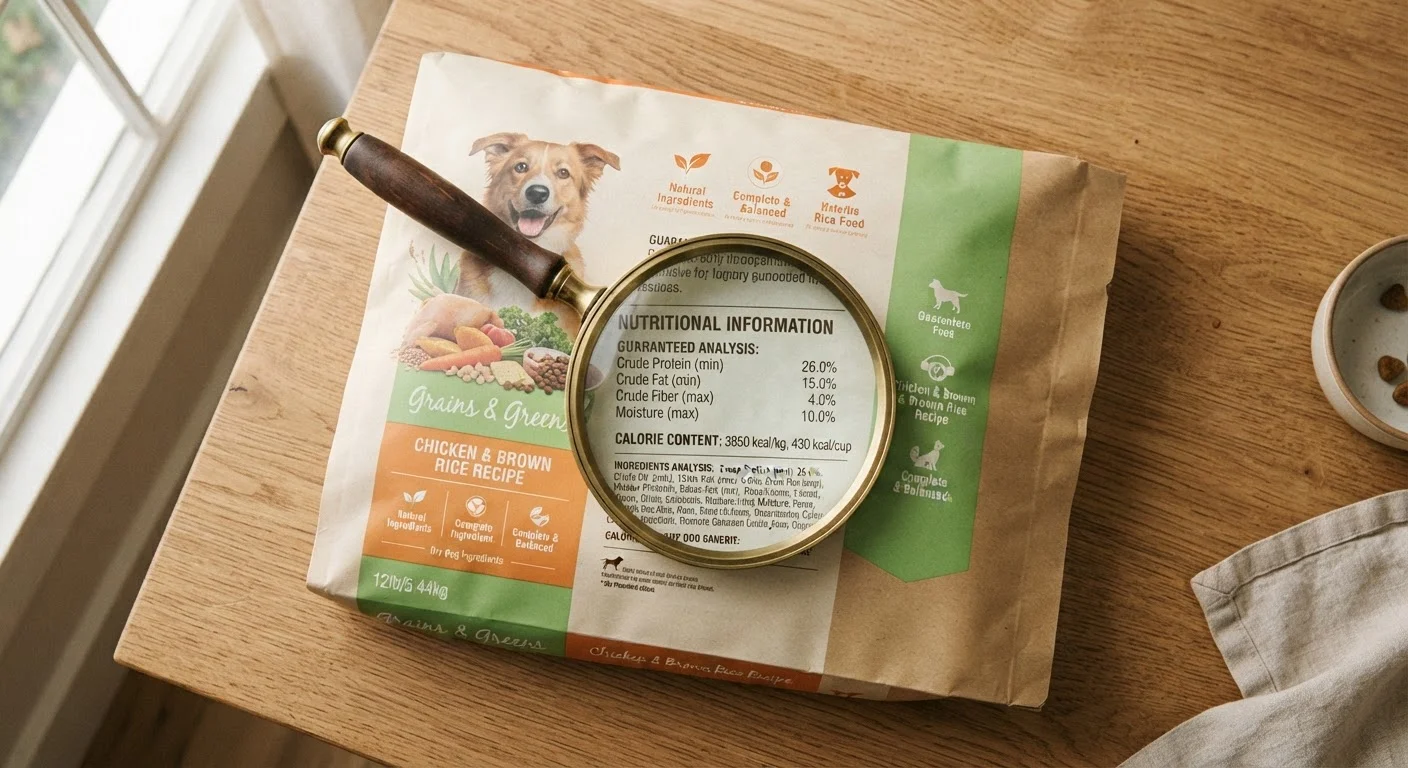
| Required guaranteed analysis nutrients | Crude protein (min), crude fat (min), crude fiber (max), moisture (max) (AAFCO model regulations) |
| Two ways to verify 'complete and balanced' | Nutrient profile formulation or live feeding trial (AAFCO) |
| Correct comparison method (wet vs. dry food) | Dry matter basis — removes moisture before comparing |
| Life stages recognized by AAFCO | Growth/reproduction, adult maintenance, all life stages (AAFCO nutrient profiles) |
Why Pet Food Label Terms Matter
Pet food packaging is regulated — but that doesn't make it easy to read. Terms like "crude protein," "complete and balanced," and "as fed basis" carry precise technical meanings that differ from everyday language. Misreading them can lead owners to overestimate nutrient quality or compare products on an uneven playing field.
This glossary defines every label term you're likely to encounter, organized so you can look up a specific phrase quickly. For a fuller walkthrough of how these terms work together on an actual package, see what pet food labels are actually telling you.
| Regulatory body for label standards | AAFCO (Association of American Feed Control Officials) |
| Required guaranteed analysis nutrients | Crude protein (min), crude fat (min), crude fiber (max), moisture (max) (AAFCO model regulations) |
| Two ways to verify 'complete and balanced' | Nutrient profile formulation or live feeding trial (AAFCO) |
| Correct comparison method (wet vs. dry food) | Dry matter basis — removes moisture before comparing |
| Life stages recognized by AAFCO | Growth/reproduction, adult maintenance, all life stages (AAFCO nutrient profiles) |
A-to-Z Glossary of Pet Food Label Terms
Use the definitions below as a quick reference whenever a label term leaves you uncertain.
AAFCO
The Association of American Feed Control Officials. AAFCO sets the model nutrient profiles and feeding trial protocols that manufacturers reference when claiming a food is "complete and balanced." It does not directly regulate or inspect products; enforcement is handled by individual states.
As Fed Basis
Nutrient percentages reported in the food exactly as it is served, including its moisture content. Useful for comparing foods of the same type (e.g., two canned foods), but misleading when comparing wet and dry foods directly.
Dry Matter Basis
Nutrient values recalculated after mathematically removing all moisture. This is the correct method for comparing nutrient levels across foods with different water contents, such as kibble versus canned food.
Crude Protein
A laboratory measurement of total nitrogen in a food, converted to an estimated protein percentage. "Crude" describes the measurement method, not the quality or digestibility of the protein sources.
Crude Fat
The total fat content measured by ether extraction. Like crude protein, it describes a testing method; it does not indicate the types of fats present or their quality.
Crude Fiber
A measure of insoluble plant material that resists digestion. It underestimates total dietary fiber because it does not capture soluble fiber. High crude fiber figures can indicate a food is high in plant-based fillers.
Guaranteed Analysis
The panel on every pet food label that lists minimum or maximum percentages for key nutrients — typically crude protein (min), crude fat (min), crude fiber (max), and moisture (max). These are guarantees, not exact measurements of what is in the bag.
Complete and Balanced
A regulated claim meaning the food meets AAFCO nutrient profiles or passes AAFCO feeding trials for a stated life stage. A food without this claim should only be used as a supplement or treat, not a sole diet.
Feeding Trial
A method for substantiating "complete and balanced" claims by feeding the actual product to live animals for a defined period and measuring health outcomes. Generally considered stronger evidence than formulation against a nutrient profile alone.
Nutrient Profile
AAFCO's documented minimum and maximum levels for essential nutrients at each life stage (growth/reproduction, adult maintenance, all life stages). A manufacturer can claim "complete and balanced" by formulating to meet these numbers without conducting live feeding trials.
Life Stage
The physiological category a food is intended for: growth and reproduction (puppies, kittens, pregnant or nursing animals), adult maintenance, senior, or all life stages. Feeding an adult-maintenance food to a growing puppy, for example, may not meet that animal's elevated nutrient needs.
Ingredient Splitting
A labeling practice where a single ingredient is divided into multiple sub-forms (e.g., ground corn, corn gluten meal, corn flour) so that each appears lower on the ingredient list, making another ingredient appear higher by weight. It is a legal practice but can make the dominant ingredient harder to identify.
For a practical, section-by-section tour of a dog food bag — from ingredient list to feeding chart — see reading a dog food bag. Nutritional needs also shift significantly as pets age, so the definitions here pair well with senior pet nutrition guidance when evaluating food for older animals.
"Complete and Balanced" Does Not Mean Optimal
Meeting AAFCO minimums means a food clears a regulatory floor — it provides the nutrients required to prevent deficiency. It does not mean the food is ideal for every individual animal. Factors such as ingredient digestibility, calorie density, and a pet's specific health conditions all influence whether a food is genuinely well-suited to that animal. When in doubt, a veterinarian or board-certified veterinary nutritionist can provide guidance tailored to your pet.
Putting the Glossary to Work
Label literacy is a skill that compounds over time. Once you understand that "crude" in crude protein and crude fat refers to a measurement method — not quality — you stop being misled by high percentages alone. Once you know the difference between a feeding trial and a nutrient profile formulation, you can assess the evidence behind an "AAFCO complete and balanced" claim more critically.
70–80%
Moisture content in typical canned pet food
This is why comparing wet and dry foods on an as-fed basis produces misleading nutrient percentages; dry matter basis is the standard correction.
~10%
Moisture content in typical dry kibble
The large moisture gap between wet and dry foods is the primary reason dry matter basis exists as a comparative tool.
If you're ever unsure whether a specific food is appropriate for your pet's health status, age, or condition, consult your veterinarian. This glossary is a reference tool for general education, not a substitute for professional dietary guidance. Explore broader pet health and wellness topics to keep your animal thriving at every life stage.