

Key Takeaways
Pet Food Label
A pet food label is the regulated set of information printed on a pet food package, including the ingredient list, guaranteed analysis, nutritional adequacy statement, and feeding guidelines. In the United States, these labels are governed by federal and state rules, with many states adopting the model regulations established by the Association of American Feed Control Officials (AAFCO). Reading a label correctly helps you evaluate whether a food actually meets your pet's nutritional needs.
AAFCO does not itself approve or certify pet foods; it establishes model nutrient profiles and definitions that states may adopt into law. Manufacturers are responsible for ensuring their products comply.
The Five Regulated Sections Every Label Must Include
U.S. pet food labels are required to carry five core elements: the product name, the net quantity statement, the manufacturer's name and address, the ingredient list, and the guaranteed analysis. Many labels also include a nutritional adequacy statement and feeding directions, both of which carry significant practical meaning.
The product name itself is regulated. AAFCO naming rules dictate that if a protein — say, chicken — is featured in the product name, the proportion of that ingredient in the formula must meet specific thresholds. A food called "Chicken Dinner" must contain at least 25% chicken; a food "with Chicken" needs only 3%. These distinctions matter when evaluating how prominently a protein actually features in a recipe.
For a full walkthrough of each bag section, see our practical guide to reading a dog food bag.
AAFCO Does Not Approve Pet Foods
A common misconception is that an AAFCO statement means a food has been government-approved or independently certified. AAFCO establishes model regulations and nutrient profiles that individual states may adopt, but it does not test, inspect, or certify individual products. Regulatory oversight varies by state, and compliance responsibility rests with the manufacturer.
How to Read the Ingredient List Without Being Misled
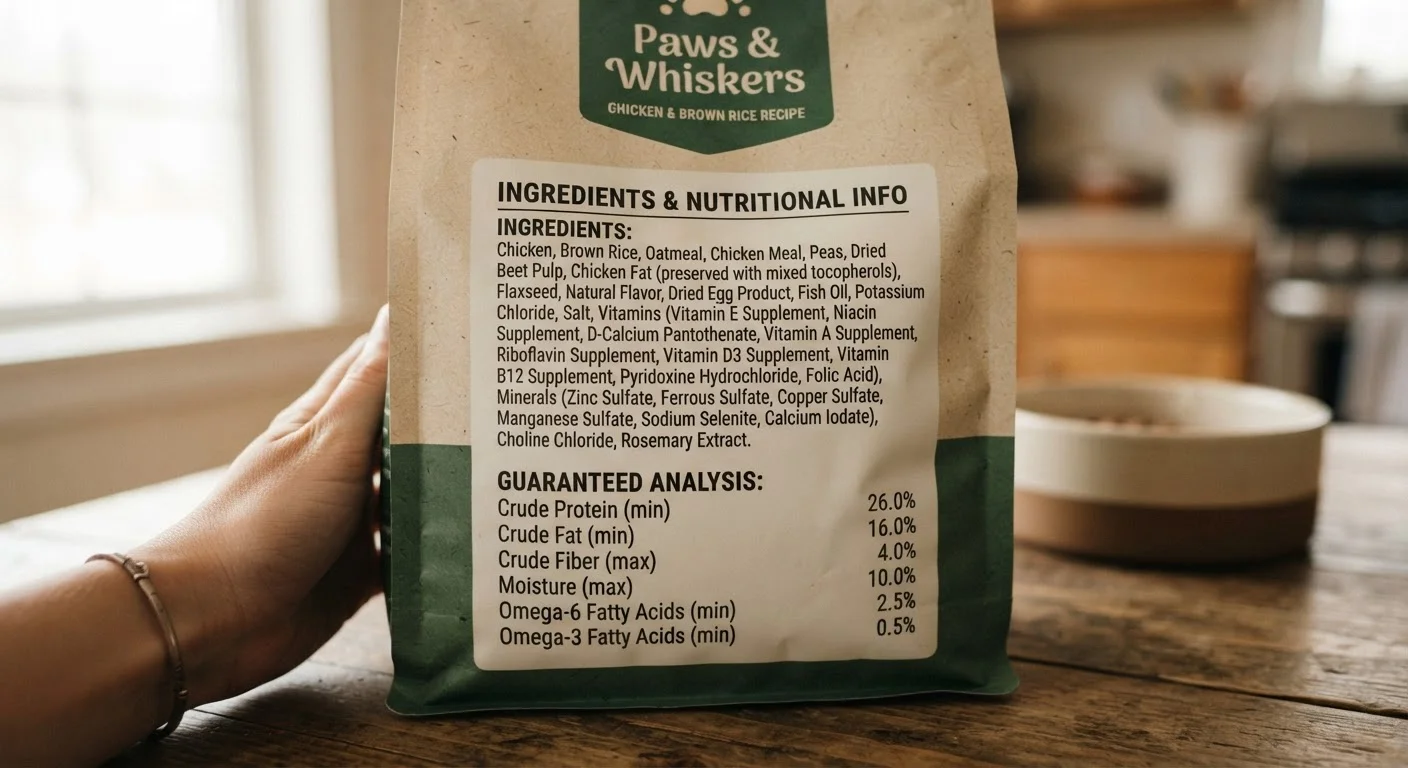
Ingredients are listed in descending order by weight before any processing occurs. Because raw meat contains significant moisture, it can appear at the top of a list even when its contribution of dry nutrients is relatively modest after cooking. A dry ingredient like "chicken meal" — which is already rendered and concentrated — may actually deliver more protein per pound than a fresh chicken listed above it.
This doesn't mean fresh meat is inferior; it means the ingredient list alone doesn't tell the full nutritional story. Ingredient splitting is another practice to recognize: a manufacturer can list "ground corn," "corn gluten meal," and "corn flour" separately, keeping each below a more prominent protein on the list, even though corn collectively represents a large share of the formula.
Marketing terms embedded in ingredient lists can also confuse. "By-products" is one example — AAFCO defines the term precisely, and organ meats included in by-product meals can be nutritionally valuable. Our article on common pet nutrition myths addresses the by-product misconception directly.
Focus on the First Five Ingredients
While the entire ingredient list matters, the first five ingredients typically represent the largest portion of the formula by weight. If the first recognizable protein source appears well down the list, the food's primary caloric contribution likely comes from another source. Use this as a quick orientation tool, then look at the guaranteed analysis and AAFCO statement to complete the picture.
The Guaranteed Analysis and What Its Numbers Really Represent
The guaranteed analysis panel lists minimum percentages of crude protein and crude fat, and maximum percentages of crude fiber and moisture. These are not precise nutritional measurements — they are chemical estimates using standardized methods, and they establish legal floors and ceilings rather than exact values.
Comparing guaranteed analysis figures across wet and dry foods is particularly misleading because moisture content differs dramatically. A wet food at 78% moisture and a dry food at 10% moisture cannot be compared on a percentage basis without converting both to a dry-matter basis — a calculation that removes moisture from the equation to reveal true nutrient density.
3%
Minimum ingredient required for 'with [Protein]' naming
AAFCO model regulations establish that a pet food using 'with' in its name (e.g., 'with Chicken') must contain only 3% of that named ingredient by weight.
25%
Minimum for dinner, entrée, or recipe product names
Under AAFCO naming conventions, foods using terms like 'dinner,' 'entrée,' or 'recipe' must contain at least 25% of the named protein ingredient, excluding water used in processing.
95%
Required for single-ingredient named products
A product simply named 'Chicken for Dogs' must be composed of at least 95% chicken by weight (excluding water), making it one of the most protein-dense label designations available.
For definitions of every term in this panel, the pet nutrition labels glossary covers AAFCO terminology from crude protein to caloric content statements.
The AAFCO Statement: The Single Most Important Line on the Label
The nutritional adequacy statement — often called the AAFCO statement — tells you whether a food is intended to be complete and balanced, and for whom. It specifies the life stage the food is formulated for: growth (puppies or kittens), adult maintenance, reproduction, or all life stages. A food labeled for "all life stages" must meet the more demanding nutrient levels required for growth.
Critically, the statement also reveals how nutritional adequacy was established. Two methods are permitted: formulation to a nutrient profile (calculated on paper) and an actual feeding trial conducted according to AAFCO protocols. A feeding trial provides more practical evidence that animals can digest and utilize the nutrients in that specific formula — not just that the recipe contains them on a spreadsheet.
Foods labeled as "complementary" or "supplemental" are not designed to serve as a sole diet. Feeding them as the only food source can lead to nutritional gaps over time. If you're considering a homemade approach alongside commercial food, our article on what nutritional balance in homemade pet food requires explains what complete and balanced truly demands.
Marketing Language That Carries No Regulatory Weight
Pet food packaging is designed to appeal to owners, not just to inform them. Several commonly used terms have limited or no standardized regulatory definition: "holistic," "premium," "natural," "human-grade," and "ancestral" are marketing positions, not verified nutritional claims. AAFCO has a working definition of "natural" that restricts the use of synthetic ingredients under that label, but the term is still frequently applied loosely.
"Grain-free" is a formulation descriptor, not a quality claim. The FDA has been investigating a possible association between certain grain-free diets and dilated cardiomyopathy (DCM) in dogs — research that remains ongoing. See our detailed look at the science behind grain-free versus grain-inclusive dog food for a balanced review of what is and isn't established.
The most reliable way to evaluate a pet food is to look past the front-of-bag claims to the AAFCO statement, the ingredient list, and the guaranteed analysis — then discuss your findings with your veterinarian, who can contextualize the label relative to your specific pet's age, breed, weight, and health status.
This article provides general educational information about pet food labeling and is not a substitute for personalized veterinary advice. Always consult a licensed veterinarian for guidance on your pet's specific nutritional needs.