

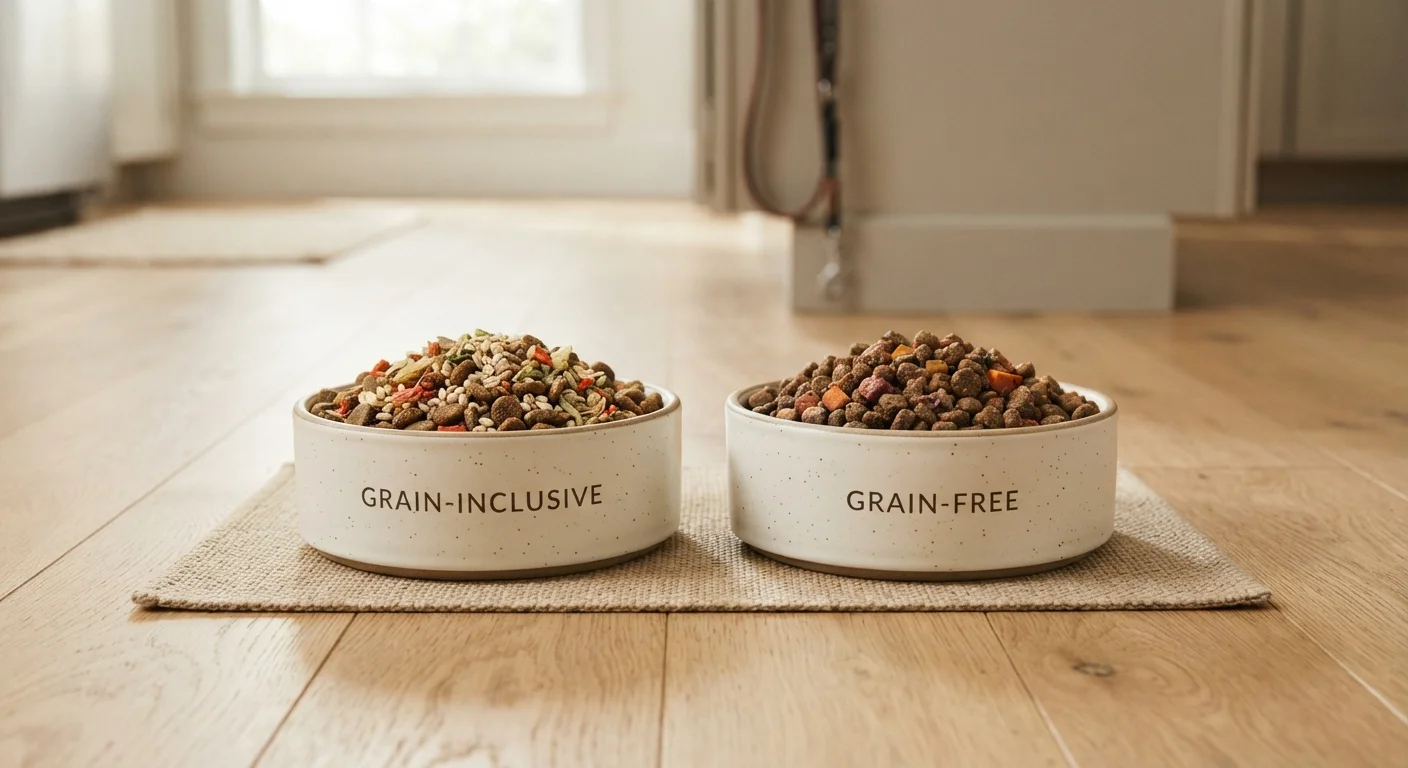
Key Takeaways
Option A
Grain-Inclusive Dog Food
The long-established, broadly studied dietary standard.
Best for: Most healthy adult dogs, those with a history of cardiac concerns, and owners who want a diet with the deepest nutritional research behind it.
Option B
Grain-Free Dog Food
The ingredient-swapped alternative still under active scrutiny.
Best for: Dogs with a confirmed grain allergy or intolerance diagnosed by a veterinarian, under professional nutritional guidance.
If your dog has no diagnosed food sensitivity
Grain-Inclusive Dog Food
Without a confirmed medical reason to avoid grains, a grain-inclusive diet backed by long-term nutritional research is generally considered the lower-risk choice by most veterinary nutritionists.
If your dog has a veterinarian-confirmed grain intolerance
Grain-Free Dog Food
A grain-free formula may be appropriate in this specific case, but should be selected with a vet's input and monitored for cardiac health over time.
If your dog is a breed predisposed to dilated cardiomyopathy
Grain-Inclusive Dog Food
Breeds such as Doberman Pinschers, Great Danes, and Boxers already carry elevated DCM risk; most cardiologists advise caution with grain-free diets until more research is completed.
If you are concerned about ingredient quality and processing
Grain-Inclusive Dog Food
Look for formulas meeting AAFCO nutritional standards rather than focusing on grain presence alone — ingredient quality and complete nutrient profiles matter far more than a single category.
What 'Grain-Free' Actually Means on a Dog Food Label
A grain-free dog food contains no wheat, corn, rice, barley, oats, or other cereal grains. What that label does not mean is low-carbohydrate, hypoallergenic, or nutritionally superior. When grains are removed, manufacturers substitute other carbohydrate sources — most commonly peas, lentils, chickpeas, potatoes, or sweet potatoes. The carbohydrate content of the finished product is often comparable to grain-inclusive formulas.
Grain-inclusive foods, by contrast, use one or more cereal grains as a carbohydrate and energy source alongside their protein and fat ingredients. Whole grains such as oatmeal and brown rice also contribute dietary fiber, B vitamins, and trace minerals. Understanding what is actually being swapped — not just removed — is the first step toward reading these labels critically. For a deeper dive into how to interpret every section of a dog food package, see Reading a Dog Food Bag: From Ingredient List to Feeding Chart.
| Criterion | Grain-Inclusive | Grain-Free |
|---|---|---|
| Primary carbohydrate source | Cereal grains (rice, oats, barley) | Legumes, potatoes, lentils |
| DCM cardiac risk signal | No association identified | Under active FDA investigation |
| Research depth | Decades of feeding studies | Limited long-term data |
| Appropriate for grain allergy | No | Yes, if vet-confirmed |
| Carbohydrate content | Moderate | Often comparable or higher |
| AAFCO compliance possible | Yes | Yes |
| Taurine metabolism concerns | Not flagged | Possible with high-legume formulas |
The DCM Investigation: What the Research Does and Doesn't Show
In 2018, the U.S. Food and Drug Administration (FDA) began investigating a possible association between grain-free diets and dilated cardiomyopathy (DCM) — a serious heart condition in which the heart muscle weakens and enlarges — after veterinary cardiologists reported an unusual number of cases in breeds not typically predisposed to the disease. Many affected dogs were eating diets high in legumes or potatoes.
Importantly, the investigation identified an association, not a proven causal mechanism. Researchers have proposed several hypotheses, including reduced taurine availability linked to certain legume-heavy formulations, but a definitive cause-and-effect relationship had not been established as of the FDA's last public update. Some cases resolved when dogs were switched back to grain-inclusive diets and given taurine supplementation, while others did not.
DCM Is Also a Genetic Condition in Some Breeds
Dilated cardiomyopathy has a well-established hereditary component in certain breeds, including Doberman Pinschers, Great Danes, Irish Wolfhounds, and Boxers. The diet-related DCM cases under FDA review were notable precisely because they appeared in breeds not typically predisposed — such as Golden Retrievers and Miniature Schnauzers. This distinction is important: a DCM diagnosis in a dog does not automatically mean diet is the cause, and conversely, a genetically low-risk breed eating grain-free food is not necessarily safe from diet-related cardiac changes.
The science here remains genuinely unsettled. Owners should not interpret the lack of a final conclusion as clearance — rather, it underscores why a veterinarian's guidance matters when choosing a long-term diet. For context on how this compares to other diet-related controversies, see our piece on raw diets for dogs.
Grains, Allergens, and the Sensitivity Question
One of the most common reasons owners switch to grain-free food is a suspicion that their dog is allergic to grains. In reality, food allergies in dogs are less common than environmental allergies, and when they do occur, the most frequently identified culprits in peer-reviewed literature are animal proteins — beef, dairy, and chicken — not grains. Wheat is occasionally implicated, but true grain allergies are relatively rare.
If you suspect your dog has a food allergy, the veterinary standard of care is an elimination diet trial conducted under veterinary supervision — not a label switch based on marketing language. Skin prick tests and blood allergy panels for food allergens are generally considered unreliable in dogs by veterinary dermatologists. What Pet Food Labels Are Actually Telling You can help you evaluate ingredient lists and AAFCO statements before making any changes.
~1–2%
Estimated prevalence of true food allergies in dogs
Veterinary dermatology literature suggests food allergies affect a small minority of dogs, with proteins more commonly implicated than grains.
524+
DCM cases reported to FDA linked to diet
The FDA's 2019 update on the diet-DCM investigation reported over 524 cases involving dogs eating atypical grain-free or legume-heavy diets.
90%+
Of reported diet-related DCM cases involving grain-free diets
The FDA noted that the vast majority of cases in its investigation involved dogs eating grain-free formulas, though causation was not confirmed.
How to Make a Well-Informed Choice
For the majority of healthy dogs, a grain-inclusive diet that meets AAFCO (Association of American Feed Control Officials) nutritional standards for their life stage is a well-supported default. The grain-free category is not inherently dangerous, but it carries an unresolved question mark regarding cardiac health that grain-inclusive diets do not. That asymmetry matters when there is no medical reason to avoid grains.
If your dog has a specific, veterinarian-diagnosed condition that warrants a grain-free approach, work with your vet — ideally alongside a board-certified veterinary nutritionist — to select a formula, schedule cardiac monitoring if appropriate, and track your dog's response over time. Diet decisions for dogs with chronic illness, puppies, and seniors deserve extra professional scrutiny. You might also find it useful to compare how ingredient profiles vary across formats in our overview of wet food vs. dry food.
This article provides general educational information about pet nutrition and is not a substitute for personalized veterinary advice. Always consult a licensed veterinarian before making significant changes to your dog's diet.