

Key Takeaways
Why the Label Deserves More Than a Glance
Most owners scan the front of a dog food bag for a familiar protein name or an appealing photo, then move on. But the front panel is almost entirely marketing territory — the information that actually tells you what you're feeding your dog lives on the back and sides. Understanding how to read those sections gives you the ability to evaluate any food on its own merits, regardless of how it's packaged.
Regulatory oversight of pet food labeling in the United States involves both federal agencies and state-level adoption of AAFCO guidelines. AAFCO sets the model language and nutrient standards that most states enforce, which is why the AAFCO statement is the single most important regulatory signal on the bag. For a broader look at how these standards work in practice, see what pet food labels are actually telling you.
Marketing Claims Are Not Regulated the Same Way
Words like 'natural,' 'holistic,' and 'premium' have limited or no regulatory definitions in pet food labeling. They do not signal that a food meets any specific nutritional standard. Focus on the AAFCO statement and guaranteed analysis rather than front-of-bag marketing language when evaluating a food.
Before working through the label on your current food, gather what you need.
What you will need
Tools That Help You Read More Accurately
You don't need specialized equipment to read a label, but a few items make portion accuracy easier once you've interpreted the feeding chart.
Dog food bag or package
The label you will be reading and evaluating section by section.
Kitchen scale
Accurately measures dry kibble portions to match feeding chart recommendations.
Measuring cup (marked for dry volume)
Provides a consistent serving size reference when a scale is not available.
With those in hand, work through each section of the bag in order using the steps below.
Locate and read the product name
The product name is governed by specific naming rules set by the Association of American Feed Control Officials (AAFCO). A food called 'Chicken Dog Food' must contain at least 95% chicken by weight (excluding water). A name like 'Chicken Dinner' or 'Chicken Entrée' only requires 25% chicken. 'With Chicken' requires just 3%, and 'Chicken Flavor' requires only a detectable amount. These distinctions matter when you want to know how much of a specific protein is actually in the product.
Find the AAFCO nutritional adequacy statement
This statement — sometimes called the 'complete and balanced' statement — is one of the most important lines on the bag. It will say the food is either formulated to meet AAFCO nutrient profiles or that it has been substantiated by feeding trials. Feeding-trial-tested foods have been fed to real dogs under controlled conditions, which is generally considered a stronger standard. The statement will also specify the life stage the food is designed for: growth (puppies), adult maintenance, or all life stages (suitable for any dog). Confirm this matches your dog before proceeding. If there is no AAFCO statement, the food is not considered complete and balanced for everyday feeding.
Read the ingredient list critically
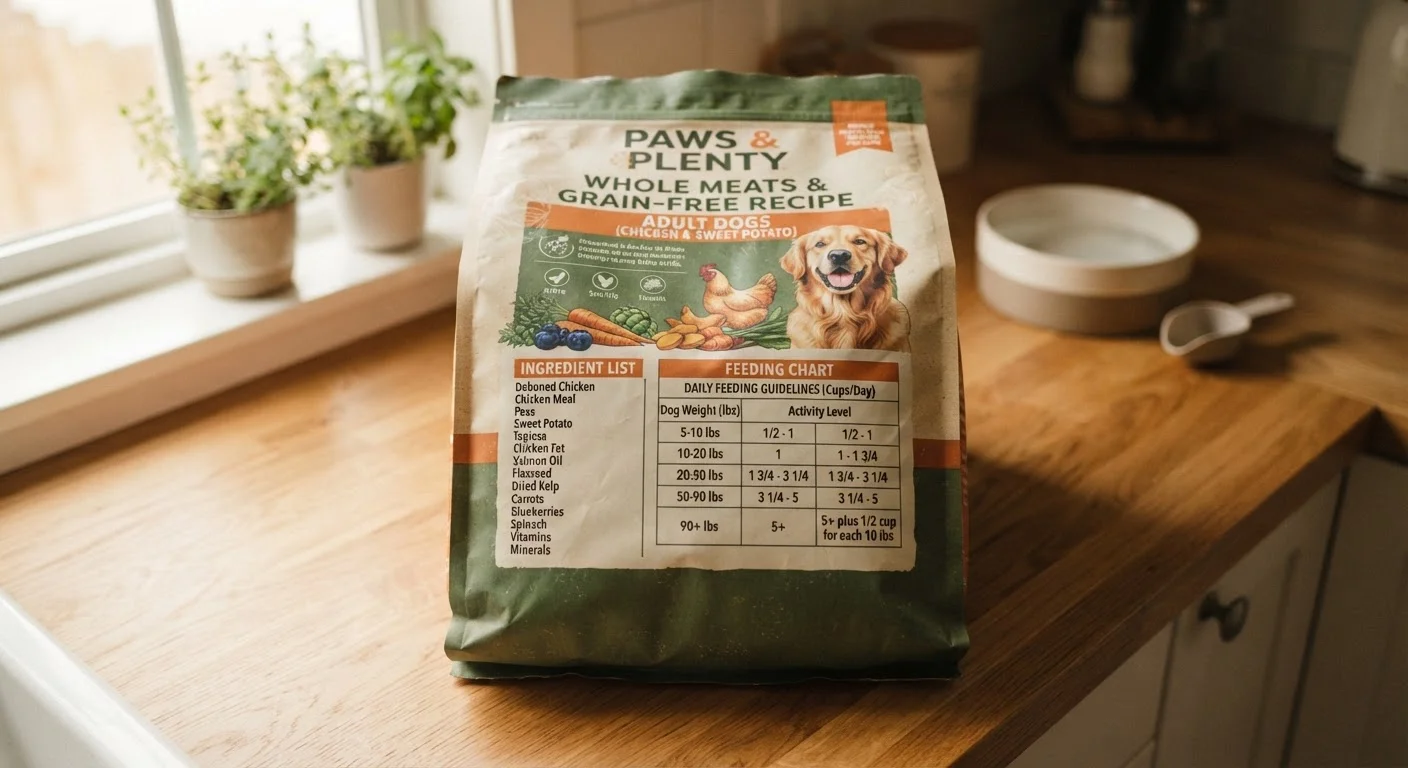
Ingredients are listed in descending order by pre-cooking weight, which includes moisture. This means a whole chicken listed first may contribute less protein than it appears once water is removed during processing. Look at the first five to eight ingredients as a rough guide to the formula's primary composition. Ingredient splitting — for example, listing 'ground corn,' 'corn gluten meal,' and 'corn bran' separately — can push a single ingredient lower on the list than its total contribution warrants. For a deeper dive into how manufacturers structure these lists, see what pet food labels are actually telling you.
Interpret the guaranteed analysis panel
The guaranteed analysis lists minimum crude protein, minimum crude fat, maximum crude fiber, and maximum moisture. These are regulatory floors and ceilings — not exact amounts. A food guaranteeing at least 26% crude protein could contain 28% or more. Because moisture content varies dramatically between wet and dry foods, comparing guaranteed analysis numbers across formats requires converting to a dry-matter basis. The numbers are a useful screening tool, but they do not reveal ingredient quality, digestibility, or amino acid completeness.
Use the feeding chart as a starting baseline
Feeding charts are typically organized by the dog's body weight and sometimes by activity level or life stage. Locate your dog's current weight range and note the recommended daily amount. This is the manufacturer's estimated starting point based on average caloric needs. Divide the daily total by the number of meals you feed per day. Keep in mind that treats, toppers, and other additions count toward total daily calorie intake and should be accounted for. For dogs managing their weight, the guide to feeding an overweight dog explains how to adjust portions thoughtfully.
Check manufacturer contact and lot information
Every bag should include a customer service phone number or website, a best-by or expiration date, and a lot or batch code. This information is critical if a recall is issued or if you notice a quality issue. Photograph or record the lot code when you open a new bag so you can cross-reference it quickly. Registering with the manufacturer's website, if available, may allow you to receive proactive recall notifications.
Putting It All Together
Use the Dry-Matter Basis for Fair Comparisons
Guaranteed analysis numbers are reported as-fed, meaning moisture is included. To compare a dry kibble to a wet food accurately, convert both to a dry-matter basis by dividing each nutrient percentage by the percentage of dry matter in the food. Your vet or a veterinary nutritionist can walk you through this calculation.
Reading a dog food label is a skill that becomes faster and more intuitive with practice. The key is knowing which sections carry regulatory weight — the AAFCO statement, the guaranteed analysis, and the ingredient list — and which are primarily marketing. Trends like grain-free formulations often dominate front-panel messaging; for a science-grounded perspective on that specific topic, see grain-free vs. grain-inclusive dog food.
Feeding Charts Are Guidelines, Not Rules
Manufacturers calculate serving sizes based on average dogs at a given weight. Your dog's actual needs depend on age, activity level, body condition, and health status. Always monitor body weight and condition score and adjust portions accordingly. Consult your veterinarian if you're unsure how much to feed.
Once you've selected a food, a gradual transition protects your dog's digestive system. The guide to switching your pet's food without upsetting their stomach outlines a practical schedule. For questions specific to your dog's health status, breed, or life stage, always consult a licensed veterinarian or a board-certified veterinary nutritionist.
This article is for general informational purposes only and is not a substitute for professional veterinary nutrition advice. Consult your veterinarian for guidance tailored to your individual pet's health and dietary needs.