

Key Takeaways
High digestibility of quality raw protein sources
Uncooked muscle meat is highly bioavailable for dogs, and some owners report firmer, smaller stools — a rough indicator of improved digestibility. However, digestibility varies by ingredient quality and individual dog.
Potential dental benefits from raw meaty bones
Chewing raw bones can help reduce tartar accumulation and support gum health. Most veterinary dentists acknowledge this benefit while cautioning that certain bone types pose fracture or obstruction risks.
Ingredient transparency and control
Preparing a raw diet at home gives owners direct knowledge of every ingredient. For dogs with documented allergies or intolerances, this control can help manage sensitivities — provided the diet is nutritionally complete.
Absence of heavily processed additives
Raw diets skip the high-heat extrusion process used in dry kibble, which some researchers suggest may alter certain nutrients. Whether this difference has meaningful clinical impact on healthy dogs is not yet well established.
Documented pathogen contamination risk
Multiple peer-reviewed studies have detected Salmonella, Listeria, E. coli, and other pathogens in commercially available raw dog food products. These organisms can infect both dogs and the people who handle their food or come into contact with their waste.
Nutritional imbalance is common in homemade formulations
Research has consistently found that most home-prepared raw recipes — including those published in popular books and websites — fail to meet AAFCO minimum nutrient requirements. Deficiencies can cause serious developmental and skeletal harm over time.
Higher risk for vulnerable dogs and people
Puppies, senior dogs, and animals undergoing chemotherapy or immunosuppressive therapy face elevated infection risk. Households with young children, pregnant individuals, or immunocompromised adults should be aware that pathogen shedding from raw-fed dogs creates a measurable household exposure risk.
Raw bone injuries are a real clinical concern
While raw bones are safer than cooked bones, they are not risk-free. Veterinary emergency rooms see cases of dental fractures, gastrointestinal perforations, and intestinal obstructions linked to bone consumption.
Claimed benefits lack rigorous clinical support
Most evidence for raw diet benefits comes from owner surveys and observational reports rather than controlled trials. Plausible mechanisms exist for some claims, but robust, peer-reviewed data confirming long-term health benefits remains limited.
Our Verdict
Raw feeding occupies a genuinely contested space in canine nutrition — passionate owner testimonials exist alongside credible veterinary caution backed by food-safety data. The claimed benefits are plausible in concept but remain largely unproven in rigorous research, while the risks of pathogen exposure and nutritional imbalance are well-documented. For most dog owners, the combination of safety complexity and nutritional precision required makes raw feeding a high-effort, higher-risk approach compared to quality commercial diets.
Best suited for owners who are willing to work closely with a board-certified veterinary nutritionist, who have no immunocompromised people or animals in the household, and who are committed to strict food-handling protocols throughout.
What Raw Feeding Actually Means
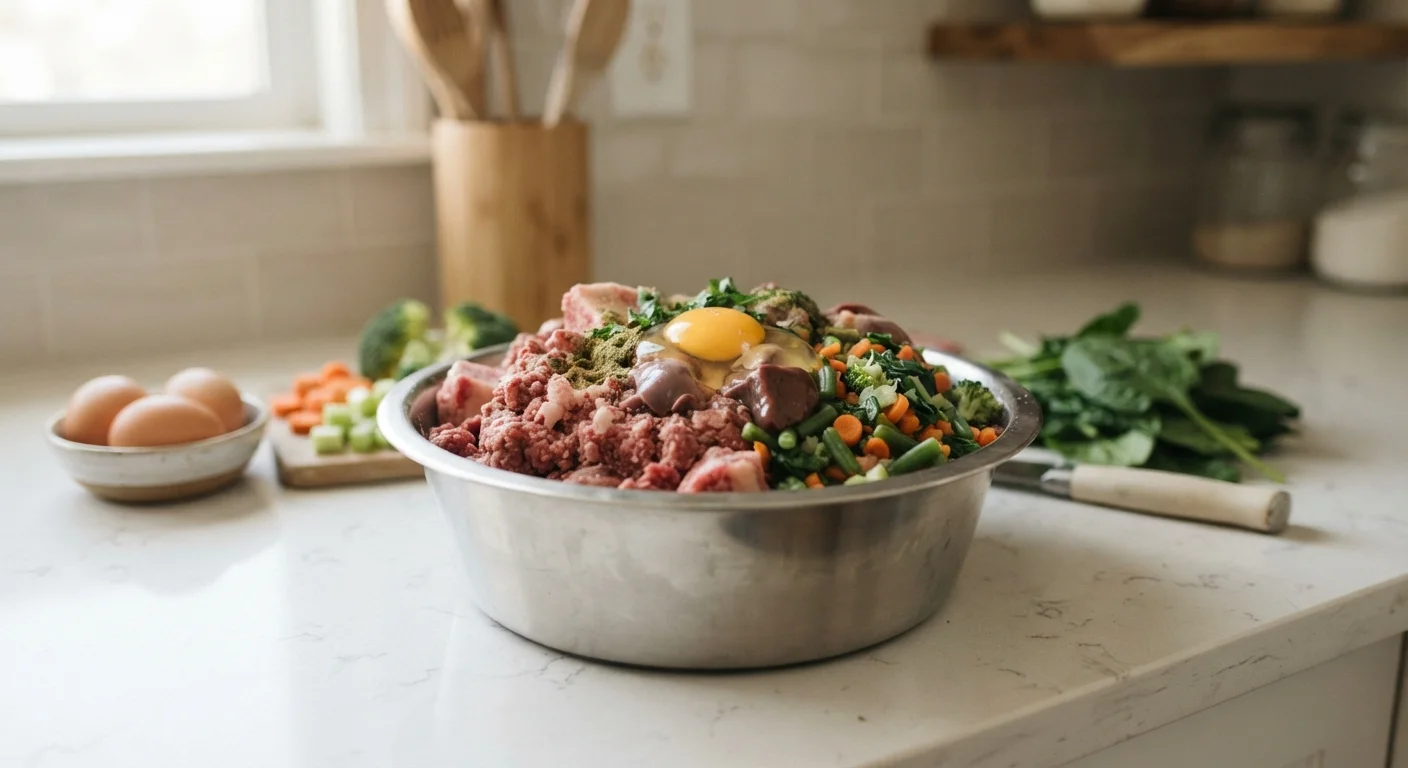
A raw diet — sometimes called BARF (Biologically Appropriate Raw Food or Bones and Raw Food) — typically consists of uncooked muscle meat, raw meaty bones, organ meat, raw eggs, and sometimes vegetables or dairy. It can be prepared at home or purchased as a commercially frozen or freeze-dried product.
The premise is that domestic dogs share enough evolutionary biology with their wolf ancestors that uncooked, minimally processed food more closely mirrors what they're built to eat. Critics counter that domestication, selective breeding, and thousands of years of living alongside humans have meaningfully shifted canine biology and dietary needs.
Before evaluating claims on either side, it's worth recognizing that "raw diet" is not a single, standardized thing. A carefully formulated commercial raw product tested for pathogens is a very different proposition from an improvised home blend. This distinction matters when weighing evidence. See our guide to what nutritional balance really requires for context on why formulation complexity is often underestimated.
The Case For Raw: What Advocates Claim
Supporters of raw feeding describe a range of improvements they attribute to switching — shinier coats, smaller stools, better dental health, higher energy, and resolution of digestive issues. Many of these are owner-observed, and while anecdotal accounts shouldn't be dismissed outright, they don't constitute clinical evidence.
High digestibility of quality raw protein sources
Uncooked muscle meat is highly bioavailable for dogs, and some owners report firmer, smaller stools — a rough indicator of improved digestibility. However, digestibility varies by ingredient quality and individual dog.
Potential dental benefits from raw meaty bones
Chewing raw bones can help reduce tartar accumulation and support gum health. Most veterinary dentists acknowledge this benefit while cautioning that certain bone types pose fracture or obstruction risks.
Ingredient transparency and control
Preparing a raw diet at home gives owners direct knowledge of every ingredient. For dogs with documented allergies or intolerances, this control can help manage sensitivities — provided the diet is nutritionally complete.
Absence of heavily processed additives
Raw diets skip the high-heat extrusion process used in dry kibble, which some researchers suggest may alter certain nutrients. Whether this difference has meaningful clinical impact on healthy dogs is not yet well established.
Some of the most credible potential advantages relate to digestibility and ingredient transparency. Raw muscle meat is highly digestible, and a well-constructed raw diet avoids heavily processed ingredients. For dogs with specific food sensitivities, a carefully supervised limited-ingredient raw diet may reduce exposure to triggering components — though the same outcome is achievable with quality commercial limited-ingredient foods. For more on decoding commercial options, see how to read a dog food bag.
Dental benefits from raw meaty bones are perhaps the most widely accepted advantage among veterinarians, with the important caveat that certain bones carry their own injury risk.
The Real Risks: What the Evidence Shows
The concerns around raw feeding are not theoretical — they are supported by microbiology studies, veterinary case reports, and public health surveillance data.
Documented pathogen contamination risk
Multiple peer-reviewed studies have detected Salmonella, Listeria, E. coli, and other pathogens in commercially available raw dog food products. These organisms can infect both dogs and the people who handle their food or come into contact with their waste.
Nutritional imbalance is common in homemade formulations
Research has consistently found that most home-prepared raw recipes — including those published in popular books and websites — fail to meet AAFCO minimum nutrient requirements. Deficiencies can cause serious developmental and skeletal harm over time.
Higher risk for vulnerable dogs and people
Puppies, senior dogs, and animals undergoing chemotherapy or immunosuppressive therapy face elevated infection risk. Households with young children, pregnant individuals, or immunocompromised adults should be aware that pathogen shedding from raw-fed dogs creates a measurable household exposure risk.
Raw bone injuries are a real clinical concern
While raw bones are safer than cooked bones, they are not risk-free. Veterinary emergency rooms see cases of dental fractures, gastrointestinal perforations, and intestinal obstructions linked to bone consumption.
Claimed benefits lack rigorous clinical support
Most evidence for raw diet benefits comes from owner surveys and observational reports rather than controlled trials. Plausible mechanisms exist for some claims, but robust, peer-reviewed data confirming long-term health benefits remains limited.
74%
Raw dog food samples testing pathogen-positive
A 2018 study published in PLOS ONE tested 35 commercially available raw dog food products and found pathogens — including Salmonella and Listeria — in approximately 74% of samples.
~95%
Home raw recipes failing nutrient standards
A study published in the Journal of Nutritional Science found that nearly all home-prepared raw diets evaluated were deficient in at least one essential nutrient relative to established canine nutrition guidelines.
Nutritional imbalance is a separate and serious problem. Studies examining homemade raw recipes — including those sourced from books and websites — have found that the majority fail to meet established nutrient profiles for dogs. Deficiencies in calcium, phosphorus, zinc, vitamin D, and other micronutrients can cause skeletal and developmental problems, particularly in growing puppies. This concern mirrors what veterinary nutritionists frequently correct when addressing popular feeding myths.
The human health angle is also real: raw-fed dogs shed pathogens in their feces and saliva at higher rates, creating exposure risks for owners — especially children, elderly individuals, pregnant people, and anyone with a compromised immune system.
What Major Veterinary Organizations Say
The American Veterinary Medical Association (AVMA), the American Animal Hospital Association (AAHA), and the Centers for Disease Control and Prevention (CDC) have all issued guidance discouraging raw protein diets, citing pathogen risks to both animals and humans. These positions are not anti-innovation — they reflect consistent patterns in food safety surveillance and clinical reporting.
Freeze-Dried and HPP Raw: Are They Safer?
High-pressure processing (HPP) and freeze-drying are used by some commercial raw manufacturers to reduce pathogen loads without cooking. HPP can significantly lower bacterial counts, but food safety agencies note it does not guarantee complete elimination of all pathogens. These products may carry lower contamination risk than untreated raw, but they should not be treated as fully equivalent to cooked or heat-processed food from a safety standpoint. Check whether a commercial raw product has undergone HPP or pathogen testing, and look for that documentation on the manufacturer's website.
Some integrative and holistic veterinarians take a more permissive view, noting that with proper sourcing, freezing protocols, and nutritional formulation, raw feeding can be managed responsibly. This remains a minority position within mainstream veterinary medicine, and it carries the important qualifier that "properly done" raw feeding requires significant knowledge and resources.
For a broader look at how diet trends are evaluated against the evidence, our article on grain-free vs. grain-inclusive dog food illustrates how quickly popular feeding trends can outpace the science behind them.
Making an Informed Decision
If you're considering a raw diet, the starting point should be a conversation with your veterinarian — and ideally a board-certified veterinary nutritionist (DACVN) who can formulate a nutritionally complete plan rather than one assembled from general online guidance. A raw diet that is genuinely balanced for your specific dog's life stage, size, and health status looks very different from a generic recipe.
Key questions worth working through before committing: Does anyone in your household have a weakened immune system? Do you have the infrastructure for safe handling, freezing, and hygiene? Are you prepared to have the diet independently verified for nutritional adequacy? The Pet Health & Wellness hub offers a broader framework for evaluating decisions like this across your dog's life.
Raw feeding is not inherently reckless, but it is genuinely demanding. For owners who choose this path with proper guidance, the risks can be mitigated — though not eliminated. For most, a high-quality commercial diet formulated to AAFCO standards delivers complete nutrition with significantly less complexity and risk.
This article is for general informational purposes only and does not constitute veterinary or medical advice. Always consult a licensed veterinarian before making significant changes to your pet's diet.