

Key Takeaways
Start here
Why 'Hair Type' Isn't the Whole Story
Next
Read Your Hair Before You Buy Anything
Then
The Core Routine: Three Steps That Work for Almost Everyone
When you're ready
Adjusting as You Learn More
Why 'Hair Type' Isn't the Whole Story
The first thing most people do when starting a hair care routine is Google their curl type — straight, wavy, curly, coily — and shop accordingly. That's a reasonable starting point, but curl pattern alone is a poor guide to what your hair actually needs. Two people with the same curl pattern can have completely opposite moisture requirements based on their hair's porosity, density, and scalp behavior.
Understanding the fuller picture is what separates a routine that genuinely works from one that just checks boxes. Our deep dive on porosity, elasticity, and density explains why these three characteristics — not curl pattern — are the real drivers of product and technique choices.
Porosity
How readily your hair absorbs and holds onto moisture. High-porosity hair absorbs water fast but loses it quickly; low-porosity hair repels water initially but retains it well once absorbed.
Curl pattern
The natural shape your hair forms — ranging from straight to wavy, curly, or coily — most visible when hair dries without any products applied.
Scalp microbiome
The community of microorganisms living on your scalp that influence its health, oil balance, and response to products.
Hair density
The number of individual strands on your head — low, medium, or high. Density affects how heavy products feel and how quickly your hair dries.
Hygral fatigue
Damage caused by hair repeatedly swelling with water and then drying out, which weakens the strand over time. Common in high-porosity hair.
Read Your Hair Before You Buy Anything
Before reaching for a single product, spend one wash cycle just observing. Shampoo with whatever you already have, skip the conditioner this once, and let your hair air-dry. Then ask: Does it feel brittle or stretchy when wet? Does it dry quickly or take a long time? Is your scalp oily by day two, or still comfortable?
The wet-hair test is your free starting point
After washing, watch how long your hair takes to air-dry and how it feels once dry — limp, crunchy, fluffy, or smooth. These reactions are early clues about moisture balance and porosity. No test kit required.
These observations map to real properties. Hair that dries fast and feels rough likely has high porosity. Hair that takes forever to dry or feels resistant to water in the shower may lean low-porosity. A scalp that oils up quickly signals higher sebum production, which affects how often you need to cleanse — and with what.
It's also worth separating your scalp from your ends in this observation. They often have opposite needs, and treating them identically is one of the most common beginner mistakes. Our explainer on scalp care vs. hair care breaks this distinction down clearly.
The Core Routine: Three Steps That Work for Almost Everyone
Once you have a baseline read on your hair, build around three steps: cleanse, condition, and protect. That's it — at least to start.
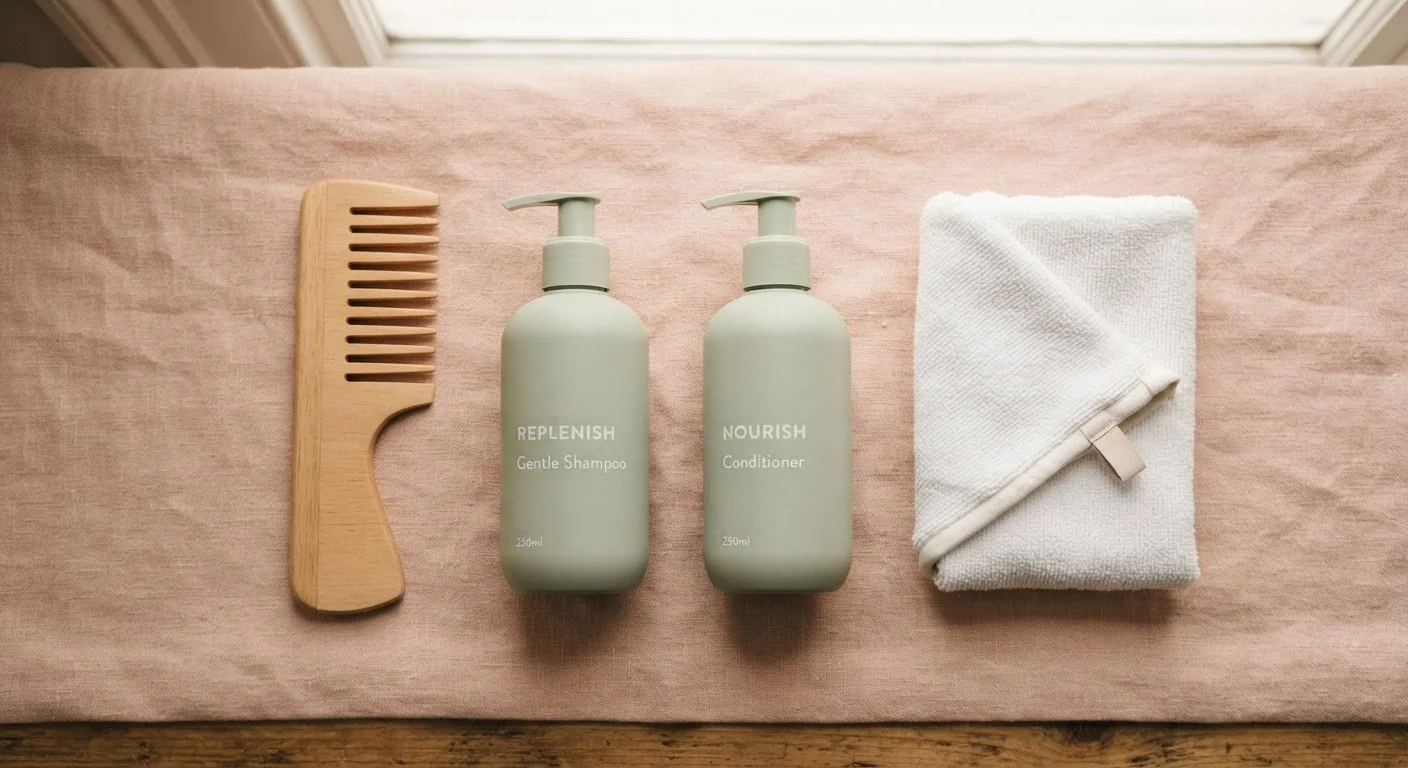
- Cleanse: Use a gentle shampoo focused on the scalp. Work it through roots and let it rinse through the lengths rather than scrubbing the ends, which adds unnecessary friction. Frequency depends on your scalp — not on any general rule.
- Condition: Apply conditioner primarily to mid-lengths and ends, where hair is oldest and most prone to dryness. Leave it on for a few minutes before rinsing. If your hair tangles easily, detangle gently with a wide-tooth comb while the conditioner is still in.
- Protect: A lightweight leave-in or a small amount of oil smoothed over damp ends can reduce moisture loss as hair dries. This step matters more for dry, porous, or textured hair; those with fine or straight hair may not need it at all.
More product does not mean better results
Layering multiple conditioners, masks, and oils before you understand your hair's baseline makes it nearly impossible to know what's actually helping. Start minimal, add one product at a time, and observe the effect before adding another.
If you're newer to building personal care habits generally, the same minimal-first approach applies to skincare. Our beginner skincare guide walks through a parallel process.
Adjusting as You Learn More
Your first routine is a hypothesis, not a commitment. After four to six weeks, evaluate honestly: Is your scalp balanced — not overly oily or dry? Do your ends feel hydrated without being weighed down? Is your hair manageable and less prone to breakage?
Give new routines time to settle
When you change products or washing frequency, your scalp and strands need a few weeks to recalibrate. An initial period of extra oiliness or dryness doesn't mean the routine is wrong — it often means your hair is adjusting. Track how it feels across at least four wash cycles before drawing conclusions.
If something is off, change one variable at a time. Adjust washing frequency before switching products. Try a deeper conditioning treatment before adding an oil. This methodical approach saves money and makes it far easier to identify what's actually helping.
As your routine matures, you can explore additional techniques — trimming between appointments, for instance, can keep your ends healthier without frequent salon visits. But all of that comes after you've established a stable base. Start simple, stay consistent, and let your hair show you what it needs.
This article is for general informational purposes only and is not a substitute for advice from a licensed cosmetologist or dermatologist, particularly if you are experiencing hair loss, scalp conditions, or other concerns that may require professional evaluation.