

Key Takeaways
Start here
Why Simple Beats Complicated Every Time
Core foundation
The Three Steps That Actually Matter
Personalize it
How to Figure Out Your Skin Type
Put it into practice
Building Morning and Evening Routines
Keep it manageable
What You Can Confidently Skip (for Now)
Why Simple Beats Complicated Every Time
Walk down any beauty aisle and it's easy to believe a good complexion requires twelve products and a morning ritual that starts before sunrise. It doesn't. The beauty industry has a financial interest in convincing you that more is better — but the evidence behind skincare consistently points to a handful of core habits done reliably, rather than an elaborate routine done sporadically.
To understand why these steps work at a biological level, our explainer on what a skincare routine actually does to your skin breaks down the science behind cleansing, moisturizing, and SPF in plain language. For now, the takeaway is this: your skin has its own regulatory systems, and a good routine supports them — it doesn't replace them.
Skin barrier
The outermost layer of skin that keeps moisture in and environmental irritants out. Supporting it is the primary goal of a basic skincare routine.
Broad-spectrum SPF
A sunscreen rating that indicates protection against both UVA rays (linked to aging and skin damage) and UVB rays (linked to burning). Look for 'broad-spectrum' on the label.
Skin type
A general description of how your skin naturally behaves — oily, dry, combination, or sensitive — which helps guide formula choices rather than routine structure.
Active ingredient
A specific compound in a skincare product intended to produce a measurable change in the skin, such as retinol, niacinamide, or an AHA exfoliant.
T-zone
The forehead, nose, and chin area — shaped like a letter T — which tends to produce more oil than the cheeks in people with combination skin.
The Three Steps That Actually Matter
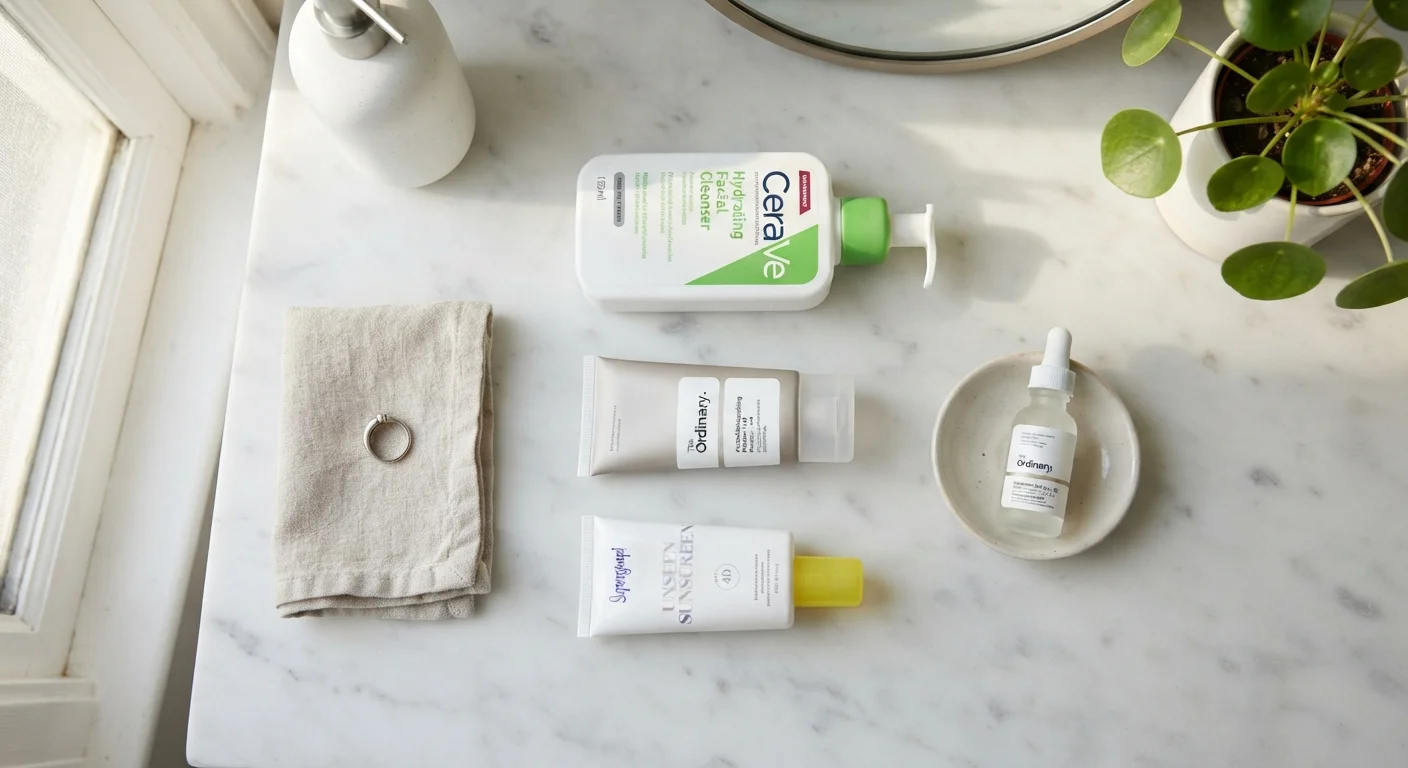
Before exploring the wider menu of serums, essences, and exfoliants, anchor yourself to three non-negotiables:
- Cleanse: Removes dirt, excess oil, and environmental residue that accumulates throughout the day. A gentle, low-irritant formula is almost always the right starting point regardless of skin type.
- Moisturize: Reinforces the skin barrier — the outermost layer that keeps moisture in and irritants out. Every skin type, including oily skin, benefits from some form of moisturizer.
- Sunscreen (AM only): Broad-spectrum SPF is the most well-supported preventive skincare habit available. Apply it as your final morning step, after moisturizer.
That's the full starter kit. For a detailed look at what each product category actually does — and whether you need every one — see our breakdown of cleanser, toner, serum, and moisturizer.
Patch Test New Products First
Before applying a new product all over your face, dab a small amount on your inner arm or just below your jawline and wait 24 hours. This simple step can help you catch a reaction before it spreads. It's especially useful if your skin tends to be sensitive or reactive.
How to Figure Out Your Skin Type
Skin type shapes which formulas will feel comfortable on your face — not whether the three core steps apply to you. Here's a quick at-home method:
- Wash your face with a gentle cleanser and pat it dry.
- Wait 30 to 60 minutes without applying anything.
- Observe: tight or flaky skin suggests a dry type; shine across the entire face suggests oily; shine only through the forehead, nose, and chin (the T-zone) suggests combination skin.
- Redness, stinging, or frequent reactions point to a sensitive tendency — often an overlay on top of another type rather than a type on its own.
With your skin type in mind, you can select formulas suited to how your skin behaves: lighter gels for oily skin, richer creams for dry skin. If you're ever uncertain about persistent concerns — acne, rosacea, eczema — a board-certified dermatologist is the right resource, not a product label.
Don't Let Skin Type Labels Limit You
Skin type descriptions are useful starting points, not permanent diagnoses. Your skin can shift with seasons, hormonal changes, diet, and stress. If a product that 'should' work for your type causes irritation or breakouts, trust your skin's response over the label. Persistent or unusual skin changes are worth discussing with a dermatologist.
Building Morning and Evening Routines
Your skin does meaningfully different things during the day versus overnight, which is why AM and PM routines aren't interchangeable. Our guide to morning vs. evening routines covers this in depth, but here's the practical starting structure:
- Morning
- Gentle cleanse (or a simple rinse with water if your skin is dry and you cleansed the night before) → moisturizer → sunscreen.
- Evening
- Thorough cleanse to remove sunscreen and daily buildup → moisturizer. Night is also when active ingredients like retinol are typically introduced — but only once the basics are solid. See our retinol beginner's guide when you're ready for that next step.
Keep both routines under five minutes when you're starting out. Sustainability matters more than comprehensiveness.
What You Can Confidently Skip (for Now)
The following categories are real — and some are genuinely useful — but they belong in a routine that already has the basics running smoothly:
- Toner: Modern cleansers rarely leave a residue that requires toning. Optional for most beginners.
- Serum: Targeted treatments for specific concerns (hyperpigmentation, fine lines, hydration). Worth exploring later, not at the start.
- Exfoliants: Chemical or physical exfoliants can do real work on texture and tone, but they also carry the highest risk of irritation if overused. Our guide to chemical exfoliants vs. physical scrubs is a useful next read once your core routine is stable.
- Eye cream: A separate eye product isn't strictly necessary; a gentle moisturizer applied carefully around the eye area covers the basics.
Starting a skincare routine is a lot like building a hair care routine from scratch: the goal is to identify what your baseline actually needs before adding complexity. Lock in three steps, stay consistent for at least four to six weeks, and then make intentional additions one at a time.
Morning vs. Evening Routine Guide
Understand why your skin needs different care at different times of day, and how to structure both routines simply and effectively.
Retinol Beginner's Guide
When you're ready to add an active ingredient, this guide explains how retinol works, how to introduce it gradually, and what to realistically expect.
Chemical Exfoliants vs. Physical Scrubs
A clear comparison of AHAs, BHAs, and face scrubs to help you decide if and when exfoliation makes sense for your routine.
This article is for general informational and educational purposes only and is not medical or dermatological advice. For concerns about your skin health, consult a qualified healthcare professional or board-certified dermatologist.