

| Standard shore power options | 30-amp and 50-amp |
| 30-amp max wattage | ~3,600 watts |
| 50-amp max wattage | ~12,000 watts |
| Full hookup includes | Electricity, fresh water, sewer |
| Water/Electric (W/E) includes | Electricity and fresh water only |
| Dry camping includes | No utility hookups at the site |
Why Campsite Hookup Terms Matter Before You Book
Browsing campsite listings for the first time, you'll quickly run into shorthand like "W/E only," "50-amp full hookup," or "primitive site." These aren't interchangeable - each describes a specific combination of utility connections that may or may not match what your RV actually needs. Booking a site without understanding these distinctions can mean arriving to find you can't run your air conditioning, fill your fresh water tank, or dump your holding tanks on-site.
Understanding hookup terminology is one of the most practical skills a new RV owner can develop. For a broader orientation to campground life and what to expect, see the complete introduction to the RV lifestyle.
| Standard shore power options | 30-amp and 50-amp |
| 30-amp max wattage | ~3,600 watts |
| 50-amp max wattage | ~12,000 watts |
| Full hookup includes | Electricity, fresh water, sewer |
| Water/Electric (W/E) includes | Electricity and fresh water only |
| Dry camping includes | No utility hookups at the site |
Shore Power: 30-Amp vs. 50-Amp Explained
Shore power refers to the external electrical supply you plug your RV into at a campsite - the same concept as plugging into a wall outlet, just at a much higher capacity. The two standard service levels in North American campgrounds are 30-amp and 50-amp.
30-Amp Service
A 30-amp outlet delivers a single 120-volt circuit at up to 30 amps - roughly 3,600 watts total. This is enough to run essential systems like one rooftop air conditioner, the refrigerator on electric mode, interior lighting, and a few small appliances, but not simultaneously without careful management. Most travel trailers, pop-up campers, and smaller Class C motorhomes are wired for 30-amp service.
50-Amp Service
A 50-amp outlet provides two 120-volt legs at 50 amps each - giving you up to 12,000 watts of available power. Larger Class A and Class B+ motorhomes, fifth wheels, and luxury travel trailers are typically built for 50-amp service, supporting multiple air conditioners, an electric range, washer/dryer units, and more running at once. For more on how rig size relates to power needs, see what RV class letters actually mean.
Check Your RV's Service Rating First
Your RV's electrical panel or owner's manual will specify whether the rig is wired for 30-amp or 50-amp service. Using the wrong adapter without understanding load limits can trip breakers or, in rare cases, damage appliances. When in doubt, consult a qualified RV technician before modifying your electrical setup.
Adapters and Compatibility
Adapters (sometimes called "dogbone" adapters) allow a 50-amp RV to plug into a 30-amp pedestal, and vice versa. Using a 50-amp rig on 30-amp service simply limits available power - you'll need to shed electrical loads accordingly. Always verify your RV's service rating before purchasing an adapter, and avoid overloading circuits.
Water and Sewer Connections: What Each Provides
Beyond electricity, campsite listings describe water and sewer access in specific ways. Here's what each means in practice.
Water Hookup (W)
A water hookup is a standard outdoor spigot at your site that connects to your RV's city water inlet via a potable water hose. When connected, water flows directly through your RV's plumbing system at city pressure - you don't need to draw from your onboard fresh water tank. Always use a hose rated for drinking water (not a garden hose), and consider adding an inline water pressure regulator to protect your RV's plumbing from high campground pressure.
Sewer Hookup (S)
A sewer connection is a ground-level cleanout at your site where you connect a sewer hose to drain your gray water (sinks, shower) and black water (toilet) holding tanks. Sites with sewer access let you dump tanks on a rolling basis rather than waiting for a dump station visit. Always use a proper sewer hose with secure fittings to prevent spills, and cap your sewer connection when not actively draining - leaving it open continuously can cause tank sensor problems and unpleasant odors.
Full Hookup
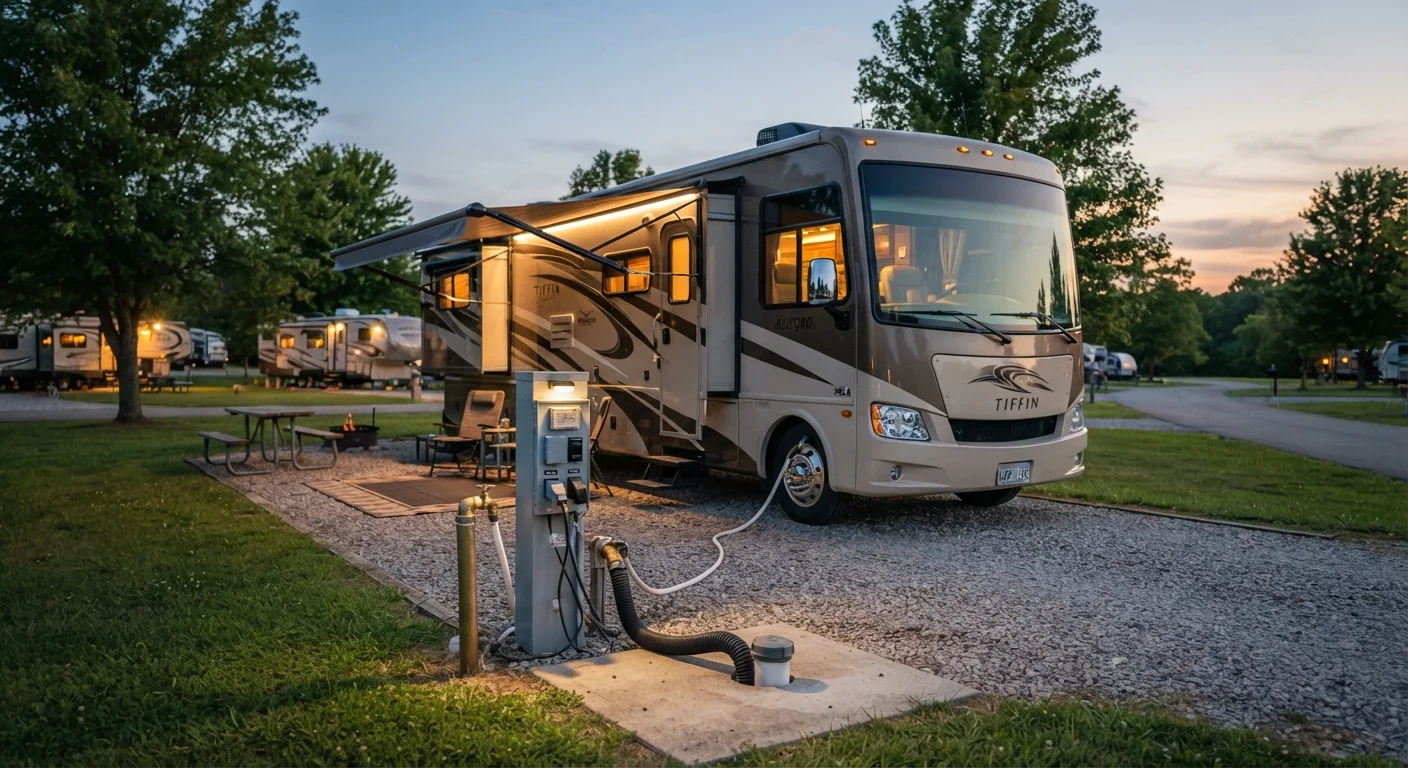
A full hookup site provides all three utilities: electricity (either 30- or 50-amp), fresh water, and sewer. This is the most convenient site type and what most large RVs are designed to use long-term. Before leaving any site, run through a campsite setup and teardown checklist to avoid leaving connections attached.
Shore Power
External electrical power supplied by a campground pedestal that an RV plugs into. Named by analogy to the maritime practice of plugging a vessel into dock-side power.
30-Amp Service
A single 120-volt, 30-amp electrical circuit providing up to 3,600 watts. Standard for smaller RVs, travel trailers, and pop-up campers.
50-Amp Service
A dual-leg 120/240-volt, 50-amp electrical connection delivering up to 12,000 watts. Standard for larger motorhomes, fifth wheels, and luxury trailers.
Full Hookup
A campsite that provides all three utilities: electricity, fresh water, and sewer connection. The most convenient site type for extended stays.
City Water Inlet
A dedicated port on an RV that accepts a direct hose connection from a campground spigot, bypassing the onboard fresh water tank.
Gray Water Tank
The holding tank that collects waste water from sinks and showers - distinct from the black water tank, which holds toilet waste.
Black Water Tank
The holding tank that collects toilet waste. Requires periodic draining at a sewer hookup or designated dump station.
Boondocking
Camping with no external hookups of any kind, typically on public land away from established campgrounds. Requires self-sufficient power, water, and waste management.
Partial Hookups, Dry Camping, and Boondocking
Not every campsite offers every utility - and some offer none at all.
- Electric-only (E): Shore power provided, but no water or sewer at the site. You'll use your onboard tank and visit a dump station when needed.
- Water and Electric (W/E): The most common partial hookup configuration - you get shore power and fresh water, but must manage gray and black tanks and use a dump station.
- Dry camping: A campsite with no utility hookups of any kind, though you're still in an established campground with shared amenities like restrooms or a dump station nearby.
- Boondocking: Camping entirely off-grid - no hookups, no campground infrastructure. Power comes from solar panels, generators, or battery banks; water from onboard tanks; waste managed until a dump station is reached. What boondocking really involves is a topic worth exploring separately before going that route.
If you're still learning the vocabulary around holding tanks, dump stations, and related systems, the RV and camping glossary covers the terms you'll encounter most often as a new owner.
30-amp
Most common service for travel trailers
The majority of entry-level and mid-size travel trailers and campers are wired for 30-amp shore power service.
3 types
Utility connections at a full hookup site
A full hookup campsite provides electricity, potable water, and sewer - the three core utility connections used by RVs.