

Key Takeaways
Option A
Natural Light
The gold standard for spatial openness and visual comfort.
Best for: Homeowners with window-rich rooms who want an effortless sense of volume and connection to the outdoors.
Option B
Artificial Lighting
The controllable, consistent solution for any room at any hour.
Best for: Renters and homeowners in darker or windowless spaces who need reliable light that works around the clock.
If you have south- or east-facing windows and want the most spacious feel with minimal investment
Natural Light
Maximizing existing natural light — through sheer curtains, mirrors, and light surfaces — costs little and delivers the strongest sense of openness.
If you live in a north-facing, basement, or window-limited space
Artificial Lighting
A layered artificial lighting plan with the right color temperature and fixture placement can convincingly brighten and visually expand a dim room.
If you want full control over mood and brightness regardless of time of day
Artificial Lighting
Dimmers, directional fixtures, and smart bulbs give you precise control that natural light simply cannot match after sundown or on overcast days.
If you're decorating on a tight budget and the room has decent natural light
Natural Light
Removing heavy drapes, painting walls a lighter tone, and adding a mirror are low-cost ways to let natural light do most of the heavy lifting.
Why Light Is the Biggest Spatial Illusion Tool You Have
Before moving furniture or knocking down walls, consider what light is already doing — or failing to do — in your room. Light shapes perceived volume more directly than almost any other interior element. It influences how high ceilings feel, whether corners read as closed-in or open, and whether a room feels welcoming or compressed.
The key principle is contrast: our eyes read a room as larger when light is evenly distributed with minimal dark pockets. Deep shadows in corners or unlit ceiling planes make a room shrink visually, regardless of its actual dimensions. Both natural and artificial light affect this, but they do so in different ways and with different constraints. See how curtains and paint interact with light to further shape a room's atmosphere.
Natural Light: Strengths, Limits, and How to Maximize It
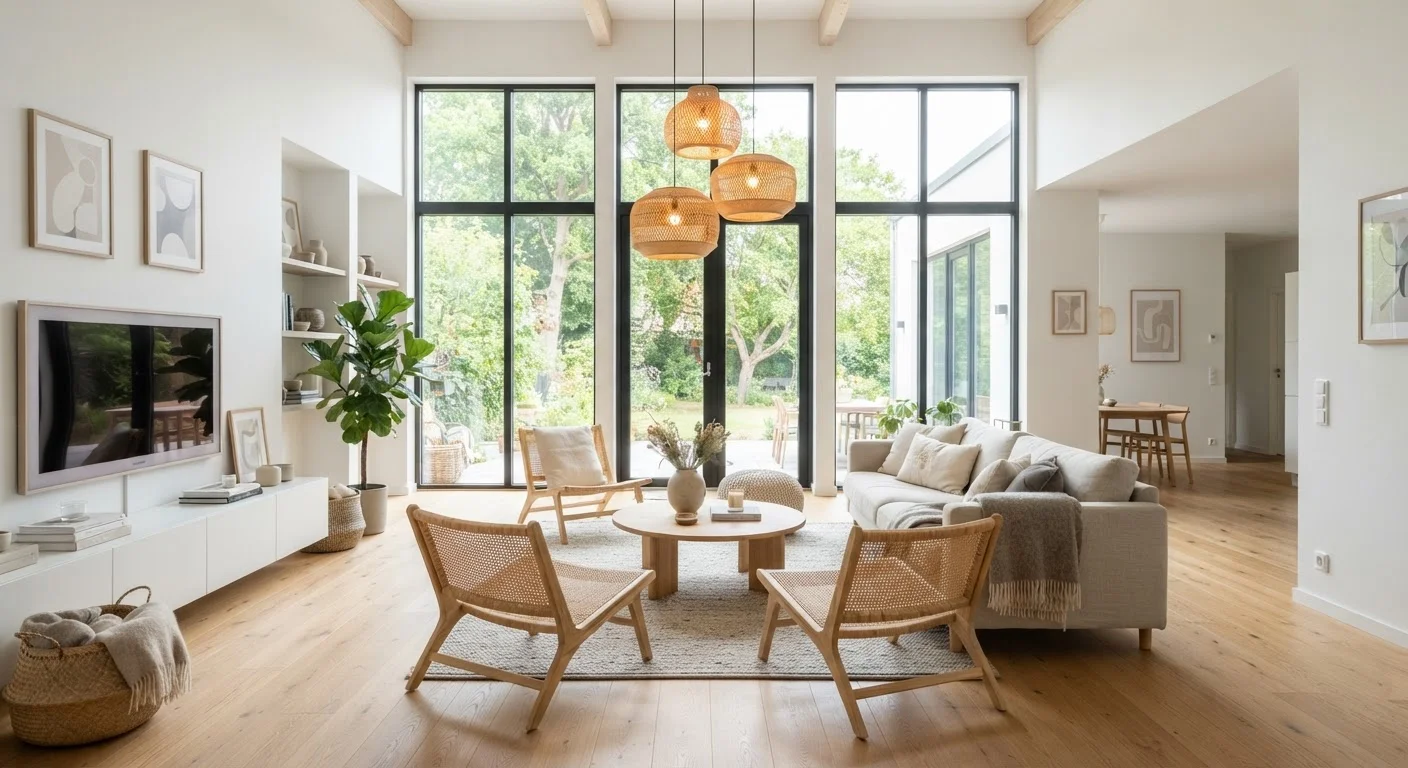
Natural light — daylight entering through windows, skylights, or glass doors — consistently ranks as the most effective way to make a room feel open and alive. Its broad-spectrum quality renders colors accurately, reduces visual fatigue, and creates a genuine sense of connection to the outdoors that artificial sources can approximate but not replicate.
That said, natural light has hard constraints. A room's orientation determines how much it receives: south-facing rooms get the most consistent daylight in the US; north-facing rooms receive indirect, cooler light; east and west rooms get strong light at limited times of day. You cannot change your building's orientation, so maximizing what you have becomes the practical goal.
Practical ways to amplify natural light:
- Replace heavy drapes with sheer panels or roman shades that filter rather than block light.
- Place mirrors on walls opposite or adjacent to windows — they bounce daylight deeper into the room.
- Use matte or semi-gloss paint in light, neutral tones to reflect rather than absorb incoming light.
- Keep window sills and frames clear of objects that interrupt light flow.
For deeper thinking on layout's relationship to light flow, the open-concept layout trade-offs guide covers how structural changes affect how light travels through a home.
Artificial Lighting: Layers, Color Temperature, and Fixture Placement
Artificial lighting gives you something natural light never can: consistency and control. A well-designed lighting plan works identically at midnight in January as it does on a sunny summer afternoon. For rooms with structural light limitations, it's not a compromise — it's a necessity.
The most important concept in artificial lighting for spatial perception is layering. Interior designers typically work with three layers:
- Ambient lighting: the room's base illumination (ceiling fixtures, recessed lights)
- Task lighting: focused light for functional areas (desk lamps, under-cabinet strips)
- Accent lighting: directional light that highlights architectural features or creates depth (wall sconces, uplights)
Relying on a single overhead fixture creates flat, shadow-heavy light that actually makes rooms feel smaller. Distributing light across multiple sources and heights eliminates the dark corners that compress perceived space.
| Criterion | Natural Light | Artificial Lighting |
|---|---|---|
| Spatial openness effect | Strongest — broad spectrum, even distribution | Strong when layered; weak with single overhead fixture |
| Controllability | Limited — depends on orientation and weather | Full control via dimmers, fixtures, bulb choice |
| Consistency | Variable by time of day and season | Consistent at any hour, any season |
| Cost to maximize | Low (mirrors, sheers, paint) | Moderate (fixtures, bulbs, dimmer switches) |
| Best room types | South/east-facing, above-grade rooms | North-facing, basement, windowless spaces |
| Mood flexibility | Shifts naturally through the day | Highly flexible with dimmers and smart bulbs |
| Color rendering accuracy | Excellent — full visible spectrum | Good to excellent — depends on bulb quality (CRI) |
Color temperature (measured in Kelvins) is equally important. Bulbs in the 2700–3000K range produce warm white light that feels cozy but can make a room feel more enclosed. Bulbs at 4000K produce a neutral white that better mimics daylight and reads as more expansive — a useful choice for small or dark rooms. Avoid going above 5000K in living spaces, as that cooler blue-white light tends to feel clinical rather than comfortable.
Dimmer switches are among the most cost-effective upgrades you can make. They let you shift from a bright, open daytime feel to a warmer, more intimate setting in the evening — all from one set of fixtures. Pair this with the furniture arrangement strategies that prevent blocking floor-level light from reaching corners.
Understanding CRI: Color Rendering Index
When choosing artificial bulbs, look for a CRI (Color Rendering Index) rating of 90 or above. CRI measures how accurately a bulb renders colors compared to natural daylight, on a scale of 0–100. Higher CRI bulbs make surfaces and finishes appear truer to their actual color, which contributes to a more open, natural-feeling room. Most hardware stores label CRI on bulb packaging.
The Practical Verdict: Use Both, Deliberately
Framing natural and artificial light as competitors misses the point. In practice, the rooms that feel most open and livable use both — intentionally. Natural light defines the daytime character of a room; artificial lighting sustains and extends that character after dark or on overcast days.
If your room has good natural light, build your artificial lighting plan around it. Use fixtures that complement the daylight spectrum during the day and shift to warmer tones in the evening. If your room struggles with natural light, invest more heavily in the layering approach outlined above — a combination of recessed ambient fixtures, at least one accent source, and task lighting tailored to how you use the space.
Either way, light interacts constantly with your other design choices. Wall color, flooring tone, mirror placement, and curtain weight all affect how much light — natural or artificial — actually circulates through a room. Treating light as part of your broader decorating strategy, rather than an afterthought, is what separates rooms that feel genuinely spacious from rooms that just look nice in photos.