

Key Takeaways
Our Verdict
Paint delivers the broadest atmospheric shift per dollar spent, making it the highest-leverage starting point for most rooms. Curtains excel at controlling light and adding vertical drama, while rugs ground furniture arrangements and introduce texture underfoot. The strongest results come from using all three in coordination rather than treating any one as a standalone fix.
| Best for | Recommended |
|---|---|
| Those seeking the most dramatic room transformation for the effort | Paint |
| Renters or those avoiding permanent changes | Rugs and Curtains |
| Rooms with hard floors that feel cold or echo-prone | Rugs |
| Spaces with small or awkwardly placed windows | Curtains |
Why These Three Elements Matter Most
When a room feels off — too cold, too small, too bland — the instinct is often to buy new furniture. But paint, curtains, and rugs are the three elements that most directly shape how a space feels to be in, and they work at a fraction of the cost and disruption of a furniture overhaul.
Each one operates differently. Paint works on every visible surface simultaneously, affecting perceived depth, warmth, and energy. Curtains control how light enters and frame the vertical plane of a room. Rugs define the floor plane, anchor furniture groupings, and soften acoustics. Together, they address walls, windows, and floors — the three dominant surfaces of any interior. Understanding how each one works on its own makes it much easier to combine them effectively. For more on how light interacts with all of these choices, see how natural and artificial lighting shape space.
Paint: The Fastest Way to Shift Atmosphere
Color is the most immediate tool for changing how a room feels emotionally and spatially. Cool tones — soft blues, grays, and blue-greens — tend to read as receding, making walls feel farther away and rooms feel calmer. Warm tones — creamy whites, tawny yellows, terracotta — advance visually and create a sense of enclosure that many people find cozy rather than cramped.
Painting a single accent wall in a deeper shade is a reliable way to add depth without committing an entire room to a dark color. Painting the ceiling a shade slightly lighter than the walls draws the eye upward and makes ceilings feel taller. Conversely, a darker ceiling can feel intentional and dramatic in the right context — a dining room, for example.
The finish you choose matters almost as much as the color. Matte finishes hide wall imperfections but are harder to clean. Eggshell and satin hold up better in high-traffic areas. Understanding paint finishes helps you choose the right sheen for each room's demands.
Test Paint Colors Before Committing
Paint colors look dramatically different under artificial light than they do in the store or on a small swatch. Before painting an entire wall, apply a large sample patch — at least 12 by 12 inches — and observe it at different times of day and under your room's actual lighting. Many paint retailers offer small sample sizes specifically for this purpose. Doing this step consistently avoids costly repaints.
Curtains: Height, Width, and Light Control
Most people hang curtain rods at or just above the window frame. Designers consistently recommend mounting the rod as close to the ceiling as possible and extending it 6–12 inches beyond the window casing on each side. This makes windows look larger, ceilings appear taller, and the room more expansive — all without changing a single structural element.
Fabric weight and opacity also do significant atmospheric work. Sheer curtains diffuse light softly and keep a room feeling airy. Heavier lined panels absorb sound, block drafts, and create a sense of intimacy when drawn. Blackout-lined curtains in bedrooms dramatically improve sleep quality for light-sensitive people.
For renters who can't paint, curtains become especially important because they introduce color and texture without touching the walls permanently. A pair of bold, richly colored drapes can anchor a neutral room the same way a painted accent wall would.
| Paint | Curtains | Rugs | |
|---|---|---|---|
| Primary effect | Color and mood shift | Light control and height illusion | Zone definition and warmth |
| Renter-friendly | Often restricted | Yes, fully removable | Yes, fully removable |
| Acoustic benefit | Minimal | Moderate with heavy fabric | Significant with pile rugs |
| Perceived room size impact | High — color affects depth | High — height placement key | Moderate — scale matters most |
| Installation effort | Moderate — prep and drying time | Low — rod mounting only | Very low — lay and adjust |
| Reversibility | Low — repainting required | High — hardware leaves small holes | High — completely removable |
Rugs: Grounding Space and Adding Warmth
The most common rug mistake in living rooms is choosing one that's too small. Interior designers use a simple rule of thumb: the front legs of all major seating pieces should sit on the rug. A rug that only fits the coffee table floats visually and makes the room feel disjointed. In bedrooms, the rug should extend at least 18–24 inches beyond the sides and foot of the bed so bare feet hit soft material first thing in the morning.
Beyond size, rugs serve acoustic and thermal functions that are often underestimated. Hard floors reflect sound, making rooms feel louder and less settled. A medium-pile rug absorbs reflected sound noticeably. In older homes with drafty floors, a dense rug adds a meaningful layer of insulation underfoot.
Pattern choice also affects perceived room size. A bold, large-scale pattern draws the eye across the floor and can make a room feel larger. Small, busy patterns tend to visually fragment the space. Solid or subtly textured rugs work in nearly any setting and let other elements in the room stand out. For more on how furniture and floor-level decisions interact, see why furniture arrangement affects perceived room size.
Avoid Layering Too Many Competing Patterns
When rugs, curtains, and upholstery all carry bold, different patterns, they compete for visual attention and make a room feel chaotic rather than layered. A reliable guideline is to limit strong pattern to one or two elements per room and keep the others in solids or subtle textures. If your sofa or chairs are already patterned, lean toward a solid or low-contrast rug.
Combining All Three for Maximum Effect
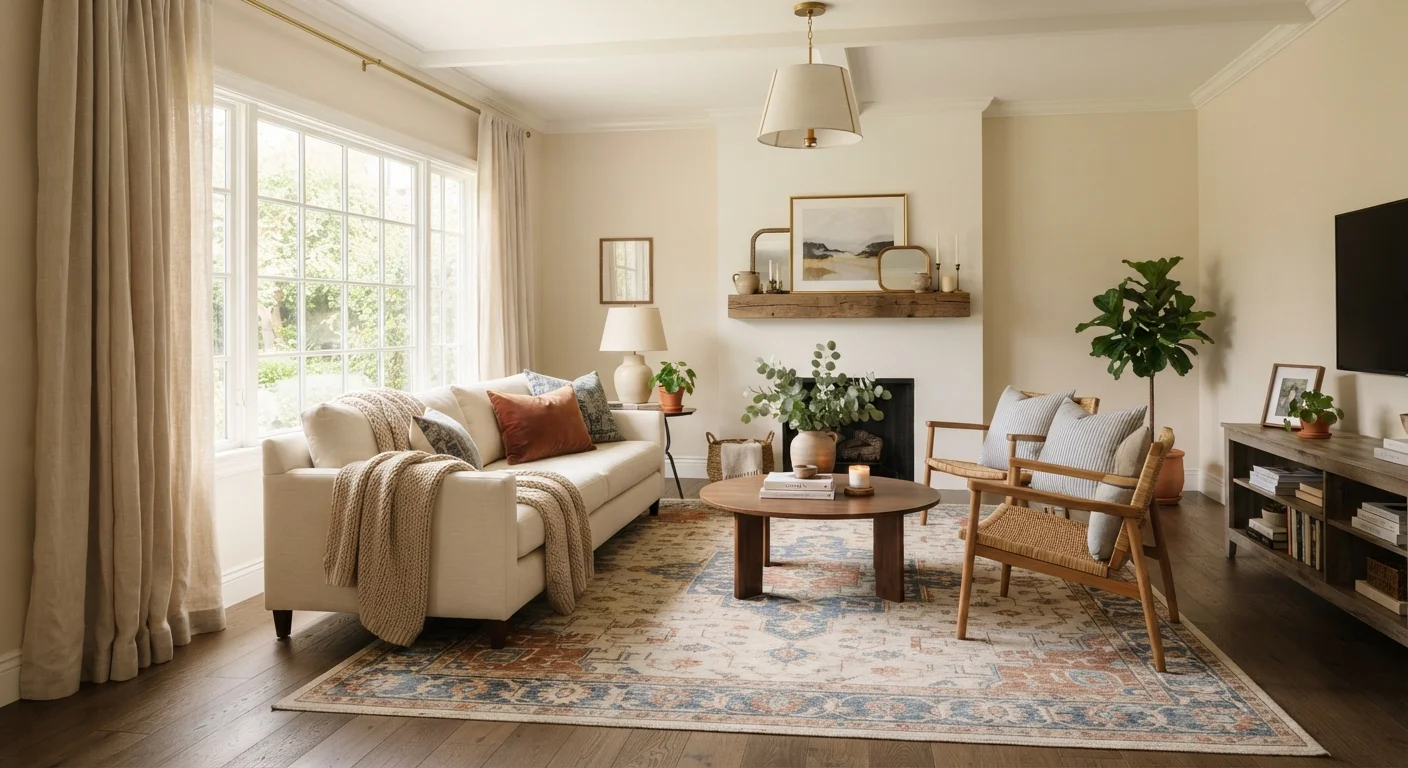
The most cohesive rooms treat paint, curtains, and rugs as a coordinated system rather than independent choices. A practical starting sequence: choose your wall color first, since it covers the most surface area and sets the room's base tone. Then select curtains that either complement or intentionally contrast the wall color. Finally, bring in a rug that ties the floor to both.
A neutral wall color gives you the most flexibility with curtains and rugs. A bold wall color calls for curtains and rugs that are quieter, or that share one element (like a color pulled from the wall) without competing. Varying texture across all three — a matte painted wall, linen curtains, a wool or jute rug — adds depth that reads as intentional and layered even when the palette is simple.
These changes don't require a large budget or a complete room overhaul. They're also fully reversible, making them ideal for renters or anyone who wants to experiment before committing. For a broader look at making your living spaces work harder, the Home Improvement hub covers everything from layout to maintenance in practical, accessible terms.