
Key Takeaways
Our Verdict
Neither collector culture is objectively superior - each reflects the automotive history, manufacturing traditions, and social values of its home continent. American classic car culture celebrates individualism, accessibility, and the visceral thrill of power. European collecting tends toward connoisseurship, restraint, and reverence for engineering heritage. Understanding both helps any enthusiast appreciate the full spectrum of what makes these vehicles worth preserving.
| Best for | Recommended |
|---|---|
| Enthusiasts who value personal customization and community inclusivity | American Classic Culture |
| Collectors who prioritize engineering history and factory-correct authenticity | European Classic Culture |
| Investors focused on documented provenance and auction market performance | European Classic Culture |
| Newcomers seeking an approachable, social entry into the hobby | American Classic Culture |
What Each Culture Actually Values
At the heart of any classic car community is a set of deeply held values about what makes a vehicle worth preserving - and those values diverge sharply across the Atlantic.
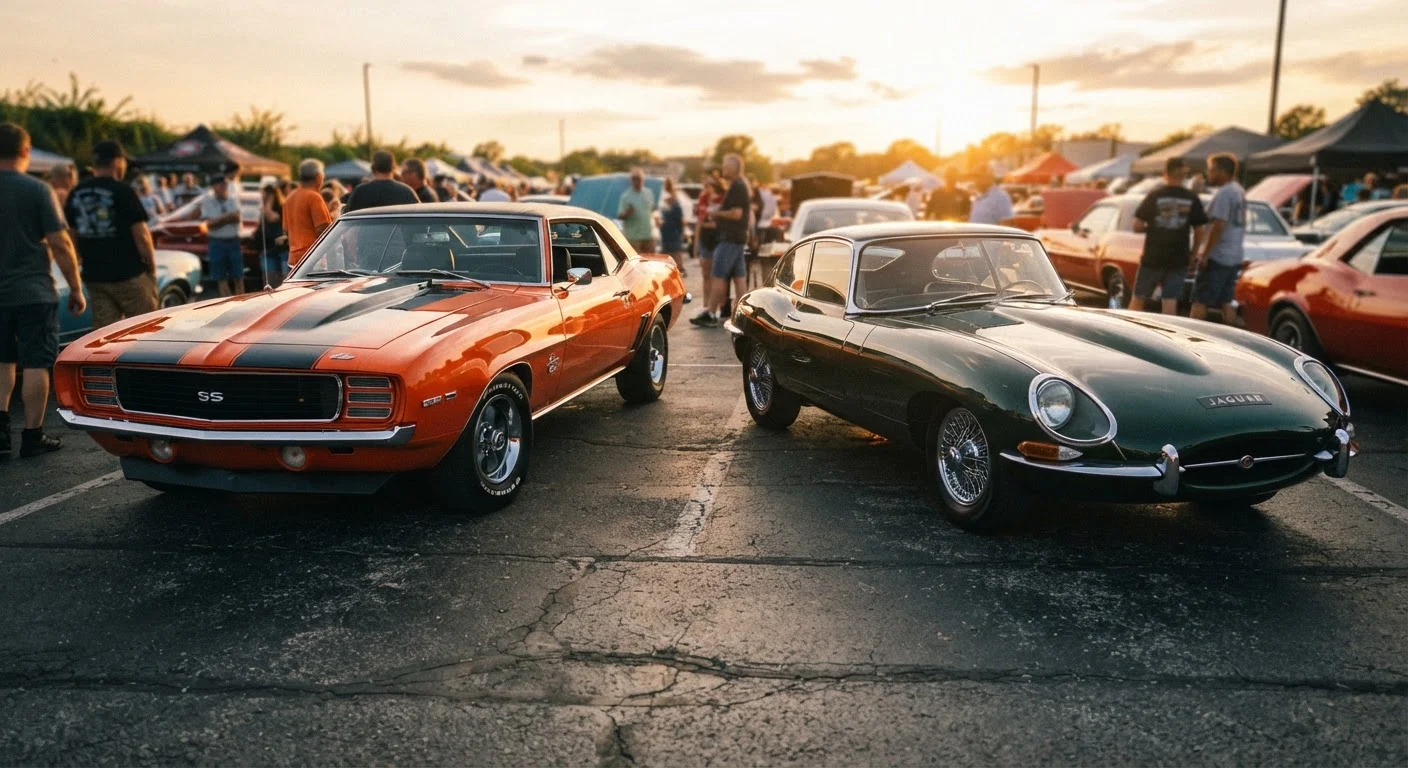
American classic car culture grew from a tradition of democratized car ownership, hot-rodding, and post-war optimism. The result is a community that prizes individuality, displacement, and self-expression. Modifications are widely accepted - often celebrated - because the car is seen partly as a canvas. A 1969 Chevrolet Camaro with a built engine and custom paint may draw as much admiration as a numbers-matching original at many American shows.
European collecting culture, by contrast, developed alongside a different automotive tradition: one shaped by grand prix racing lineage, coachbuilt luxury, and precise engineering. Collectors in Britain, Germany, Italy, and France tend to view the factory specification as the pinnacle - the expression of the designer's intent. Departure from that intent, even for performance reasons, is often viewed with skepticism rather than admiration.
For a deeper look at how the term "classic" itself is defined across different contexts, see how classic cars are defined.
| Dimension | American Classic Culture | European Classic Culture | |
|---|---|---|---|
| Core value | Individual expression and power | Engineering purity and authenticity | |
| Attitude toward modifications | Widely accepted, often celebrated | Generally discouraged at collector level | |
| Restoration standard | Flexible; restomods respected | Factory-correct preferred at shows | |
| Provenance importance | Valued but gaps tolerated | Heavily weighted; gaps penalize value | |
| Show atmosphere | Inclusive, spectacle-oriented | Formal, curated, selective at top tier | |
| Patina acceptance | Growing appreciation | Mixed - depends on marque and context |
Restoration Philosophy: Purity vs. Expression
One of the clearest points of divergence between the two cultures is how restoration is approached.
In European collecting - particularly at the concours level - factory-correct restoration is the standard. Period-correct paint codes, original stampings, matching engine numbers, and documented service history all carry significant weight. A beautifully executed restomod may be admired as craftsmanship, but it typically competes in a separate class, if it competes at all. The restomod versus purist debate plays out differently in European circles, where deviating from factory spec carries a real cultural cost.
American culture holds more room for interpretation. Restomods - vehicles with vintage exteriors fitted with modern drivetrains, suspension, or electronics - have become a celebrated category. Events like SEMA showcase vehicles that no purist would recognize as original, yet the community embraces them as legitimate expressions of the craft. The philosophy is less about preserving history exactly and more about honoring the spirit of an era through personal vision.
Neither approach is wrong. They simply reflect different ideas about what a classic car represents: artifact or inspiration.
Know the Culture Before You Buy
If you plan to show or eventually sell a classic car, understanding which collector culture its value is tied to matters. A European marque modified in the American style may be penalized at European-influenced auctions even if the work is high quality. Research the specific marque community's norms before committing to any restoration approach. Common assumptions about classic ownership that don't hold up can save new collectors significant money and frustration.
Provenance, Documentation, and Market Implications
Documentation culture also differs in meaningful ways. European collectors - and particularly the major European auction houses - place exceptional weight on provenance. A Ferrari or Aston Martin with a complete documented history, original build sheet, and known ownership chain commands a measurable premium. How collectors trace and verify a vehicle's history is a subject taken with particular seriousness in European markets.
American collecting culture values documentation too, but the threshold for acceptable gaps in history is generally higher. A barn-find muscle car with unclear ownership history can still command enthusiastic bidding if the physical evidence - matching numbers, original trim, unrestored condition - is compelling enough. How collectors weigh barn finds against restored examples is a lively discussion on both continents, but Americans tend to give more credit to physical authenticity even without paper trails.
These differences have real market consequences. European classics with strong provenance often perform more consistently at international auction, while American classics can see wider value swings tied to trends, nostalgia cycles, and cultural moments.
70%+
European classics with full history at major auctions
Industry observers note that the majority of high-value European classics offered at prestigious auction houses are accompanied by documented ownership histories.
~50%
American collector car owners who have modified their vehicles
Surveys by major American collector car organizations suggest roughly half of enthusiasts have made at least some performance or aesthetic modification to their classic vehicles.
Show Culture and Community Access
Walk a major American car show and the atmosphere is unmistakable: loud engines idling, vast parking lots organized by era or marque, and an inclusive spirit that welcomes a rat rod alongside a concours-quality restoration. Events range from grassroots cruise nights to large organized shows, and participation barriers are relatively low. What classic car shows involve and how judging works varies enormously depending on the event's ambitions.
European show culture, particularly at the top end, skews more formal. Prestigious concours events - held on manicured grounds at historic estates and motor circuits - involve rigorous pre-screening, detailed judging criteria, and a quieter, more curated atmosphere. Access to elite events can be selective; not every vehicle or owner is invited. This formality reflects the culture's emphasis on connoisseurship over mass participation.
That said, both cultures have grassroots layers. European club runs, driving tours through countryside roads, and marque-specific rallies offer entry points that feel as relaxed as any American cruise night. The difference is more pronounced at the prestige end of each market than at the grassroots level.
If you're considering entering either world, what new enthusiasts should know before starting applies regardless of which collecting tradition appeals to you most.